

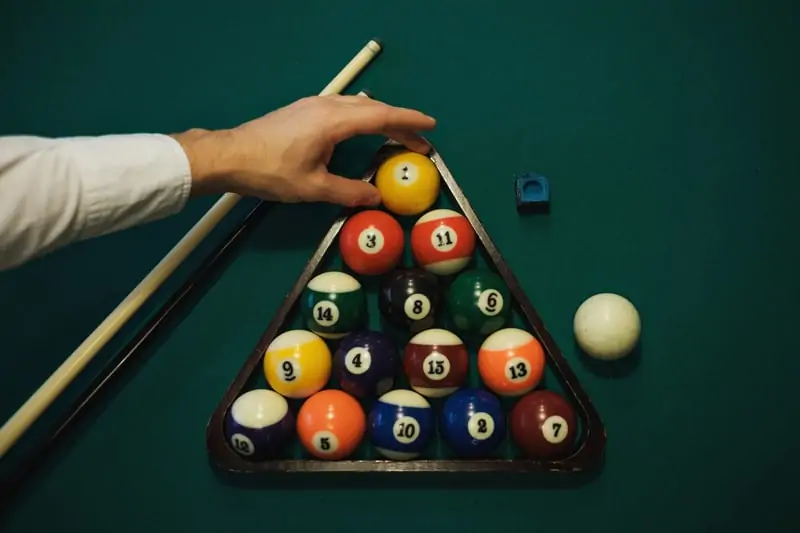
Pool is built for two players. But you don’t need a partner to get on the table and get better.
Plenty of games and drills work just as well alone, and some sharpen your stroke faster than a casual match against a buddy ever would.
Pool Games You Can Play Alone
Below are 9 solo games: solo 8 ball, fifteen in a row, 3 ball, 14.1 straight pool, bowlliards, speed pool, target pool, ghost pool and cowboy pool. Some are two-player games adapted for one, and some were built for playing alone from the start.
Solo 8 Ball
Rack all fifteen balls as you would for a traditional game of 8 ball, with the 8 in the center and the rest in random order around it. Break, then sink all the stripes followed by all the solids, or the other way round.
Pocket the 8 last and call your pocket every time. Calling is the part most people skip, and it’s the part that makes this worth doing.
A clean, true-rolling set of pool balls helps more than people expect here, since a scuffed bar set throws off the exact position play you’re trying to groove.
Fifteen in a Row
Rack as you would for 8 ball and break. You have to pocket at least one ball on the break, and if you don’t, you re-rack and start over.
From there the rule is simple and unforgiving: pocket at least one ball on every single shot. Miss once and you go back to the rack.
The goal is all 15 in a row without a single miss. Order doesn’t matter, though calling your order in advance makes it considerably harder. Racing a clock or adding your own restrictions works too.
3 Ball
3-ball uses just three object balls racked at the foot spot. Break, then count how many shots it takes you to clear all three. Lower is better, and a clean break sometimes sinks them all at once.
The short rack plays fast and forces you to plan position from the very first stroke. Our full 3-ball rules cover the scoring if you want to play it properly against someone later.
14.1 Straight Pool (Solo)
This is the game serious players use to measure themselves alone. Rack all 15, then pocket any ball you call, one point each.
When you’re down to the last ball, re-rack the other 14 and leave the apex spot open. That leftover ball becomes your break ball: pocket it so the cue ball caroms into the fresh rack and opens it up, then keep going.
Your score is your high run, meaning the number of balls you pocket in a row across re-racks before you miss. It’s humbling at first. Willie Mosconi’s high run was 526, and most amateurs celebrate their first 20.
Bowlliards
Bowlliards turns solo practice into a game with a real score, borrowed straight from bowling. Rack 10 object balls, break, and give yourself two innings per frame, the same two tries you get at the lanes.
Clear all 10 in the first inning and you score a strike. Clear whatever’s left in the second inning for a spare. Miss some and you score a point per ball pocketed, then move on to the next frame.
Play 10 frames and total it the way a bowling card does, where a clean run of strikes tops out at 300. It’s the most honest way to track whether your run-out game is actually getting better.
Speed Pool
Speed pool is a timed version of 8 ball, and it does one thing better than any other solo game: it teaches you to stay calm when the clock is the opponent. Rack and play exactly as you would in 8 ball, but run a timer and record how long it takes to clear the table.
Beat your own number and you’ll notice the change in real matches. Rushing under pressure is a reliable way to lose a rack you’d already won, and the only cure is having rushed before.
Target Pool
Target pool is more drill than game. You pocket an object ball in a specific pocket from a specific spot, and you have to land the cue ball on a designated target afterward. Position play is the entire point.
You can buy this as a kit with printed targets and shot cards. You can also just put napkins down where you want the cue ball to stop, which costs nothing and works about as well. Set up ten shots, run them, then move the targets tighter.
Ghost Pool
Ghost pool is the honest one, and every serious player has been beaten by it. Set up 8 ball or 9 ball as usual, break, then give yourself ball in hand anywhere on the table.
Now run the whole rack in a single turn. Miss a shot or scratch and the ghost wins the game outright. Most players race the ghost to a set number of wins, which turns a practice session into something with actual stakes.
The first time I raced the ghost to five in 9 ball I lost 5-0, and I’d been playing league for two years. That’s the value of it. Nothing else tells you where your run-out game really is that quickly.
Cowboy Pool
Cowboy pool is the oddest game on this list and the best one for carom skills. You play it with only the 1, 3 and 5 balls, racing to exactly 101 points. The 1 goes on the head spot, the 3 on the foot spot, and the 5 on the center spot, in a straight line.
Points come from pocketing balls, from caroms, and from combinations, and they stack within a single shot up to a maximum of 11. After contact, the cue ball or an object ball has to reach a cushion or you’ve fouled.
Two rules make it brutal. Your 90th point has to land on exactly 90, and going over is a foul. The 101st then has to come from caroming the cue ball off the 1 ball into a called pocket without touching anything else.
Getting to 90 is a decent evening. Finishing is a different problem.
Tips for Playing Pool Alone
Pick one game and stay with it long enough to have a number you’re chasing. High run in 14.1, frame score in bowlliards, a win-loss record against the ghost: any of them beats drifting around the table hitting whatever looks fun.
Write the numbers down. A run of 14 means nothing in isolation and means a lot next to last month’s best of 9.
Solo practice also rewards you faster when the cue has a responsive tip and a consistent feel, because you’re the only one reading the feedback. Our cue guide for every budget helps if you’re shopping for a practice stick, and our full rundown of billiard games covers the two-player versions once you’ve got someone to play.
FAQ
Can you really play pool by yourself?
Yes. Many traditional games have solo variations that help you practice and improve your skills without needing another player.
What’s solo 8-ball?
Rack 15 balls, break, then sink all striped balls followed by solids, or vice versa. Call your pocket on every shot and pocket the 8-ball last. It’s great for keeping your skills sharp.
What is ghost pool?
Set up 8-ball or 9-ball as usual, break, then give yourself ball in hand. Try to run the entire rack in one turn. If you miss, the ‘ghost’ wins.
What’s cowboy pool?
Cowboy pool is played with only the 1, 3 and 5 balls, racing to exactly 101 points. Points come from pocketing, caroms and combinations, stacking up to 11 on a single shot. Your 90th point must land on exactly 90, and the 101st must be a carom off the 1 ball into a called pocket.
How does ‘fifteen in a row’ work?
Rack all 15 balls and break. You must pocket at least one ball on every shot. Miss once and restart. The goal is to pocket all 15 without missing.
Related Articles
For more on this topic, check out how to play pool, pool table reviews, pool cue reviews, billiard game types, and best cues for beginners.
Browse our full Rules hub for tested picks, buying guides, and head-to-heads.