

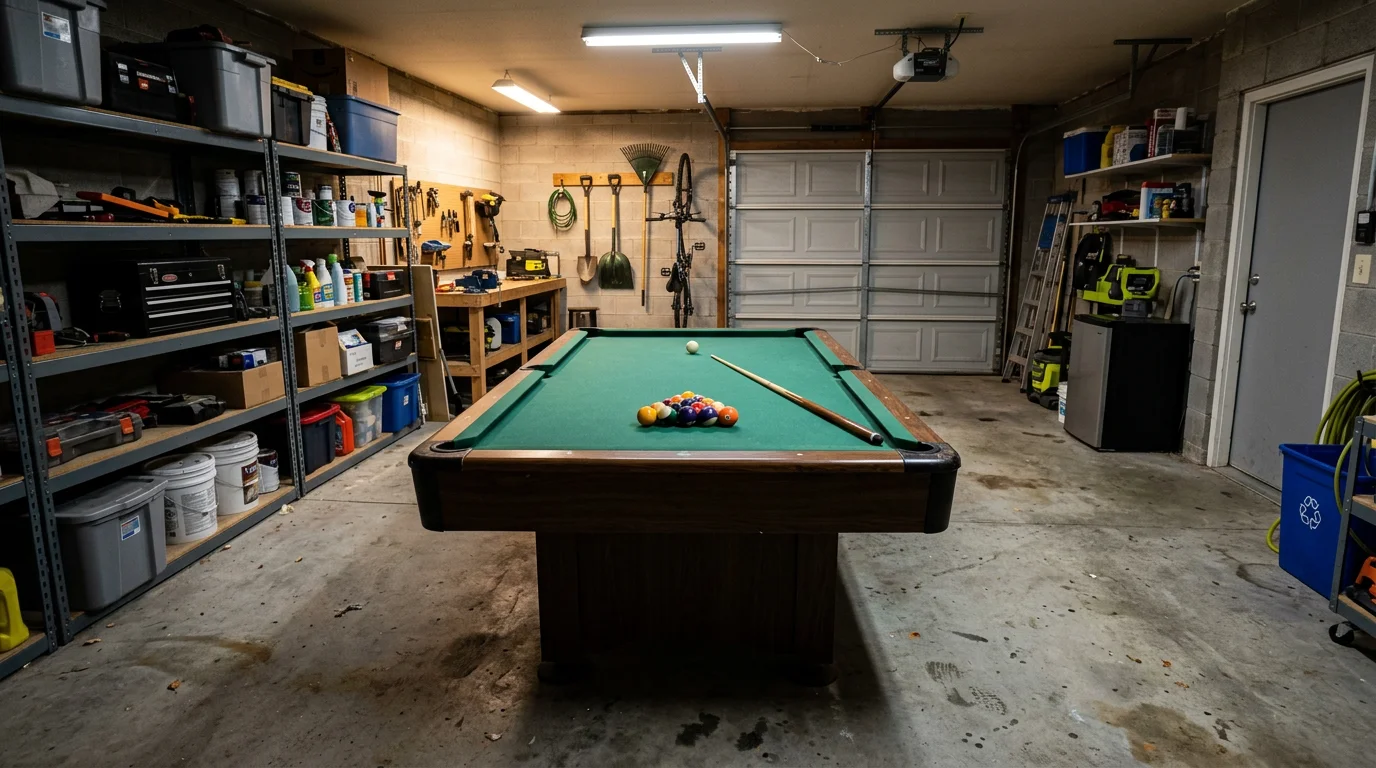
For many people, the garage is the best (or only) place for a home pool table. Unless you’ve only got a single-car garage, there’s usually room for a table, and you can often leave enough space to keep a car inside when you’re not playing.
Go further and the garage becomes a small pool hall: stools, a fridge, a couch, a TV in the corner. The real question is whether a garage is actually a good home for a table, and the answer comes down to a few things you can check before you buy.
There are four of them, and none require a contractor.
Key Considerations
A garage works well as a pool room for a lot of players. Before you start shopping, four things decide whether the table plays well or fights you: the floor, the space, the climate, and the table itself.
Start with the floor. Garage slabs are usually poured with a slight fall toward the door so water runs out instead of pooling. That slope is the reason getting a table level enough that a slow-rolled ball doesn’t drift takes more shimming in a garage than it would on a flat living-room floor. I have never seen a garage table go in without shims under at least two legs, so plan on spending real time with a level.
Space is more than the table’s footprint. You need cue clearance on every side, plus room for a cue rack and for anyone walking past. Climate matters too. An uninsulated garage swings hot and cold with the seasons, and if yours never gets heated, an all-weather outdoor table shrugs off the temperature and damp that would warp an indoor build.
The table itself is the last piece, and in a garage the material you pick matters more than usual. More on that below.
None of this has to be expensive. With a bit of planning you can turn a half-used garage into a room you actually want to spend time in.
Assessing Your Garage Space
Most garages already hold tools, bikes, boxes, and half-finished projects, so the open floor is smaller than it looks. People underestimate how much room a table needs once you add the space to draw a cue back on every shot.
Most two-car garages land somewhere around 20 by 22 feet. That’s enough for a 7-foot table with room to shoot around it, and sometimes enough to keep one car inside too, but built-in shelving and storage eat into it fast. If space is tight, our guide to the best pool tables for small spaces covers tables that fit without crowding you out of the room.
Measure the real open footprint with the bikes and bins where they normally sit. Then tape out the table plus five feet of cue swing on each side, which is what a standard 58-inch cue needs to draw back cleanly, and see what’s left to stand in. Our wall clearance guide has the numbers for shorter cues if the tape says you’re a foot short on one side.
If the tape says a full 8-footer won’t leave room to shoot, size down. A 7-foot table you can move around beats a bigger one jammed against the wall.
Light is the other thing garages get wrong. A single ceiling bulb sits too high and too far off-center, so you spend half the game shooting into your own shadow. The fix is a fixture hung directly over the playing surface, and the Billiard Congress of America puts the bottom of that fixture 31 to 33 inches above the bed. Our picks for the best pool table lights cover how long the fixture needs to be for your table size.
Slate Bed Tables for Durability
Slate bed tables are what the pros play on, and they hold up in a garage better than anything else. Slate is rock, so the humidity swings that warp a cheap MDF table barely touch it. Keep it covered between sessions and check the level once or twice a year, and a slate table plays true for decades. Not every table sold as a slate table gives you the same bed, though, and our best pool table brands guide breaks down which manufacturers put real three-piece slate under the cloth.
A cover does most of the protective work in a garage. Dust settles and damp creeps in whether you play or not, and a car parked alongside kicks up grit every time it pulls in. The cover keeps all of that off the cloth. Our picks for the best pool table covers sort out which ones are genuinely water-resistant without trapping damp against the felt underneath.
Related Articles
For more on this topic, check out how to play pool, pool table reviews, pool cue reviews, billiard game types, and best cues for beginners.
Browse our full Pool Tables hub for tested picks, buying guides, and head-to-heads.