

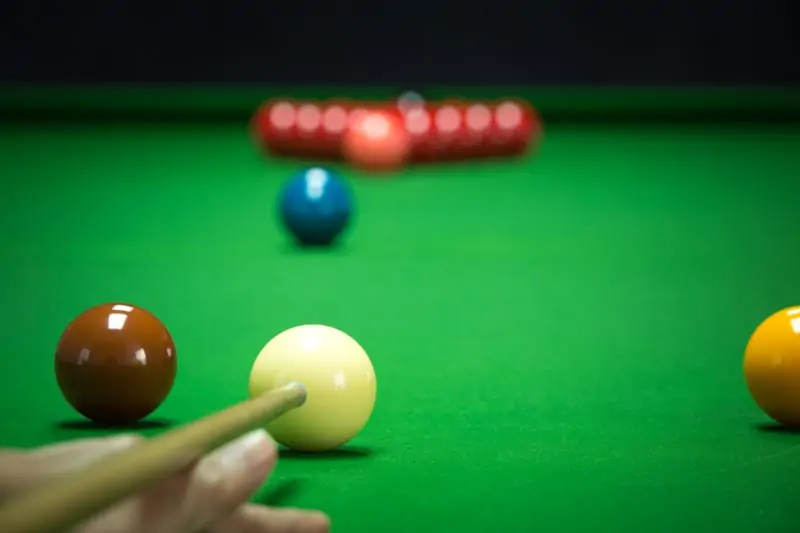
Billiards, pool, and snooker are three different games that share a common ancestor. Most people use these words interchangeably. They shouldn’t. Billiards (carom) is played on a pocketless 10-foot table with 3 balls. Pool uses a 7-9 foot table with pockets and 16 balls. Snooker uses a massive 12-foot table with 22 balls and tight pockets. Each game rewards different skills. Here’s every difference at a glance.
The Complete Comparison
| Feature | Billiards (Carom) | Pool (8-Ball) | Snooker |
|---|---|---|---|
| Table size | 10 ft × 5 ft | 7, 8, or 9 ft | 12 ft × 6 ft |
| Pockets | None | ~5 inches (straight cut) | ~3.5 inches (rounded) |
| Number of balls | 3 (2 object + cue) | 16 (15 object + cue) | 22 (15 reds + 6 colors + cue) |
| Ball diameter | 2 7/16” (61.5mm) | 2 1/4” (57.15mm) | 2 1/16” (52.5mm) |
| Cue tip size | 11-12mm | 12-13mm | 9-10mm |
| Cue weight | 16-18 oz | 18-21 oz | 16-18 oz |
| Scoring | Points per carom | Pocket your group, then the 8 | Points per ball (1-7 pts) |
| Average game time | 15-45 minutes | 5-10 minutes | 20-30 minutes per frame |
| Hardest part | Cue ball control with no pockets | Pattern play and safety | Position on a massive table |
| Biggest markets | Europe, Korea, S. America | USA, Philippines, Asia | UK, China, Europe |
| Invented | 1400s, France | 1800s, United States | ~1875, British India |
For exact table measurements across all sizes, see our pool table dimensions guide.
You walk into a billiards hall and see three tables. One has no pockets at all, with a player making the cue ball dance between two object balls. One looks massive with serious players bent over it, barely moving the cue ball an inch. The third is tighter, faster, with players chalking aggressively between shots. Those are billiards, snooker, and pool. Cousins, not twins. If you play one expecting another, you’ll be frustrated in about thirty seconds.
Billiards (Carom): The Game Most People Forget
Billiards — real billiards, not what Americans call “billiards” when they mean pool — is the oldest of the three. It’s played on a 10-foot table with no pockets. Just three balls: a white cue ball, a yellow cue ball, and a red object ball. Each player uses their own cue ball.
The objective is to score caroms. A carom means hitting the cue ball so that it contacts both other balls in one shot. That’s it. No pocketing. No clearing groups. Just pure cue ball control.
The main variations are three-cushion billiards (the cue ball must touch at least three cushions before contacting the second object ball), balkline (the table is divided into zones that limit scoring runs), and straight rail (no cushion requirement). Three-cushion is the most popular competitive format and is genuinely one of the hardest games you can play with a cue stick. Imagine having to plan a three-rail path before your cue ball touches the second ball. Every shot is geometry.
Carom billiards is huge in South Korea, the Netherlands, Turkey, and across South America. It doesn’t have much of a following in the US, which is why most Americans have never seen a pocketless table. But it’s the purest test of cue ball control in any cue sport, and skills learned here transfer directly to pool and snooker.
The Tables
This is the most obvious difference.
Snooker tables are big. Regulation size is 12 feet long by 6 feet wide. That’s a lot of table to work with. The pockets are small, about 3.5 inches, and rounded. You’re not dropping balls in with careless confidence. Every shot requires precision because the table forces you to think ahead. You can’t just smash balls around and hope something goes in.
Pool tables are smaller. Standard sizes run 7, 8, or 9 feet long. The pockets are wider, roughly 5 inches, and cut straight. That extra half-inch makes a real difference when you’re aiming. The smaller field of play also means faster games and more direct action.
The Balls and Scoring
Snooker uses 22 balls: 15 red balls worth 1 point each, 6 colored balls (yellow through black) worth 2 to 7 points, and a white cue ball. You have to pot a red ball first, then a color, then another red, and so on. It’s a specific sequence. If you break the sequence or miss, your opponent gets a turn. Miss badly enough and your opponent gets penalty points added to their score. The maximum break (sinking every ball perfectly) is 147 points. Ronnie O’Sullivan has done it many times. Most people never will.
Pool 8-ball uses 16 balls: 7 solids, 7 stripes, 1 black (the 8 ball), and the cue ball. You pick your group (solids or stripes) on the break, pot all your balls, then sink the 8 to win. Simple. If you accidentally hit your opponent’s ball first, it’s a foul. 9-ball is even simpler. Just pot balls numbered 1 through 9 in order, and sinking the 9 wins the game.
The scoring difference matters psychologically. In snooker, you’re constantly tracking exact point values. In pool, it’s mostly “did I sink my group or not?” Snooker rewards planning. Pool rewards rhythm.
The Cues
Snooker cues are lighter and more delicate. The tip is smaller, typically 9 millimeters. You’re making finesse shots, not slamming balls. The lighter weight lets you make fine adjustments without exhausting your arm over a long match.
Pool cues are heavier and tougher, with a larger tip, usually 12-13 millimeters. You need the extra mass for power shots and breaking. Pool is a more physical game in that sense.
Using a pool cue on a snooker table feels like trying to do surgery with a hammer. It’ll work, technically, but you’ll hate the experience.
The Strategy
This is where snooker gets its reputation for being harder.
In snooker, you’re planning 3-5 shots ahead. You pot a red, then you have to position the cue ball so that when your opponent misses (or doesn’t), you’re set up for your next shot. The table is so big that position control is everything. Missing by six inches doesn’t mean “I’ll try again next turn.” It means you’ve handed your opponent 20 points in penalties and they have the advantage.
Pool is more immediate. You pot your balls, sure, but there’s forgiveness built in. You can play defensively, hitting your opponent’s ball first and leaving them in a bad position. Pool rewards aggressive play and quick thinking. The smaller table means you’ve got more options and more ways to recover from a bad position.
A snooker match at the professional level looks meditative. Players stand for long periods, thinking. A pool match looks aggressive. Players move between shots, make quick decisions, setup for the next ball.
This is also why snooker is genuinely harder. The larger table, the specific sequences, the penalty system all punish mistakes more severely. In pool, you’ll get another chance. In snooker, one mistake might cost you the frame (that’s what they call a game).
Which Is Actually Harder?
Snooker, by most measures. The 12-foot table means longer shots. The 3.5-inch pockets mean tighter margins. The red-color sequence means you can’t just pick the easiest ball — you have to pot what the game tells you to pot, then navigate to a color. One bad positional shot and your break is over.
But three-cushion billiards might be harder than both. No pockets to aim for means you’re calculating three rail contacts on every shot. The average score in a professional three-cushion match is around 1.2 points per inning. That means even the best players in the world miss more often than they score.
Pool is the most accessible of the three. The wider pockets, shorter table, and flexible shot selection let beginners compete within weeks. But don’t confuse accessible with easy — professional pool at the 9-ball or one-pocket level demands skills that take decades to master. Efren Reyes, the Filipino legend, could do things with a cue ball that snooker players couldn’t replicate on their own table.
The honest answer: each game is hardest at its own highest level. For a casual player walking in cold, snooker will humble you fastest.
The History
Snooker was invented around 1875 by British officers stationed in India. They were bored with regular billiards and pool, so they mixed the rules together and called the result “snooker” (supposedly British military slang for a newly recruited soldier). The game was formal, rule-bound, and perfectly suited to the Victorian sense of order and precision. It spread through the British Empire and eventually dominated in Britain and across Asia.
Pool comes from an older tradition. The mechanics trace back to French billiards and 18th-century games, but modern pool as we know it developed in America in the 1800s. It was less formal and more rough-and-tumble. It fit the American preference for faster games and less rigid rules. Pool became the game of American dive bars and pool halls.
The cultural split is still real today. Snooker feels British and formal. Pool feels American and casual.
Popularity and Geography
Snooker dominates in Britain and China especially. The World Snooker Championship is a major event with serious prize money. Professional snooker players are celebrities in Britain and China. Ding Junhui, a Chinese snooker player, is more famous in Asia than most American athletes.
Pool owns North America and parts of Asia like the Philippines. The US Open, the Mosconi Cup, and the PBA Tour draw serious players and viewership. But pool has never achieved the same global prestige as snooker, partly because it’s so informal and partly because it started in bars rather than formal clubs.
If you’re visiting London, you’ll find snooker. Visit a bar in Texas, you’ll find pool. This isn’t a coincidence. It reflects the history and culture of where these games took root.
The Legends of Each Game
Every cue sport has its defining players:
Snooker: Ronnie O’Sullivan holds the record for most ranking titles (over 40) and is widely considered the greatest snooker player ever. His maximum 147 breaks are almost casual at this point. Stephen Hendry dominated the 1990s with seven World Championship titles.
Pool: Efren “The Magician” Reyes from the Philippines redefined what was possible on a pool table. His shot-making creativity is still unmatched. In the US, Earl Strickland and Shane Van Boening have dominated 9-ball for decades. Our article on Efren Reyes goes deeper into his legacy.
Billiards (Carom): Dick Jaspers from the Netherlands has held the top ranking in three-cushion billiards for years. Torbjorn Blomdahl of Sweden revolutionized the power game. In South Korea, carom players are genuine celebrities.
Which One Should You Play?
If you want a game that punishes every lazy shot, play snooker. Be ready to practice a lot. The larger table and tighter pockets mean that even pros spend hours working on position control. You won’t be good quickly, but it’s deeply satisfying once you get there.
If you want something faster, more social, and easier to get into, pool is your game. You can walk into almost any bar with a pool table and play. The learning curve is gentler. You’ll be competitive within a few weeks instead of years.
The real answer: try both. They’re different enough that the answer depends on you. Some people love snooker’s meditative precision. Others find it frustrating and prefer pool’s faster pace. Neither is objectively better; they’re just different approaches to the same basic idea.
Worth checking out: The Players Technology Series HXT15 Cue works well for pool and transitions decently to snooker-style play. For a dedicated snooker cue, the CUESOUL 57-inch snooker cue with a 9.5mm tip is a solid entry point.
FAQ
Why are snooker pockets so tight?
Snooker’s pockets are smaller to increase difficulty and reward precise play. The larger table and tighter pockets together force you to think several shots ahead. It wouldn’t work with pool-sized pockets. The game would be too easy.
Can professional pool players beat snooker players at snooker?
Not usually. The games require different skills. A pool player moving to snooker has to relearn everything: table size, pocket tightness, scoring rules, strategy. It takes years. Some professional players excel at both, but they’re rare.
How long does a snooker match take?
A professional snooker match can last hours. A best-of-25-frames match (the format for major tournaments) typically runs 5-6 hours over two days. A single frame can take 30 minutes if the players are playing carefully. Pool frames are usually 5-10 minutes.
Is snooker more expensive to play?
Not necessarily. A snooker club membership and cue aren’t more expensive than pool. But snooker requires more practice time to get decent. You’ll spend more hours and possibly more money on lessons to improve.
Can you learn snooker online?
You can learn the rules online, sure. But snooker is a game where position control requires feel and thousands of repetitions. You need a real table. Books and videos help, but nothing replaces actually playing.
What is billiards (carom) and how is it different from pool?
Billiards, also called carom, is played on a pocketless table with just 3 balls. You score by hitting the cue ball off both object balls in a single shot (a carom). There’s no pocketing involved. The table is typically 10 feet long. It’s the oldest of the three games and remains popular in Europe, South America, and Korea.
Related Articles
For more on cue sports, check out pool table sizes and dimensions, how to play pool for beginners, whether snooker is harder than pool, snooker and pool cue differences, 8-ball rules, and our full guide to billiard games.
Check out our top-rated gear picks — selected and reviewed by billiards enthusiasts.