

- Carbon at entry price
- Humidity-proof shaft
- Consistent hit
The Collapsar CXL500 (~$120 complete cue) is the best carbon fiber pool cue for the money in 2026. A straight, warp-proof carbon fiber shaft for less than most maple cues. If you want the shaft the rest of the industry gets measured against, the Predator REVO (~$400-500) is the safe pick. The Cuetec Cynergy SVB (~$695) is the premium complete cue for players who want everything carbon fiber from tip to bumper.
BilliardBeast doesn’t sell cues. The links below go to Amazon and Billiard & Pool Center, and we earn a commission if you buy through them.
All five cues in this guide, side by side:
| Cue | Price | Type | Deflection | Made In | Best For |
|---|---|---|---|---|---|
| Collapsar CXL500 | ~$120 | Complete cue | Higher | China | Best value overall |
| Jacoby Black | ~$300-400 | Shaft only | Very low | USA (Wisconsin) | Hand-wrapped quality |
| Mezz Ignite | ~$350-450 | Shaft only | Very low | Japan | Precision engineering |
| Predator REVO | ~$400-500 | Shaft only | Lowest | USA-designed | Industry standard |
| Cuetec Cynergy SVB | ~$695 | Complete cue | Very low | USA-designed | Premium complete cue |
Carbon fiber cues range from $120 to $700+, and the gap between the cheapest and the priciest comes down to deflection numbers and brand history.
The quick take
The Collapsar CXL500 (~$120) is the value king, a complete carbon fiber cue for less than most decent maple sticks, and it holds its line as well after a year as it did out of the box.
The Predator REVO (~$400-500 shaft) is the standard everyone measures against. It’s the shaft you see most often on tournament streams and league nights alike, which is the whole argument for buying one: nothing about the choice is a gamble.
The Cuetec Cynergy SVB (~$695 complete cue) is the premium package. Full carbon fiber shaft and butt with SVB’s name behind it. Expensive, but you get everything in one box.
If you want something different: the Mezz Ignite (~$350-450) and Jacoby Black (~$300-400) are both underrated shaft-only options. Mezz is Japanese precision engineering. Jacoby is hand-wrapped in Wisconsin.
Most players don’t need carbon fiber. If you play once a week, stick with wood, and our best pool cues under $300 picks are where maple money goes furthest before shaft technology starts driving the price. If you’ve been frustrated by shaft warp, humidity swings, or tip deflection, carbon fiber solves those things. But be ready for the hit feel to be different.
Carbon fiber vs wood: what actually changes
Wood shafts warp, usually a couple of millimeters over a few years, and usually because the humidity where you store the cue swings. Carbon fiber doesn’t move. Store it in a damp basement or an unheated garage, or live somewhere the seasons actually swing, and the shaft still comes out of the case the same shape it went in.
The hit feels different. Carbon fiber sounds like you’re hitting a rubber ball, where maple sounds more wooden and more organic. Some players prefer carbon fiber’s feedback because they feel the strike crisper, and others hate it and want to switch back after a week.
Deflection is lower. A 13mm maple shaft at full break speed throws the cue ball roughly an inch and a half off the center line, while most carbon fiber shafts cut that to under an inch. That matters if you’re playing position and need the cue ball to go exactly where you’re aiming, and it matters a lot less if you’re playing 9-ball and breaking balls every shot anyway.
The maintenance is honestly better. Wipe a carbon fiber shaft down and you’re done, where maple wants conditioner and careful storage and a general amount of babying. Carbon fiber is indestructible in normal use.
The ferrule and tip still wear out normally. Expect to replace a leather tip inside a year of regular play, and the ferrule somewhere in the three-to-five-year range before it loosens or chips. Neither of those has anything to do with the carbon fiber. That’s just the running cost of owning a cue.
The cues, ranked
One caveat before the picks. The deflection figures in this guide come from manufacturer specs and published shaft measurements rather than our own bench testing, so treat them as a ranking rather than as lab data. The gap between 0.86 and 0.93 inches is smaller than the difference your own stroke makes on any given night.
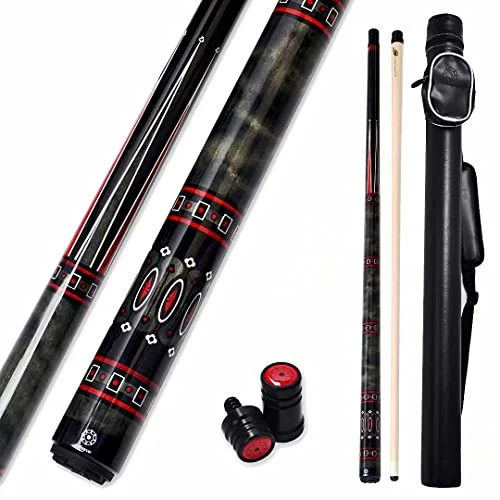
Best "cheap carbon" story, prioritize environment over brand prestige.
- Carbon at entry price
- Humidity-proof shaft
- Consistent hit
Collapsar has no heritage to sell you, and the CXL500 doesn’t pretend otherwise. What it does is cost ~$120 and stay straight, which covers the entire reason most players want carbon fiber in the first place.
At around 1.15 inches, this shaft squirts the cue ball noticeably more than the premium options, which you’ll feel on bank shots and kicks where precision matters. In regular play you probably won’t. The hit feel sits in the middle of the field, less crisp than a REVO without ever going soft.
The wrap looks cheap and the butt is plain, so nobody is buying this cue for looks. It’s the Honda Civic of carbon fiber cues: no style points, runs forever. Players break with these in league matches and keep them around for years, which is more than you can say for most $120 cues.
The case for buying one is cheap curiosity. Hate carbon fiber and you’re out $120 instead of $500, and if you like it you can move up to a Predator or a Mezz later with a clear idea of what the extra money is actually buying you.
The measurement stick. Everyone else is compared to this.
- Industry-standard 0.86" deflection
- Massive tournament track record
- Crisp without being harsh
Predator has newer shafts than the REVO now, the REVO MAX among them, and the original is still the one you see most often in pool halls and tournaments. It’s what players measure all other shafts against, and that track record is most of what you’re buying. Predator vs McDermott is a question forum threads have chased for years, and our McDermott vs Predator buyer’s verdict works through it by player type, from the home table up to tournament play, with a separate call for each.
Deflection is the lowest in this guide at 0.86 inches, and the feel is crisp without turning harsh at speed. Buying a REVO is the low-risk move in this category, because whatever complaint you might have about it, plenty of players have already made peace with it.
The downside is price, and a fair amount of it is the name. The shaft is better than a Collapsar in ways you can feel rather than measure, which is worth the money if you play seriously and hard to justify if you don’t.
Note: The REVO shaft is frequently out of stock on Amazon. Check specialty billiard retailers if Amazon doesn’t have it.
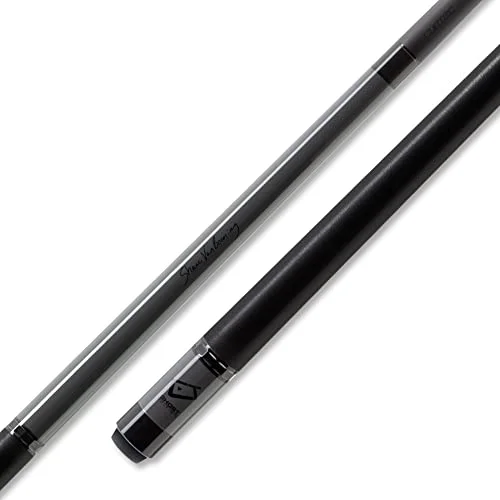
Carbon without full custom pricing, strong performance tier.
- Extremely consistent
- Warp-resistant
- Strong tour presence
The Cynergy SVB is a complete cue, shaft and butt together, with a carbon fiber shaft that plays nearly identical to the Predator REVO. Squirt measures 0.88 inches against the REVO’s 0.86, a gap you will never feel across a table.
You get the whole package in one box, with no separate butt to source and a wrap that’s perfectly decent. Balance sits where it should. It’s a finished cue you unbox and play.
The hit feel is slightly less crisp than the REVO and more forgiving with it, so a marginal mishit reports back to your hand more quietly. Some players want exactly that, and others would rather have the REVO’s sharper feedback telling them what went wrong.
At ~$695 it’s an expensive cue, though a REVO shaft at $400-500 plus a quality butt at $200-300 lands in the same place or higher. For a full carbon fiber setup without piecing anything together, the Cynergy SVB is the simplest path. The full head-to-head with the REVO, down to the tips and joints and the price math, is in our Cuetec Cynergy vs Predator REVO verdict.
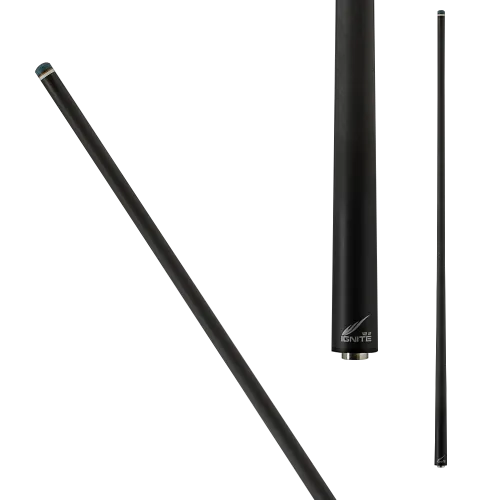
Japanese attention to detail. Underrated because Mezz doesn't advertise like Predator.
- Japanese precision engineering
- Quieter hit feel preferred by some
- 0.91" deflection
Mezz makes cue shafts in Japan and actually obsesses over the details. The Ignite is a shaft only, so you’ll need a butt already sitting in your case or a plan to buy one, and if you have the butt covered this is worth trying.
The number lands at 0.91 inches, between the Collapsar and the REVO. The hit is quieter and softer, and players who’ve shot both often describe the Ignite as more “liquid” against the Predator’s crisp feedback. It’s harder to explain than it is to feel.
Mezz doesn’t have Predator’s marketing budget, which is why the brand is far better known among Japanese and European players than American ones. The engineering reputation is there, it’s just quieter.
Anyone with a butt they already like, who’s curious what carbon fiber feels like outside the Predator house style, should try an Ignite. It plays different in a way you might prefer.
Note: The Mezz Ignite is generally not available on Amazon. Check specialty billiard retailers.
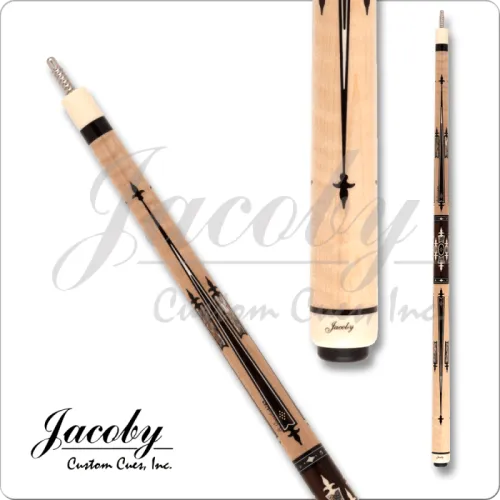
American craftsmanship applied to carbon fiber. Plays clean, feels premium.
- Hand-wrapped in Wisconsin
- 0.93" deflection
- Small-batch quality control
Jacoby Cues are made in Wisconsin by people who’ve been wrapping cue shafts for decades. The Black Carbon Fiber is their answer to the Predator REVO, built in small batches by hand rather than at volume.
Hand-wrapping matters less for performance than for consistency. A small production run gets looked at more carefully than a large one, so what arrives at your door varies less. You see that in the finish more than you feel it in the hit.
At 0.93 inches it squirts the most of the four premium shafts, though that whole premium band only spans 0.86 to 0.93 and position players won’t complain about either end of it. The hit is solid and direct, with none of the polish-and-marketing gloss the bigger brands put around the same specs.
Buy it if supporting a small American manufacturer matters to you and you still want a genuinely good product for the money. It undercuts the REVO by roughly $100 across the range, so the craftsmanship isn’t costing you a premium.
Note: Jacoby shafts cycle in and out of Amazon stock. Check specialty retailers if unavailable.
Shaft only vs complete cue: which should you buy?
If you already have a cue you like, meaning the butt and the wrap and the weight all suit you, buy a shaft only. Predator, Mezz, Jacoby, Cuetec and McDermott all sell carbon shafts separately, and all of them fit standard joint types. You keep the butt you already own, thread on the new shaft, and you’re playing carbon fiber five minutes later.
McDermott also runs a hybrid carbon-and-maple line called G-Core. See what shaft material does McDermott use for how G-Core stacks up against their i-Shaft and Defy lines across price tiers.
If you don’t have a cue you love, or you want everything new, buy a complete cue. That’s a two-option decision here: the Collapsar CXL500 at ~$120 on the budget end and the Cuetec Cynergy SVB at ~$695 on the premium end. A REVO shaft plus a separate butt typically runs $600-800 all in, which is what makes the Cynergy competitive for anyone who wants the full package in one purchase.
One caveat: check your joint type. Most cues use 5/16x18, with Uni-Loc and Radial covering most of the rest. A shaft bought for an existing cue has to match that joint or it simply won’t thread on, so confirm the compatibility before you order. Most retailers list it, and the ones that don’t will tell you if you ask.
When carbon fiber makes sense (and when it doesn’t)
Carbon fiber is worth buying if:
You play twice a week or more. At that frequency shaft consistency starts to matter, because you want the same feel every session and a maple shaft can drift after a few years of regular play.
Breaking is part of your game. Hard breaks warm the wood and load stress into it, and carbon fiber shrugs that off.
Your playing conditions move around. A cold basement one night and a humid room the next will shift how a maple shaft plays, where carbon fiber doesn’t register the difference.
Position play is where you win racks. Lower deflection means the cue ball ends up closer to where you aimed it, which is worth real money in 9-ball and 8-ball.
The cue is something you plan to hand down. Carbon fiber won’t degrade, so it’ll still be straight in twenty years.
Carbon fiber is probably not worth buying if:
You play once a month. That’s not enough frequency to justify the expense. A good maple shaft will outlast your interest in the game at that pace, and the maple picks in our best pool cues for the money guide are built for exactly that buyer.
The feel puts you off. This happens more than the marketing admits, and some players shoot a REVO for two weeks and go straight back to wood. If you’re one of them, no deflection number is going to change your mind.
Quick comparison
| Cue | Price | Type | Deflection | Best For |
|---|---|---|---|---|
| Collapsar CXL500 | ~$120 | Complete | 1.15” | Best value / first carbon fiber |
| Jacoby Black | ~$300-400 | Shaft | 0.93” | American-made preference |
| Mezz Ignite | ~$350-450 | Shaft | 0.91” | Players who value quietness |
| Predator REVO | ~$400-500 | Shaft | 0.86” | Industry standard |
| Cuetec Cynergy SVB | ~$695 | Complete | 0.88” | Premium complete cue |
Frequently asked questions
Is a carbon fiber pool cue better than wood?
It depends on what bugs you about wood. Carbon fiber won’t warp and it deflects less, and it asks almost nothing of you in maintenance. But some players hate the hit feel. If you’ve been playing with maple your whole life, carbon fiber will feel different for a few weeks.
How long do carbon fiber shafts last?
Basically forever. The carbon fiber itself won’t warp, crack, or degrade from humidity. The ferrule and tip still wear normally. Budget for tip replacements but the shaft itself should outlast you.
Can I put a carbon fiber shaft on my existing cue?
Usually yes if the joint type matches. Every shaft maker in this guide cuts for the common joints, meaning 5/16x18 and Uni-Loc and Radial. Check what your butt uses before buying.
Why are carbon fiber cues so expensive?
The manufacturing process. Carbon fiber layers get wrapped around a mandrel, cured under heat and pressure, then finished to exact tolerances, and every one of those steps costs more than turning a piece of maple on a lathe. The Collapsar CXL500 at ~$120 is the budget exception: simpler manufacturing that doesn’t cut corners on the carbon fiber itself.
Do carbon fiber shafts need to be cleaned?
Less than wood, but yes. Wipe down with a damp microfiber cloth after playing. You don’t need shaft cleaners or conditioners. That alone saves money and time.
Related Reading:
The #1 recommendation from this guide, chosen for quality, value, and real-world performance.