

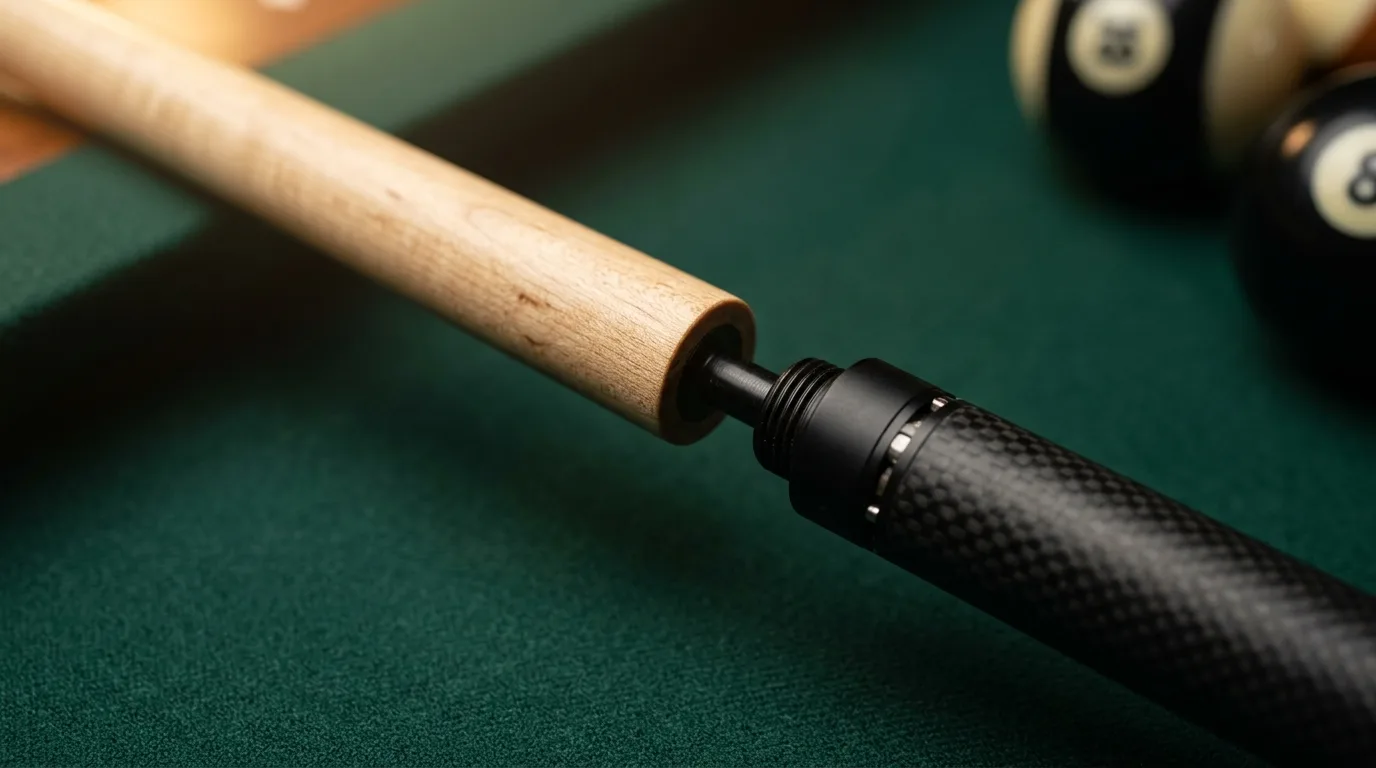
McDermott uses three shaft materials , hardrock maple, the G-Core hybrid (carbon fiber hollow core inside a maple jacket), and full carbon fiber on the Defy line. There’s also a fourth option, the Intimidator i-Shaft, that splits the difference between G-Core and Defy. Which one’s in your cue depends on the model and the year it was made.
I’ve shot with all three over the past four years, and the playing differences are bigger than the price tags suggest. The point of this piece is to put them next to each other in one place, so you can stop tab-hopping between manufacturer pages and forum threads.
BilliardBeast does not retail McDermott products. Affiliate links in this article go to Billiard & Pool Center, a specialty cue retailer.
McDermott’s three shaft technologies, in plain English
McDermott builds its shafts in three distinct lineages, plus the i-Shaft variant, with each one targeting a different price tier and player profile. The construction details below come from McDermott’s published specs and a few hours with a digital caliper.
Traditional hardrock maple , what every McDermott uses unless you upgrade
Stock maple is what ships on every McDermott unless you buy up. North American Grade AA hardrock maple, turned to a 12.75mm or 13mm tip, no carbon, no laminations. It plays the way maple has played for a century , with traditional squirt and a warm, alive feel through the bridge hand.
Stock maple is not low deflection. If you’re chasing minimal cue ball squirt on power shots, you’ll feel the limit fast. For weekend players who shoot a couple of times a month, that limit doesn’t matter. For league regulars working on long rail-cuts, it starts to.
G-Core , the hollow-core hybrid that splits the difference
G-Core is the upgrade most McDermott owners look at first. The construction: a hollow carbon fiber tube extending roughly seven inches down from the tip, jacketed in North American hardrock maple. The maple gives you the visual and the warmth of wood; the carbon hollow reduces tip-end mass, which is what actually drops deflection.
Tip diameter is 12.5mm or 12.75mm depending on configuration. Standalone, G-Core sits in the $200-300 range. The deflection is medium-low , measurably better than stock maple, but not as aggressive as a solid carbon shaft like the Defy or a Predator REVO. The benefit is that the hit still feels like wood, because outside the first seven inches, it is wood.
I switched from a stock McDermott maple shaft to a G-Core in early 2024 on a G605 butt. Long cuts that I used to overcompensate on, by about half a tip on the cue ball, started landing where I aimed. The transition took maybe two range sessions.
See the G-Core shaft at Billiard & Pool Center, the specialty cue retailer that stocks the McDermott line in the most depth.Intimidator i-Shaft , the layered-carbon option that gets forgotten
The i-Shaft is the lineage that most articles skip, including the manufacturer’s own marketing. It’s a layered carbon fiber construction over a maple core, in 12.5mm. Think of it as McDermott’s middle-carbon option, somewhere between G-Core’s hollow hybrid and Defy’s solid carbon.
i-Shafts ship standard on McDermott’s H-Series cues and as a $300-450 standalone upgrade. The deflection is low , comparable to first-generation Predator shafts, not as low as a modern REVO or Defy. The selling point is feel: the maple core gives the i-Shaft more wood-like feedback than a solid carbon shaft does, which some players prefer for fine touch on close-range shots.
Defy , full carbon fiber for the lowest deflection
The Defy is McDermott’s full-carbon answer to Predator’s REVO. It launched in 2018, originally in 12mm and 12.5mm tip diameters, with the SmacWrap composite damping layer added later. Model code MCDCF.
Construction: solid carbon fiber from ferrule to joint, no maple jacket, no hollow core. The SmacWrap layer dampens the harsh acoustic ring that early carbon shafts were known for; the modern Defy hits closer to wood-tone than a 2018-era carbon shaft did. Tip diameters are 12mm or 12.5mm; standalone price is $432 to $499 depending on configuration.
Compared head-to-head with a Predator REVO 12.4mm, the Defy is competitive on deflection , not always lower, but in the same neighborhood , and noticeably warmer in feel. Carbon-curious players who hated the plasticky tone of earlier carbon shafts often land on the Defy.
See the Defy 12.5mm at Billiard & Pool Center.The shaft comparison table
| Shaft | Material | Deflection | Tip diameter (stock) | Price band | Best for |
|---|---|---|---|---|---|
| Hardrock maple (stock) | North American Grade AA hardrock maple | High (traditional) | 12.75mm or 13mm | Included with cue | Traditional feel, weekend players, league players who don’t want carbon |
| G-Core | Maple jacket over hollow carbon-fiber core (about 7” from tip down) | Medium-low | 12.5mm or 12.75mm | $200–$300 standalone | Players who want some deflection reduction without losing the maple feel |
| Intimidator i-Shaft (i-2, i-3) | Layered carbon fiber from ferrule down, maple core | Low | 12.5mm | $300–$450 standalone | H-Series owners; players upgrading from G-Core who want more carbon performance |
| Defy 12mm | Solid carbon fiber with SmacWrap damping | Lowest | 12mm | $499+ standalone | Pure low-deflection chasers, smaller-tip preference |
| Defy 12.5mm | Solid carbon fiber with SmacWrap damping | Lowest | 12.5mm | $499+ standalone | Carbon-curious players who want a near-traditional tip diameter |
Numbers are stock specs from McDermott’s product pages and direct measurement on shafts I’ve owned. Prices reflect April 2026 standalone retail; bundled-with-butt prices are typically lower.
How to tell which shaft is on your McDermott
Three quick visual checks will sort almost any McDermott shaft in under thirty seconds.
Collar color. A natural wood-toned collar at the joint means maple or G-Core. A grey collar means i-Shaft. A black collar means Defy. McDermott has been consistent on this for years , if the collar is wood-colored, the construction is at least partly wood.
Tip diameter. Pull out a digital caliper or check the engraving. 12mm is Defy. 12.5mm is i-Shaft, G-Core, or Defy. 12.75mm or 13mm is traditional maple or G-Core. The tip diameter narrows the field; the collar color usually closes it.
Etched markings near the joint. Most shafts post-2015 carry a model code etched into the wood or carbon a few inches up from the joint. “G-Core,” “i-2,” “i-3,” “Defy,” or “MCDCF” tells you exactly what you’re holding. If the engraving is missing, the shaft is either pre-2015 or aftermarket.
If you’re buying used, ask the seller for a clear photo of the joint area and the engraving. Vintage McDermotts from before the i-Shaft and Defy lines (pre-2010) will all be solid maple regardless of how the cue is described. Pay accordingly.
Shaft taper also varies between McDermott’s shaft lines, so a same-model used cue can feel different than expected if a previous owner swapped shafts.
Which McDermott shaft is right for you
Here’s the part most articles hedge on. The honest answer depends on how often you play and what you’re trying to fix.
League player who shoots once a week, mostly 8-ball. Stock maple is fine. Don’t upgrade unless you’re losing matches because of cue ball squirt , and that’s almost never the actual reason. Spend the money on table time.
Serious amateur stepping up. G-Core. The transition from maple to G-Core is small (the feel is still wood-forward), the deflection improvement is real, and at $200-300 standalone, it’s the best value upgrade in the McDermott lineup. Don’t buy the i-Shaft unless you already own an H-Series butt that ships with one , the i-Shaft is good but G-Core hits the price-to-performance sweet spot.
Tournament player or carbon-curious. Defy. Pick by tip preference: 12mm if you’ve been playing a Predator Z-3 or REVO 12.4mm, 12.5mm if you’re coming from a 12.75mm maple shaft and want a softer transition. Don’t pay $499 for a Defy if you’re a weekend league player , the stock maple shaft on your existing McDermott is fine until the day it isn’t, and that day is usually further off than carbon-fiber marketing suggests.
The contrarian take: G-Core is hyped harder than it deserves at the higher end of its price range. If you’re already past $300 on a shaft upgrade, save another $200 and go straight to a Defy. The intermediate option only saves you money if you stop there.
For the G-Core upgrade specifically, the McDermott G-Core shaft at Billiard & Pool Center is the standalone shaft you’d pair with an existing butt. Specialty retailers carry deeper shaft inventory than Amazon on the higher-end options.
For broader brand context, the best pool cue brands guide covers how McDermott’s shaft program compares to Predator, Pechauer, Lucasi, and Meucci.
Related Articles
For more on this topic, check out best carbon fiber pool cues, best pool cues for the money, best brands of pool cues, pool cue shaft taper explained, and the McDermott cues full review.