
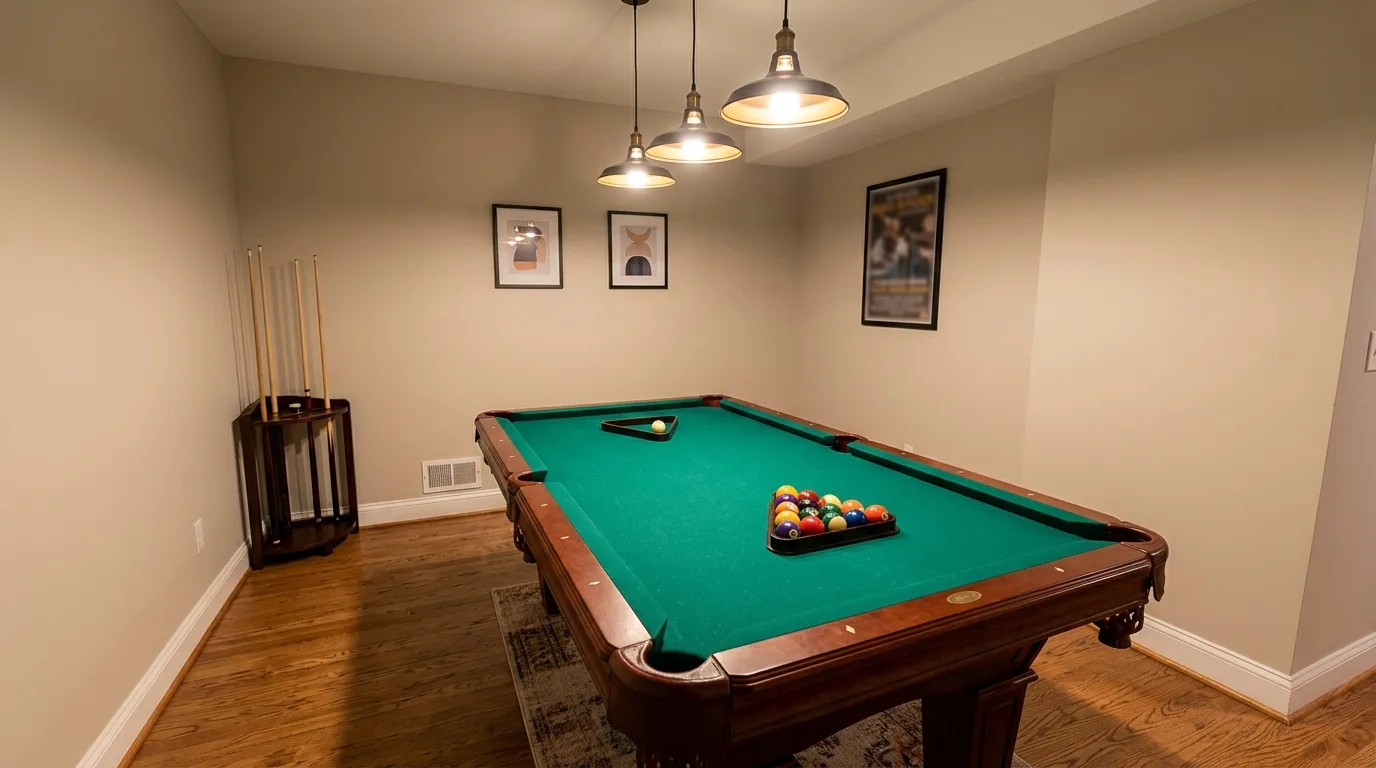
No, a 7ft pool table won’t fit a 12x12 room with full cue clearance. A home 7-footer has a 39” × 78” playing surface, so a 12-foot room leaves only 33 inches between each end rail and the wall. A standard cue is 58 inches long, and even a 48” short cue comes up 15 inches short at each end. The table fits on the floor and you can play it with short cues, but shots off both end rails will be cramped.
Corrected October 2026: an earlier version of this page said a 7-footer fits a 12x12 room with 52” cues. With 52” cues the table needs a room 15’2” long, and the arithmetic is below.
To test your own room, use the Pool Table Room Planner. It maps which shots you can play with a standard 58” or a short 48” cue and flags the rail that will give you the most trouble.
The clearance math, run on a 12x12 room
Each room dimension equals the playing surface plus two cue lengths, because you need a full cue length behind the cue ball on every side of the table. It’s the formula behind Olhausen’s published room chart, and our standard pool table size guide covers room sizes for 8- and 9-foot tables too.
Run it backward for a 12x12 room and a 39” × 78” home 7-footer:
- Length: 144 inches of room minus 78 inches of playing surface leaves 66 inches, or 33 inches behind each end rail.
- Width: 144 minus 39 leaves 105 inches, or 52.5 inches beside each long rail.
So the longest cue that clears every shot in that room is 33 inches. Aska’s shortest short cue is 36.
Run it forward and the answer holds. With 52” cues, a 7-footer needs 39 + 104 = 143 inches of width (11’11”) and 78 + 104 = 182 inches of length (15’2”). The width fits with an inch to spare, half an inch per side. The length is 38 inches short.
Brunswick’s own room size guide agrees. On its slightly smaller 38” × 76” bed, it asks for 12’ × 15’ with 52-inch cues and 11’6” × 14’6” with 48s.
The clearance table: 7ft and 8ft tables across cue lengths
Room sizes are width × length in feet. A cell either fits or shows how many inches of room length are missing, so split that number in half for each end. First, a home 7-footer with a 39” × 78” playing surface:
| Room | 58” cues | 52” cues | 48” cues |
|---|---|---|---|
| 12 × 12 | 50” short | 38” short | 30” short |
| 12 × 13 | 38” short | 26” short | 18” short |
| 13 × 13 | 38” short | 26” short | 18” short |
| 12 × 15 | 14” short | 2” short | Fits |
| 13 × 16 | 2” short | Fits | Fits |
| 14 × 14 | 26” short | 14” short | 6” short |
| 14 × 17 | Fits | Fits | Fits |
An 8-footer with a 44” × 88” playing surface needs more of both:
| Room | 58” cues | 52” cues |
|---|---|---|
| 12 × 12 | 60” short | 48” short |
| 12 × 13 | 48” short | 36” short |
| 13 × 13 | 48” short | 36” short |
| 12 × 15 | 24” short | 12” short |
| 13 × 16 | 12” short | Fits, 0” spare |
| 14 × 14 | 36” short | 24” short |
| 14 × 17 | Fits, 0” spare | Fits |
Both playing surfaces come from the standard pool table size reference. Some of the 12- and 13-foot-wide rooms also come up short on width, and those cells already show a shortfall.
The formula counts the cue and nothing else. Even a cell marked Fits leaves no extra room for your backstroke when the cue ball is frozen to a rail.
Which shots get cramped in a 12x12 room
Shots off the two end rails get cramped, and how far out from the rail the trouble reaches depends on your cue length. The table below runs a home 7-footer through each common cue length, from the standard 58” down to a 36”. “Each end” is the space behind each end rail, and “Each side” is the space beside each long rail.
| Cue | Room needed | Each end | Each side |
|---|---|---|---|
| 58” | 12’11” × 16’2” | 25” short | 5.5” short |
| 52” | 11’11” × 15’2” | 19” short | 0.5” spare |
| 48” | 11’3” × 14’6” | 15” short | 4.5” spare |
| 42” | 10’3” × 13’6” | 9” short | 10.5” spare |
| 36” | 9’3” × 12’6” | 3” short | 16.5” spare |
With a 48” cue, trouble starts when the cue ball sits within about 15 inches of an end rail. Cue straight up the length of the table from there and the butt hits the wall. The diamonds on a 78-inch bed sit 9.75 inches apart, so that’s roughly a diamond and a half out from each end. Angled shots get a little more room, because part of the cue’s length points toward the side walls, which have 52.5 inches to give.
The break is tight too. You break from behind the head string, which sits 19.5 inches from the head cushion on a 78-inch bed. With the cue ball on the head string, a 48” cue leaves 4.5 inches between the butt and the wall for your backstroke, and a 42” leaves 10.5. Longer cues lose that margin fast: a 52” leaves half an inch, and a standard 58” touches the wall before you’ve drawn it back.
The side rails give you far less trouble. There are 52.5 inches beside each long rail, so a 48” clears with 4.5 inches to spare and a 52” with half an inch. A standard 58” is 5.5 inches too long on every side-rail shot played straight across the table.
The one-wall tradeoff
One tight wall is easy to live with, and a 12x12 room gives a 7-footer two of them. With a single short wall, only the shots that leave the cue ball near that rail need the short cue or the bridge. Center the table in a 12x12 room and both end rails sit 33 inches from the wall, so the cramped shots show up at both ends.
You can trade one end for the other. Slide the table 9 inches off center and one end gets 42 inches while the other drops to 24. A 42” cue then clears every shot at the roomy end, and the cramped end gets worse. Put the roomy end at the head rail, where you break.
If one end wall has a wide doorway or an opening into another room, that end has more space than the tape says for any shot whose cue points through the opening. That’s the end to shortchange.
Measuring a 12x12 room for a pool table
Measure the clear space along each wall at about rail height, because that’s where the cue butt travels. The 12x12 math assumes 12 clear feet on both axes. A door that swings in over an end rail, or a bookshelf taller than the table, takes inches you don’t have.
Furniture that sits below rail height (about 31.5 inches on an Olhausen) won’t block a level cue, but anything taller will.
Measure the path in, too. A home 7-footer is about 48.5” × 87.5” outside on Olhausen’s standard rail, and slate tables arrive in pieces, so check stair turns and door openings before delivery day.
Brand-specific footprints: does the manufacturer matter?
The manufacturer matters by an inch or two per end, because “7-foot” doesn’t mean one playing surface. Brunswick lists its 7-footers at 38” × 76”, and Olhausen’s home 7-footer is 39” × 78”. Diamond’s coin-op bar box runs bigger, at 40” × 80”.
In a 12x12 room the Brunswick bed leaves 34 inches behind each end rail and the Diamond leaves 32. Neither gets a 48” cue close to full clearance.
Cabinet size matters for walking around the table and getting it through the door. Brunswick’s Allenton 7’ measures 48.6” × 86.6” outside, which leaves about 29 inches of floor at each end in a 12x12 room. That’s a narrow walkway while someone’s down on a shot.
If your search started with a Brunswick 7-footer, its smaller bed buys you about an inch per end, and the room is still too short. Brunswick’s own chart asks for 13’ × 16’ with standard cues.
What fits a 12x12 room
A 6-foot table is the closest thing to a clean fit. Hathaway’s Fairmont 6’ has a 33” × 66” playing surface, which leaves 39 inches at each end and 55.5 inches at each side of a 12x12 room. Its included 48” cues come up 9 inches short at the ends, 6 inches better than a 7-footer, and a 36” cue clears every shot with 3 inches to spare.
| Table | Surface | Each end | Each side |
|---|---|---|---|
| 6ft Fairmont | 33” × 66” | 39” | 55.5” |
| 7ft Brunswick | 38” × 76” | 34” | 53” |
| 7ft Olhausen | 39” × 78” | 33” | 52.5” |
| 7ft Diamond bar box | 40” × 80” | 32” | 52” |
| 8ft | 44” × 88” | 28” | 50” |
The end space is the binding number in every row, so it’s also the longest cue that clears every shot.
Six-foot playing surfaces vary by maker, so check the spec sheet before you trust these numbers. Whether a 6-footer is enough table for you is its own question, and is a 6-foot pool table too small covers who it suits and who outgrows it.
A 7-footer with short cues is the other honest option. You get the bigger table and give up full strokes off both end rails. If you already own the table, or a 7-footer is the table you want, that compromise is workable. If you’re buying fresh and want to play without workarounds, go 6-foot or find a bigger room. With a bigger room to work with, the 7 ft vs 8 ft pool table verdict shows how little extra space the next size up needs.
Buying short cues and a bridge for a tight room
For a 7-footer in a 12x12 room, buy 48” cues as your everyday sticks and add a 42” for the end rails. A 52 doesn’t earn its place here, since the ends need something shorter and the sides already work with a 48.
Aska sells two-piece short cues in 36, 42, 48, and 52 inches, mostly around $50 to $70 each, with maple shafts and 13mm tips.
They get lighter as they get shorter. Aska lists its 52 at 19 oz, its 48 at 14 oz, its 42 at 13.5 oz, and its 36 at 12.5 oz. That puts the 48 a full 5 ounces under the 52, so expect it to feel light at first.
Both the WPA and the BCA set a 40-inch minimum cue length for sanctioned play, which makes a 36 a home-only cue. If you play league, practice your end-rail shots with the 42 or the 48.
Add a mechanical bridge to the rack as well. A short cue fixes the wall problem but costs you reach, so long stretches across the table come up sooner, and the bridge covers those shots.
What table to buy if you’ve decided
If you’ve measured and you’re going 7-foot with short cues, our best 7-foot pool tables guide covers picks from budget MDF up to slate. If you’re leaning toward 6 feet, best pool tables for small spaces lists compact tables with their actual dimensions.
Brunswick sells direct on its own site and through dealers, and its 7-footers list from around $3,400 as of October 2026. For the budget tier, start with pool tables under $1,000.
Common questions about fitting a 7ft table in a 12x12 room
Can a 7ft pool table fit in a 12x12 room?
Not with full cue clearance. A home 7-foot table has a 39” × 78” playing surface, so a 12-foot room leaves 33 inches between each end rail and the wall. It needs a 12’11” × 16’2” room with standard 58” cues, and even with 48” cues it needs 11’3” × 14’6”, 30 inches longer than the room. The table fits on the floor, but shots off both end rails will be cramped.
What size cue do I need for a 7ft table in a 12x12 room?
Use 48” cues for most shots and keep a 42” or 36” for balls near the end rails. A 12x12 room leaves 52.5 inches beside each long rail, so a 48” clears the side rails with 4.5 inches to spare. At the end rails a 48” comes up 15 inches short and a 42” comes up 9. Only a 36” gets within 3 inches.
What size pool table fits a 12x12 room?
No 7-, 8-, or 9-foot table gets full clearance in a 12x12 room with standard cues. A 6-foot table comes closest. Hathaway’s Fairmont has a 33” × 66” playing surface, which leaves 39 inches at each end. Its included 48” cues come up 9 inches short at the end rails, and 36” cues clear every shot.
How much room does a 7ft pool table need?
A home 7-foot table with a 39” × 78” playing surface needs a 12’11” × 16’2” room with standard 58” cues. That drops to 11’11” × 15’2” with 52” cues and 11’3” × 14’6” with 48” cues. A 40” × 80” coin-op bar box needs 13’ × 16’4” with 58” cues.
Does the brand of the pool table change the room I need?
Only by an inch or two, because 7-foot playing surfaces vary. Brunswick lists 38” × 76” and Olhausen 39” × 78”, while Diamond’s coin-op 7-footer is 40” × 80”. In a 12x12 room the Brunswick leaves 34 inches behind each end rail and the Diamond 32. Cue clearance depends on the playing surface, so cabinet styling makes no difference.
Related Articles
For more on this topic, check out standard pool table sizes, how far a pool table needs to be from the wall, can you put a pool table in a 12x12 room, best pool tables for small spaces, and pool tables under $1,000.