

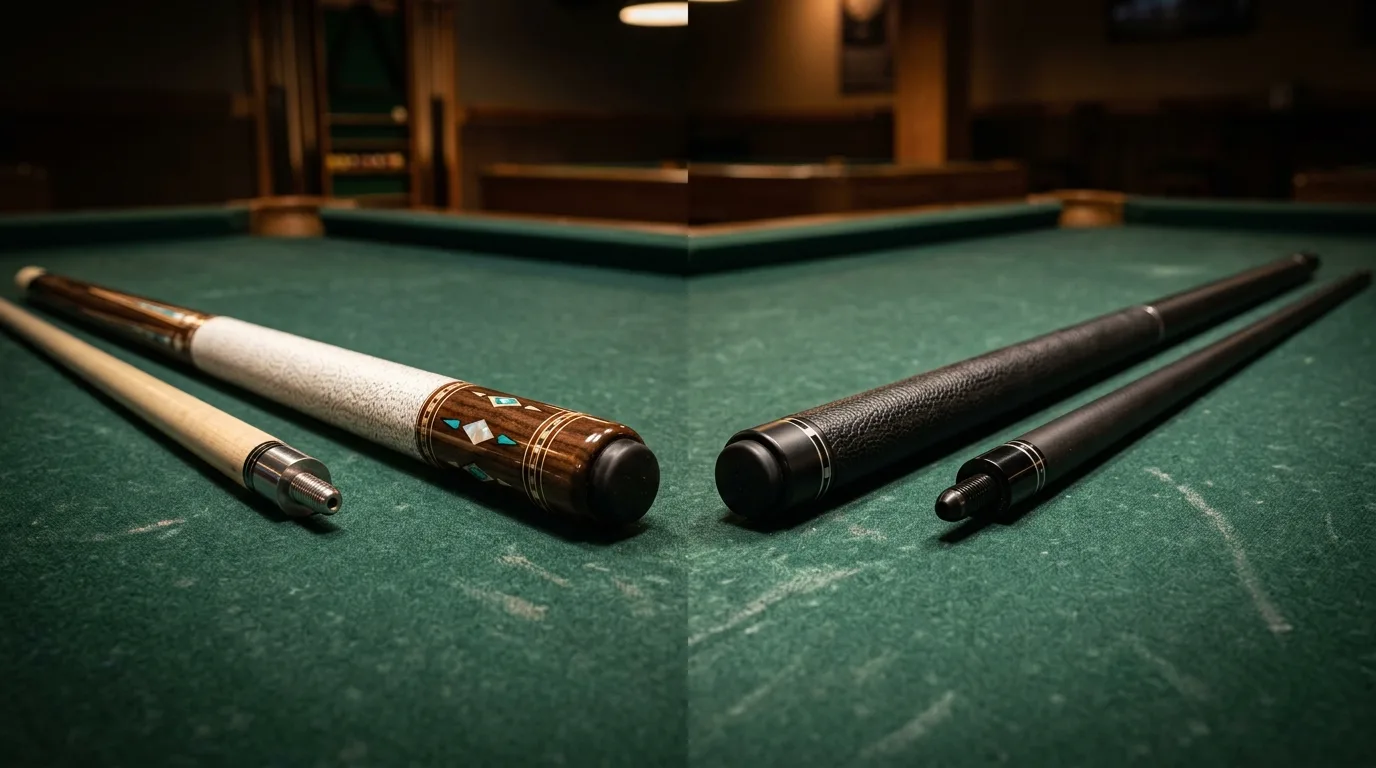
For home recreation, McDermott. For league play, McDermott or Predator depending on which shaft tech you want under your hands. For tournament play, Predator , but only if you’re either upgrading the shaft separately or buying a REVO-equipped package. Both brands are quality builds with lifetime warranties; the answer turns on what you actually play and how often.
That’s the verdict in three sentences. The rest of this article shows the work.
BilliardBeast does not retail either brand. Affiliate links go to Billiard & Pool Center, a specialty cue retailer that carries both lines.
The verdict in one table
| Use case | Winner | Why |
|---|---|---|
| Home recreation (occasional play) | McDermott | Better entry-level price, traditional feel, lifetime warranty on cabinet and shafts |
| League play (weekly) | Tie , depends on shaft preference | McDermott G-Core if you like maple feel; Predator REVO if you want low deflection |
| Tournament play (serious) | Predator | REVO carbon shaft + Vault Plate joint = measurably lower deflection. McDermott Defy is competitive but the supporting cue lineup is thinner |
| Pure value (under $300) | McDermott | Predator’s value tier is shallow; McDermott has more $150-250 cues with full warranties |
| Resale / used market | Predator | Predator butts hold 70-85% of MSRP; McDermott butts hold 50-65% |
The “depends on what you like” hedge that retailer blogs lean on isn’t wrong, exactly , it’s just useless. Both brands are good. The interesting question is which one fits your specific situation, and the table above answers that.
How they differ at the technology level
McDermott and Predator solve the same problem (a low-deflection shaft attached to a hand-built butt) with different engineering choices. Below is what’s actually different, not what the marketing pages say.
Shaft technology , REVO vs Defy and G-Core
Predator REVO is solid carbon fiber from ferrule to joint, currently sold in 11.8mm, 12.4mm, and 12.9mm tip diameters. The Vault Plate joint at the joint end is a mechanical change that locks the shaft to the butt with less play than a traditional pin-and-collar fit. Combined with the carbon construction, REVO produces what is , by every published deflection test I’ve seen , the lowest squirt of any production shaft.
McDermott Defy is also solid carbon fiber, in 12mm and 12.5mm. The differentiator is SmacWrap, a composite damping layer that softens the harsh acoustic ring early carbon shafts were known for. Defy is competitive on deflection , sometimes a hair higher than REVO at matched tip diameter, sometimes equivalent , and feels noticeably warmer through the bridge hand.
McDermott G-Core is the hybrid: a hollow carbon core extending about seven inches down from the tip, jacketed in maple. Deflection sits between traditional maple and full carbon. Standalone price runs $200-300, which makes G-Core the value play if you want a real upgrade without going to $499 carbon. For deeper detail on McDermott’s shaft program, see the McDermott shaft technologies guide.
Joint construction , Uni-Loc vs Speed Joint and Intimidator
Predator standardized on Uni-Loc on most modern cues , a quick-release joint that takes about a half-turn to attach. McDermott uses 5/16x14 on the bulk of its lineup, 3/8x10 on the Intimidator series, and Uni-Loc on select higher-end models. Both designs hold tolerance well. The functional difference is shaft compatibility , Predator REVO ships in multiple joint configurations, so you can run a REVO on a Uni-Loc McDermott if you have one.
Butt construction , what’s inside the wrap
McDermott butts are North American hardwoods, hand-inlaid, with the inlay work cut on production CNC equipment but finished by hand at the Wisconsin plant. The wood is typically birdseye maple, ebony, cocobolo, and exotic veneers depending on the model line.
Predator butts are also hardwoods at the high end, but composites (urethane resin overlays, particularly on the Aspire and Sport series) appear at the entry tier. At $300 retail, a Predator butt is almost always machined with composite elements; McDermott at $300 still ships solid hardwood. This is where the under-$500 value verdict comes from.
Warranty and lifetime support
Both brands offer lifetime warranties. McDermott’s is broader in scope (any structural defect, including warped shafts, gets repaired or replaced) and faster in turnaround (typically 2-4 weeks). Predator’s warranty covers manufacturing defects but excludes wear and play damage, and turnaround can run 4-8 weeks depending on the shaft model. For weekend players who’ll never invoke it, this doesn’t matter. For league players who break shafts or need re-tipping, McDermott’s program is better.
How they differ at the price tier
The two brands compete head-to-head only at certain tiers. Here’s where each one wins.
Under $200 , McDermott has the lineup, Predator effectively doesn’t
Predator’s cheapest cues run $300+, and most start at $400. McDermott’s Lucky series ($62-175) and the entry-tier G-Series ($195-340) cover the under-$200 range completely. If you’re a casual or beginner player, this is McDermott’s tier , there isn’t a real Predator competitor. The McDermott Lucky L9 on Amazon at ~$150 (cue plus soft case) is the cleanest entry into the brand.
For broader context on cues at this price, the best pool cues for the money roundup covers what under-$300 actually buys you across all brands.
$200-500 , most direct competition
This is the tier with the cleanest tradeoff. McDermott G-Series with a G-Core shaft runs $250-400; entry-level Predators start at $300 with composite butts. The McDermott option gives you more solid hardwood and the option to upgrade to a Defy shaft later without replacing the cue. The Predator option locks you into the Predator joint family but offers a cleaner upgrade path to REVO.
For league players, this is where the real decision happens. See best pool cues under $300 for specific picks.
See the McDermott G-Core shaft at Billiard & Pool Center, or compare against the Predator REVO 12.4mm shaft at the same retailer. Both stocked at depth.$500-1,000 , Predator REVO vs McDermott Defy or G-Core
REVO-equipped Predator packages start around $700; Defy-equipped McDermott packages start around $750. Standalone REVO is $550, standalone Defy is $432-499. At this tier, you’re paying for shaft tech, and the verdict turns on which carbon shaft you prefer to feel , REVO for the lowest deflection, Defy for the warmest carbon hit.
Played a Predator 314-3 for two years, then went back to a McDermott G605 with a G-Core shaft in 2024. The G-Core’s deflection wasn’t as low as the 314-3, but the cue felt more alive in my hands. That’s the trade , and it matters which one matters to you.
$1,000+ , both have it, custom configurations dominate
At $1,000 and up, both brands compete with custom cuemakers. The decision becomes about aesthetics, balance preference, and whether you want a McDermott H-Series with an i-Shaft or a Predator with a high-end REVO. The technical gap shrinks; the personal-fit question gets bigger.
Predator REVO 12.4mm at BPC for the lowest-deflection option, or the McDermott Defy 12.5mm for the warmer carbon feel.The full spec comparison
| Spec | McDermott | Predator |
|---|---|---|
| Country of manufacture | Wisconsin, USA | Mexico (Bauxbar facility), select USA assembly |
| Flagship shaft | Defy (full carbon, SmacWrap damping) | REVO (carbon, Vault Plate, 8-layer Victory tip) |
| Mid-tier shafts | G-Core (hybrid hollow core), Intimidator i-Shaft | 314-3, Z-3, P3 (laminated maple LD shafts) |
| Joint type | 5/16x14 most, 3/8x10 Intimidator, Uni-Loc on select | Uni-Loc signature on most |
| Butt construction | Solid North American hardwoods, hand-inlaid | Hardwoods + composites; composite content increases at lower tiers |
| Price range | $80 , $4,000+ | $300 , $5,000+ |
| Warranty | Lifetime, structural and wear | Lifetime, manufacturing defects |
| Used-market resale | Holds 50-65% of MSRP | Holds 70-85% of MSRP, REVO especially |
| Ideal player level | Entry through pro | Intermediate through pro |
The shaft tech timeline matters too. Predator launched the original 314 shaft in 1994 , the first widely-adopted low-deflection shaft on the market , and shipped REVO in 2016. McDermott launched the Defy in 2018, two years behind REVO, with SmacWrap damping added later. The R&D arms race continues; expect both brands to update their flagship carbon line every 4-6 years.
What the AzBilliards forum threads actually said
This article exists partly because the AzBilliards threads on McDermott vs Predator never close , they sprawl across years and never reach a verdict. Here are the three claims that get repeated most, and what’s actually true.
Claim 1: “Over half the top 20 pros use Predator.” True, by Predator’s own count. The context that gets left out: most pros are sponsored. Sponsorship deals include cue and shaft supply, plus stipends for prominent use. The signal is real (Predator’s tech is competitive at the top level) but not as clean as the marketing suggests. Most McDermott players at the amateur level aren’t sponsored either , the brand mix at a regional 8-ball tournament looks different than the brand mix at a televised World Championship.
Claim 2: “McDermott has better build quality.” Depends on the tier. Under $500, true , McDermott uses solid hardwoods where Predator uses composites. At $1,000+, equal or favor-Predator (Predator’s premium butts are well-built; McDermott’s H-Series is excellent but not categorically better). The forum claim usually comes from amateur players who own under-$500 cues, which is exactly the tier where it’s true.
Claim 3: “You can’t go wrong with either.” Lazy. The right answer for a $200 buyer is McDermott. The right answer for a $700 tournament player who wants the lowest deflection available is Predator. Telling both buyers “either is fine” lets the retailer keep them warm without committing to a verdict , but it’s also exactly what a buyer reading three competing reviews already heard everywhere else.
For broader brand context, see the best pool cue brands guide, which covers how McDermott and Predator stack against Pechauer, Lucasi, and Meucci.
Common questions about McDermott vs Predator
The contrarian take, plainly: if you’re a sponsored pro, Predator. If you’re paying retail and you care about getting the most cue per dollar at every tier under $500, McDermott. The “both are great” hedge protects retailer revenue, not buyer interest.
If you’ve decided on a brand but not a model, the Predator Aspire PREAS110 and the McDermott GS02 at Billiard & Pool Center are representative starting points in each lineup. Specialty retailers carry deeper inventory than Amazon on these brands, particularly at the higher-end series.
Related Articles
For more on this topic, check out best carbon fiber pool cues, best pool cues under $300, best pool cues for the money, best brands of pool cues, what shaft material does McDermott use, and the McDermott cues full review.