

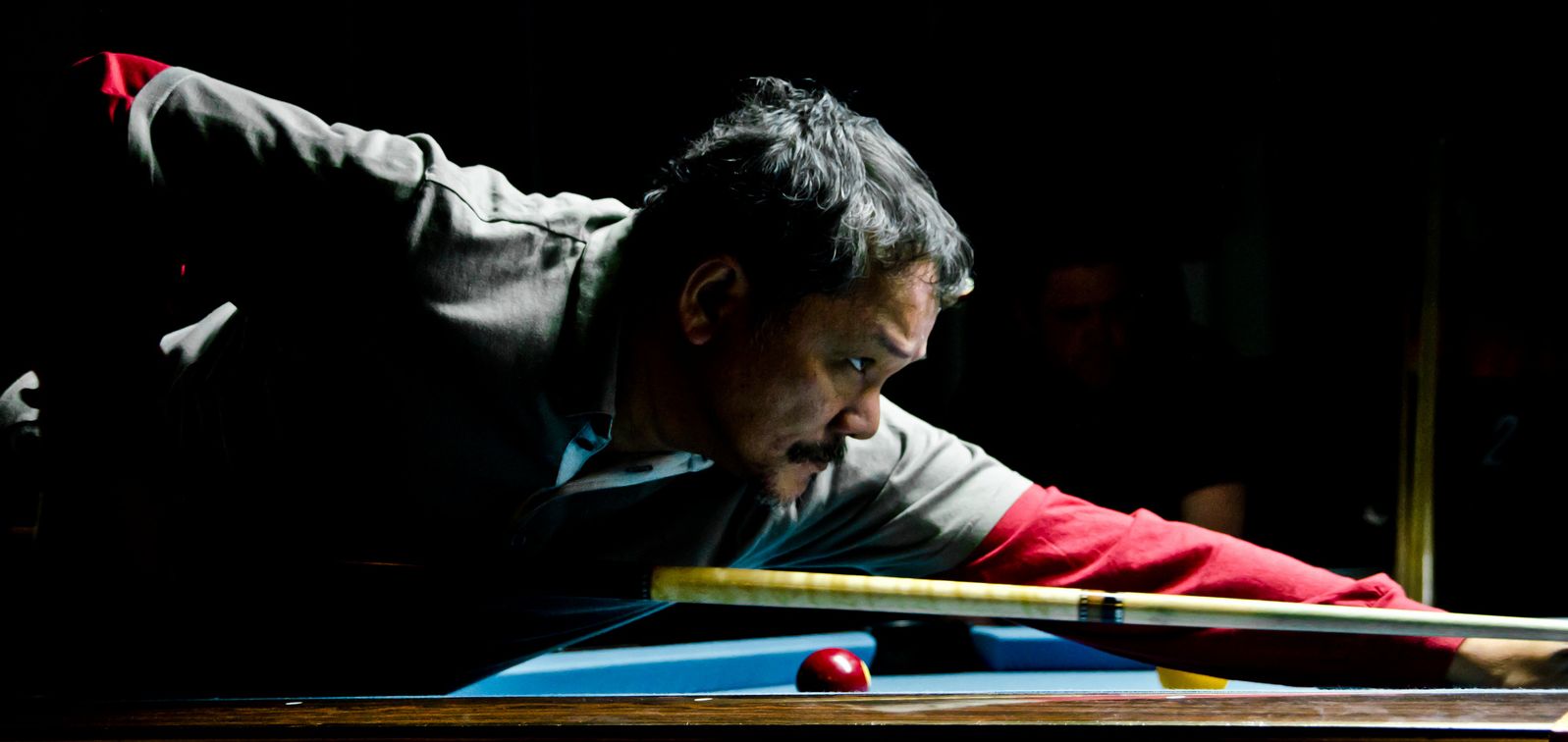
Every pool player has seen the Z-shot. Efren Reyes stands over the table with no clean path to anything, and then the cue ball spins left, then right, then left again, drawing a Z across the felt before kissing the object ball into the pocket. The room goes quiet for about half a second. Then it comes apart.
That kind of shot told you everything about Efren Reyes. It was proof that pool operated by slightly different rules for him.
Who is Efren “The Magician” Reyes?
Efren “Bata” Reyes is a Filipino pool player who won the WPA World 9-Ball Championship in 1999 and the WPA World 8-Ball Championship in 2004, the first Filipino to take either title. He has collected over 70 international titles across 9-ball, 8-ball, rotation, and one-pocket, and he is widely considered the greatest pool player in history.
Efren was born August 26, 1954, in Angeles City, Philippines. He started as a pin boy at his uncle’s Lucky 13 pool hall in Manila, sleeping under the tables at night and racking balls all day, stealing shots between customers whenever the room went quiet.
That kid would eventually beat every major player on the planet, on every stage that mattered.
Two nicknames stuck. In the Philippines he’s “Bata” (Tagalog for “kid”), the name fellow pool hall regulars gave him as a child. On the international circuit he’s “The Magician,” and he earned that one by making impossible situations disappear.
You’d be up a game, controlling the table, and somehow Efren would find a way out: a shot that shouldn’t exist, a safety that left you absolutely frozen. Then he’d run out the table and leave you wondering what just happened.
His big international breakthrough came in 1994, when he took the US Open 9-Ball Championship over Nick Varner and became the first non-American to win it. The WPA World 9-Ball Championship followed in 1999, where he beat Chang Hao-ping of Chinese Taipei 17-8 in the final. He added the World 8-Ball Championship in 2004.
Then came the 2006 IPT World Open 8-Ball in Reno, where he beat Rodney Morris 8-6 for a $500,000 first prize, the largest in the sport’s history at the time. Also in 2006, he and Francisco Bustamante won the inaugural World Cup of Pool for the Philippines, and the two took it again in 2009. Add the Philippine Open and more Derby City and Asian tour wins than anyone has bothered to count. If a tournament existed, Efren either won it or came close enough that it didn’t matter.
Efren Reyes Career Highlights
Across roughly four decades of pro competition, Efren won world titles in both 9-ball and 8-ball, the US Open, the richest single event the sport has ever staged, and the inaugural World Cup of Pool for his country. The headline wins:
| Year | Tournament | Result |
|---|---|---|
| 1985 | Red’s 9-Ball Open (Houston) | Won, entered under the alias “Cesar Morales” in a 108-player field, beat Wade Crane in the final |
| 1994 | US Open 9-Ball Championship | Won over Nick Varner, first non-American champion in the event’s history |
| 1996 | Color of Money (Hong Kong) | Won 120-117 over Earl Strickland, race to 120 in 9-ball, $100,000 winner-take-all |
| 1999 | WPA World 9-Ball Championship | Won, beat Chang Hao-ping 17-8 in the final |
| 2004 | WPA World 8-Ball Championship | Won |
| 2006 | IPT World Open 8-Ball (Reno) | Won, beat Rodney Morris 8-6 for a $500,000 first prize, the largest in pool at the time |
| 2006 | World Cup of Pool (with Francisco Bustamante) | Won, inaugural WCP, Philippines |
| 2009 | World Cup of Pool (with Bustamante) | Won, second WCP title for the Philippines |
| Multiple | Derby City Classic, Master of the Table | Multiple all-around titles across the one-pocket, banks and 9-ball divisions |
The “Cesar Morales” trip in 1985 is the story most pool players retell. Efren was already the best player in the Philippines, and almost nobody in the States had seen him shoot.
He entered Red’s 9-Ball Open in Houston under an assumed name, went through a 108-player field stacked with American road players, and beat Wade Crane in the final. Only afterwards did anyone work out who had just taken their money. The alias stopped working after that.
The Shots That Changed Everything
Efren’s signature shots are the Z-kick (cue ball drawing a Z across the table off three rails before striking the object ball), legendary multi-rail banks, and improvised escapes from supposedly hooked positions. The shot that won him the most matches was plain position play, executed on every single ball.
Most people remember the flashy stuff from Efren’s game: the Z-shots, and the kicks that curve around three rails to reach a ball nobody else thought was hittable.
Ask anyone who played pool seriously in his era and you’ll hear about the table control. His positional play ran years ahead of everyone around him, and that is what put him in finals.
He’d make a shot and leave the cue ball somewhere that gave him two or three options for the next ball. At the highest level of pool, position is everything. One inch to the left and you don’t have the next shot; one inch to the right and you’re running the table. Efren had that instinct wired into his brain.
His kick shots became legendary. For anyone unfamiliar, a kick shot is when you hit a rail first before hitting the object ball. Most players avoid them when they can, because there are too many variables and too many ways to miss, but Efren turned them into a weapon. He’d kick at balls nobody thought were hittable, striking the rail at a speed and angle that sent the cue ball exactly where he needed it.
His opponents learned to fear that. If they left him without a direct hit, he had options they didn’t have, so the safety battles that other players used to grind out racks just handed him the table.
Two things drive a kick: reading the rail angle, and knowing how far your cue ball squirts off the aim line when you hit it firm. Our guide to aiming in pool breaks down the angle half of that. The squirt half is mostly a function of shaft design, which is the whole argument behind low-deflection cues. Efren was making those kicks long before anybody sold a shaft that promised to help.
Banking is the same story. Bouncing a ball off a rail into a pocket sounds simple until you try it under pressure in front of a few hundred people. Efren banked from positions that made the geometry look negotiable. He read the rolls so clearly that he’d take on banks other players wouldn’t even line up.
From Pool Halls to Championship Tables
Efren’s pool education was a Manila pool hall in the 1960s, with no coaches and no instructional material of any kind. He learned by racking balls at the Lucky 13 all day and stealing reps between customers, which is the kind of education that builds pure feel for the cue ball.
The path from Angeles City to the world stage wasn’t straight. Efren got his early education shooting on tables in Manila’s pool halls, and there were no coaching videos or decent instruction books to be had back then anyway. He learned by playing, by watching other players, by sinking thousands of balls, and by slowly building an almost supernatural feel for how the cue ball responds to different strokes, different speeds, different spins, different table conditions.
By his twenties he was already beating players with international reputations. The talent was obvious. The harder thing to describe was his calmness at the table, an ability to stay focused when the match tightened, and it showed up most when the pressure was crushing everybody else in the room.
Competing at the top of pool means traveling constantly, tournament schedules that take you away from family for months, pressure that builds with every match, prize pools that create real financial stakes. Efren handled all of it because he never seemed to be proving anything. He was just playing 9-ball.
Ask any athlete how their performance changes once they stop trying so hard, and most of them will tell you they never managed it. Efren made it look like his default setting.
The Physical Side: How He Does It
Efren’s stroke is minimal and repeatable, built on a still body and no wasted motion anywhere above the elbow. Decades of daily reps turned the delivery into something he no longer has to think about, which is the whole point of it.
If you’ve never watched Efren shoot, find some footage. His stroke is smooth and almost economical, with very little movement anywhere above the elbow. That comes from decades of repetition, to the point where the motion runs on muscle memory.
His bridge, meaning the way he rests his hand on the table to guide the cue, is nothing exotic. Different grips and bridges suit different players, and anyone who has spent time at a table knows this. What sets Efren apart is that his version repeats: the same stroke, shot after shot, hour after hour, which is far harder than it sounds.
If you’re still working out your own setup, our beginner’s guide to holding a cue covers the grip and bridge basics he built on.
His cueing action, meaning the speed and acceleration of his arm, changes with the shot but never gets loose. There’s no jerk in the delivery and no extra movement to clean up afterward, just a smooth stroke producing the effect he wants on the cue ball.
All that mechanical quiet buys him something valuable: he isn’t spending any attention on his own delivery, so he has all of it available for the table and the man sitting in the chair.
His Competition and His Rivals
Efren faced every major name in professional pool during his peak: Earl Strickland, Mika Immonen, Alex Pagulayan, Ralf Souquet, Niels Feijen, and dozens more across 9-ball, 8-ball, rotation, and one-pocket. The defining match was the 1996 Color of Money against Strickland, a $100,000 winner-take-all race to 120 in 9-ball that Efren took 120-117 after trailing by 17 games.
Efren played every major name in pool during his peak years and beat most of them. He lost plenty of matches along the way. His hit rate in the ones that decided titles was the outlier.
Earl Strickland (USA). The defining rivalry of Efren’s career. The Color of Money challenge match, played at Ridgway’s in Hong Kong in November 1996, was a marathon: a race to 120 in 9-ball over three days, $100,000 winner-take-all. Efren fell behind 104-87 and won it 120-117. The two played dozens more times across two decades. Strickland was the most accomplished American 9-ball player of his generation, and Efren beat him often enough to settle the GOAT debate for most of pool.
Francisco Bustamante (Philippines). More partner than rival. The two won the inaugural World Cup of Pool in 2006 for the Philippines and took the title again in 2009. In singles play they landed across the table from each other constantly.
Mika Immonen (Finland), Ralf Souquet (Germany), Niels Feijen (Netherlands). The European core of Efren’s tournament era. He met all three across the 9-ball and 8-ball circuits through the 1990s and 2000s. None of them ever found a way to consistently lock him out of finals.
Alex Pagulayan, Ronato Alcano, Carlo Biado (Philippines). The next generation, all of whom came up in a Philippine pool scene Efren had already put on the map. Alcano won the World 9-Ball title in 2006, Pagulayan in 2004, and Biado in 2017.
Efren scouted all of them the same way. He worked out where an opponent’s strengths were and then structured the layout so those strengths never got used. Against a great long-rail shooter he kept everything short. Against someone who struggled with draw (pulling the cue ball backward), he left positions where draw was the only way out.
That’s the marker of a truly great player. Sinking balls is half the job, and the other half is making your opponent uncomfortable by controlling the tempo of the match and playing the person as much as the game.
Size and strength never came into it, because pool doesn’t work that way. Efren simply saw the game differently, reading angles and possibilities three, four, five balls ahead while everyone else read pockets. He could run tables that looked hopeless because he’d spotted a path nobody else picked up.
The Impact on Modern Pool
Efren proved that a player from the Philippines could dominate American and European pros on their own turf, opening international pool to a generation of Asian players.
Efren changed pool in ways that go past his win-loss record. He showed that you didn’t have to come up through the traditional American circuit to dominate it. A player from the Philippines could fly into tournaments in America and Europe and beat the entire field, and once he’d done it, the door stayed open for everyone who followed. Filipino players grow up on rotation, and Efren proved that background transferred to any game on the schedule.
His kick shots and banks raised the technical standard for everyone else, because other players had to get better at those shots just to stay in racks against him. His positional play made the same point from a different direction: there was more science in the game than most of the tour was using. Angles and physics beat raw power at that level, every time.
He also brought a quieter temperament to competitive pool, with less trash talk and ego and more attention on the game itself. Players have been trying to copy that ever since.
You can see his influence in the formats too. 10-ball has grown into a fixture of the international calendar over the last couple of decades, and its called-shot rule rewards exactly what Efren built his reputation on, which is planning the whole rack before you touch the first ball.
Playing Like Efren: What We Can Learn
Three things from Efren’s game transfer straight into an amateur one. Play position before you play the pocket. Practice the kicks and banks that everyone at your table ducks. And keep your head when the match tightens, which is the habit that takes years to build.
I’ve watched the Z-shot clip probably fifty times, and every pool player I know has a favorite Efren moment of their own. Study his pattern play. His real skill was seeing angles three shots ahead of everyone else at the table.
There are lessons in his game for a total beginner working out the basics of how to hold a cue, and lessons in it for someone who has been playing league for a decade.
First: position is everything. Before you shoot, know where the cue ball needs to end up for your next shot, because that matters more than the ball sitting in front of you right now. Time spent learning what English means in pool and how to move the cue ball around pays back quickly.
Second: practice the shots other players avoid. Kicks and banks belong here, along with two-way shots that leave you safe even when the primary shot misses. All of it is more practical than it looks. Our guide on how to get better at pool covers the practice routines that actually work.
Third: stay calm. The biggest jump in most amateur games comes from the mental side. Efren stayed level under pressure and kept playing pool.
If you’re shopping for a cue, the stick matters less than people think. Efren made incredible shots with equipment that wouldn’t impress anyone today, and the thing that mattered was how well he knew it. A cue that fits your hands and your budget still helps.
If you’re just starting out, our picks for beginners are an honest place to begin, and if you want the most cue for your money, these are the ones we’d buy. Bad equipment makes the game harder than it needs to be.
The Later Years and Legacy
Efren scaled back full-time pro competition in his late 60s but still turns up for exhibitions and select Asian tour events. He became pool’s elder statesman: the player younger Filipino pros grew up watching, and the one whose read on a table still settles arguments.
Efren played professionally for decades and stayed competitive far longer than anyone expects a pool player to. In his later years the schedule got shorter and the exhibitions got more frequent, but the standing never slipped. He is the player everyone in the sport respects, and the one whose opinion on the game actually carries.
His legend kept growing as his tournament schedule shrank. Every time a player pulls off a kick that shouldn’t work or banks a ball from a hopeless angle, somebody in the room calls it an Efren shot. He did it so many times that the impossible version became the expected one.
Why Efren Matters Now
Efren matters because his story is the rare clean proof that mastery beats privilege. He started with no coaching and no money of his own, in a pool hall where he also slept, and spent decades taking reps until he was the best in the world. The shape of that path looks the same in any craft.
Someone who doesn’t play pool seriously has a fair objection to all this, which runs roughly: why care about a guy who got very good at knocking balls into pockets.
The answer is that Efren’s story is about mastery. About taking one specific thing and getting so good at it that you move what people believe is possible. He had none of the equipment or coaching his rivals grew up with. He simply showed up and played thousands of hours, until he had an intuitive understanding of his craft that nobody else could match.
Something did go out of the sport when he stopped playing full time. He left behind a standard to aim at, and proof that the ceiling sits higher than anyone had assumed.
The Z-shot still gets replayed online. Commentators still shake their heads at footage of his banks and kicks. And somewhere right now, some kid in some pool hall is trying to see the table the way Efren saw it.
That last part is the real magic: forty years on, he is still producing players who want to try.
Practicing Efren-style kicks and banks mostly takes table time. A cue that hits the same way on every stroke makes the feedback honest though, and that’s usually where a house cue starts costing you shots. Our picks for intermediate players cover the range where that consistency starts to show up.
FAQ
When did Efren Reyes win the World 9-Ball Championship?
Efren Reyes won the WPA World 9-Ball Championship in 1999, beating Chang Hao-ping of Chinese Taipei 17-8 in the final. He was the first Filipino to take the title. He added the WPA World 8-Ball Championship in 2004.
Where is Efren Reyes from?
Efren Reyes was born in Angeles City, Philippines in 1954. He started as a pin boy at his uncle’s Lucky 13 pool hall in Manila as a child and learned the game by sneaking shots between his cleaning duties.
What is the Z-shot that Efren Reyes is famous for?
The Z-shot is a multi-rail kick where the cue ball travels in a Z-shaped pattern, hitting rails in alternating directions before striking the object ball. Efren hit versions of it throughout his career, and clips of his multi-rail kicks and escapes still circulate widely among players.
Why is Efren Reyes called “The Magician”?
Efren earned the nickname “The Magician” on the international circuit for creating seemingly impossible escapes from safety positions. In the Philippines he is also called “Bata” (Tagalog for “kid”), a name that stuck from his pin-boy days at the Lucky 13 pool hall.
How many major pool titles did Efren Reyes win?
Efren Reyes won over 70 international titles across 9-ball, 8-ball, rotation, and one-pocket. Headline wins include the 1994 US Open 9-Ball, the 1999 World 9-Ball Championship, the 2004 World 8-Ball Championship, the 2006 IPT World Open 8-Ball (a $500,000 first prize, the largest in pool at the time), and the World Cup of Pool in 2006 and 2009 with Francisco Bustamante for the Philippines.
How old is Efren Reyes today?
Efren Reyes was born August 26, 1954, in Angeles City, Philippines. As of 2026 he is 71 years old. He has scaled back full-time pro competition in recent years but still appears at exhibitions and select Asian tour events.
Did Efren Reyes beat Earl Strickland in the Color of Money?
Yes. The “Color of Money” challenge match was played at Ridgway’s in Hong Kong in November 1996: a winner-take-all $100,000 race to 120 in 9-ball, contested over three days. Efren trailed 104-87 and came back to win 120-117, in what became one of the most-watched pool matches ever recorded.
Related Articles
Rules of the games Efren dominated: 9-ball rules | 10-ball rules | 8-ball rules | billiard game types
Skills from the Efren playbook: how to aim | how to break | English in pool | how to hold a cue | how to get better at pool
Gear: best pool cue brands | best cues for the money | pool cue reviews | pool table reviews
Pool culture: pool halls in LA | how to play pool