

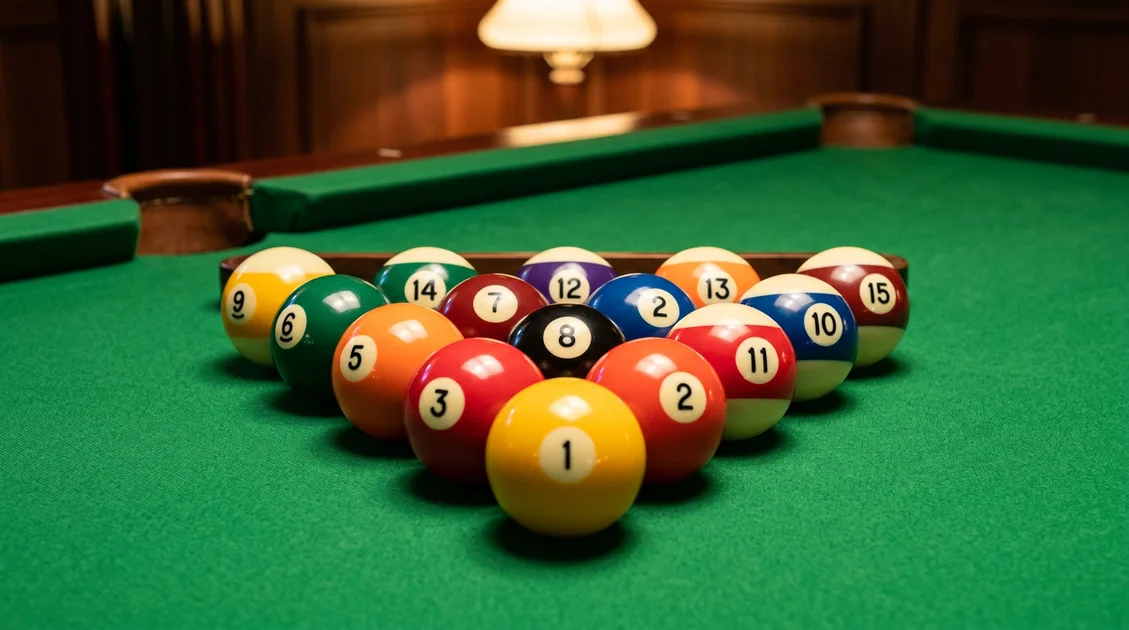
Yes, Aramith pool balls are worth the money. They last 5-10 years against 1-2 years for cheap polyester sets, and they protect your felt from premature wear. For regular players they also cost less per year of use: a $200 Aramith set over 5 years works out to $40/year, while a $60 polyester set replaced annually costs $60/year plus the faster felt degradation that runs $300-500 to fix.
The comparison at a glance:
| Feature | Aramith (Phenolic Resin) | Budget (Polyester) |
|---|---|---|
| Price | $150-300 | $30-80 |
| Lifespan | 5-10 years | 1-2 years |
| Cost per year (typical set) | ~$20-40 ($200, 5-10 yr life) | ~$30-60 ($60 set, 1-2 yr life) |
| Diameter tolerance | 0.002-0.005 inches | 0.01+ inches |
| Ball weight | ~6 oz (consistent) | ~6 oz (varies) |
| Felt damage | Minimal | Accelerated wear |
| Color retention | Years of gloss | Fades within months |
| Used in tournaments | Yes (BCA standard) | No |
| Manufacturer | Saluc/Belgium (80% market share) | Various |
You’re staring at two sets of pool balls on the website. One costs $60 and the other costs around $200. They look identical and play nothing alike. If you’ve already decided, you can check the current price on the Aramith Premium set. If you haven’t, the math below is what changed my mind.
What Makes Aramith Balls Different
Phenolic resin behaves differently from polyester, and the gap shows up in play. When a polyester ball gets struck, it gradually loses its perfect shape. It becomes slightly flatter on one side, just enough that your stroke feels “off” without you knowing why. You blame yourself or your stroke. But the problem is sitting in a ball that’s quietly gone out of round.
Aramith balls maintain their shape and balance year after year. They resist scuffing and stay glossy long after a polyester set has gone dull, and they still feel alive on the table.
The Belgian company Saluc owns Aramith and has dominated 80% of the billiard ball market. They started making balls in the 1960s and quickly became the standard for professional tournaments worldwide. In 2012, they merged with Iwan Simonis, one of the top felt manufacturers, so they had a vested interest in making balls that don’t destroy the cloth.
The Engineering Behind the Price
What the extra money buys is inspection. Each ball gets checked at least six times: by computer during forming, then by hand before it leaves the factory. They measure roundness, diameter tolerance, surface polish, brilliance, and color precision. It sounds obsessive, and it is, but that obsession is why professionals trust them.
When a pool ball is off by even a hundredth of an inch, it affects how it rolls and how other balls respond when you strike them. At the professional level, you can feel the difference immediately. At the amateur level, the difference is more subtle, but it’s still there, grinding away at your confidence every time you miss a shot.
Polyester balls don’t get this treatment. They’re cut, then polished and packed.
The Real Cost of Cheap Balls
Cheap balls cost more over five years than a single Aramith set does, and the arithmetic is simple. You buy a $60 set of polyester balls. After a year of regular play (three or four nights a week), they’re visibly worn. You buy another set. Within three years, you’ve spent $180 on balls alone.
But there’s more. Cheap balls wear the felt faster. Pool table felt costs $300 to $500 to replace, plus labor. If you’re playing on your own table, that’s a real expense. The polyester balls are literally eating your felt, leaving marks and dead spots where the cloth has broken down.
With Aramith balls, you’re spending $200 up front but you won’t need another set for five years, maybe longer if you’re not a daily player. Your felt lasts longer too. By year five, you’re way ahead financially.
If you’re in a pool hall or tournament environment, your venue manager already knows this math, which is why the best halls stock Aramith.
Consistency Builds Skill
Consistent equipment is what lets your skill actually show, and it’s why competitive players bring their own balls to tournaments. When you play with inconsistent equipment, you can’t develop consistency. You adjust your stroke because the ball feels wrong, then change your angle because the last shot behaved oddly. You never actually know if you’re improving or just adjusting to bad gear.
With Aramith balls, you can isolate what’s in your control: your shot selection and your stroke. The balls stop being a variable. That’s when your game actually gets better.
Some players swear they can feel the difference after their first break. Others need a few games to notice. Either way, once you’ve played with good balls, cheaper ones feel sluggish and unpredictable.
What About Durability on Your Table?
Polyester balls quietly wreck your felt, and most owners never connect the two. The synthetic material is harder than the cloth, so every impact leaves tiny wounds. Over months, these accumulate into a rough, dead spot where the cloth fibers have broken down. The ball rolls differently there. It’s basically like playing on a damaged table.
Aramith balls are friendlier to felt. The phenolic resin is slightly softer and distributes impact more evenly. This is partly why tournaments specifically require Aramith or equivalent phenolic balls, since they protect the playing surface.
If you own a nice table, this matters more than almost any other equipment choice you’ll make. Cheap balls are costing you twice: once through replacement costs, and once through accelerated felt wear. The Aramith Premium set runs about $200, which is less than a single refelt.
Tournament Standards and Professional Play
Professional tournaments mandate specific equipment, and for balls that means Aramith or equivalent phenolic resin. Pool halls hosting serious matches won’t let you play with random balls either. The reason is fairness.
If players could bring their own balls, and those balls had slightly different weights or rolling characteristics, you’d have an unfair advantage. The stronger player might get slower balls while the weaker player gets faster ones, and the playing surface itself becomes unpredictable.
Tournaments eliminate that variable by mandating equipment standards. Aramith meets the strictest specifications. They’ve been the default choice since the 1960s because Saluc understood that consistency in manufacturing and materials, combined with strict quality control, was the only way to build trust.
When you buy Aramith balls for your home table, you’re getting the same equipment used in professional play. That matters to serious players. It means your practice on home equipment translates directly to match conditions. You’re not adjusting for different balls when you walk into a tournament.
The Feel Factor
Feel is the hardest part of this to quantify, harder than durability or cost, and it comes down to how the balls behave in play.
Polyester balls have a slightly dead response. When you hit them, there’s a subtle lag in how they accelerate. The impact feels muted. Professional players describe it as “sluggish” or “heavy,” even though the weight is identical. It’s a materials thing. The polyester absorbs energy differently than phenolic resin.
Aramith balls respond crisply and the impact feels alive. Your english (spin) translates more directly, and speed control on touch shots gets noticeably more predictable.
Again, this is subjective, and some casual players never notice. Once you’ve played with quality balls, though, it’s hard to go back.
This is why serious players get picky about equipment. Better tools make the game feel right, and when the game feels right, you play better.
Aramith vs the Competition
| Ball Set | Material | Price | Lifespan | Felt Damage | Best For |
|---|---|---|---|---|---|
| Aramith Premium | Phenolic resin | ~$200 | 5-10 years | Very low | Serious home players |
| Aramith Tournament | Super Pro resin | ~$280 | 8-15 years | Minimal | Tournament practice |
| Japer Bees Deluxe | A-grade resin | ~$40 | 3-5 years | Low-medium | Budget home tables |
| Generic polyester | Polyester | ~$60 | 1-2 years | High | Occasional use only |
The price gap between Aramith Premium and generic polyester is about $140. Over five years of regular play you’d buy that polyester set four or five times, so $240-300 total, and pay for felt damage on top of it. The Aramith set is still going strong at $200. On balls alone that’s a $40-100 swing, and the felt savings are what make it lopsided.
That Japer Bees row deserves an honest note, because at $40 for three to five years it’s the best raw cost-per-year number on this table. What it doesn’t match is Aramith’s diameter tolerance or its tournament acceptance, and it’s still the set I’d point a once-a-month player toward over generic polyester. If you want to see where Aramith lands against the budget and mid-tier sets actually worth buying, our best pool balls roundup ranks every price tier.
FAQ
Are Aramith pool balls really worth $200?
If you play semi-regularly or seriously, yes. You’ll spend less over five years than you would replacing cheap balls every year, and you’ll get better performance and easier table maintenance.
How long do Aramith balls actually last?
Aramith balls last up to five times longer than polyester. That usually means 5 to 10 years for active players, longer if you’re casual. There’s no sudden failure point. They gradually accumulate minor cosmetic wear.
What’s the difference between Aramith Premium and Aramith Tournament?
The Tournament set uses Super Aramith Pro resin held to tighter diameter tolerances than Premium, and it carries a harder polish that keeps its gloss longer. Premium runs about $200 and Tournament about $280.
Can I tell the difference immediately?
Maybe. Some players feel it on the first break. The response is crisper, the rolling is truer. Others notice after a few games that their shots are more predictable. Either way, the difference becomes obvious over time.
Do professional tournaments only use Aramith?
Most do. Saluc set the standard decades ago, and the BCA generally specifies Aramith or equivalent phenolic resin balls.
What if I only play casually once a month?
Then $200 is overkill. A mid-tier resin set like the Japer Bees will serve you fine at around $40. If you play weekly or more, the Aramith investment pays for itself in felt savings alone.
What’s the best way to care for Aramith balls once I buy them?
Check out our guide on how to clean billiard balls for proper maintenance. Also read about billiard ball colors if you’re customizing your setup; color choice doesn’t affect performance, but matching your felt can keep your table looking sharp.
The Bottom Line
Spend an extra $140 now on balls that last five times longer and won’t trash your table. Or save $140 today and spend $240-300 replacing polyester across the same five years. Accelerated felt wear comes on top of that.
If you’re ready to upgrade, you can check the current price on the Aramith Premium set. It also helps to understand the rest of your gear: how cue ball size compares to the object balls, and which cue tips are worth installing. If you want the full picture, our breakdown of how pool table diamonds work for aiming rounds out the setup.