

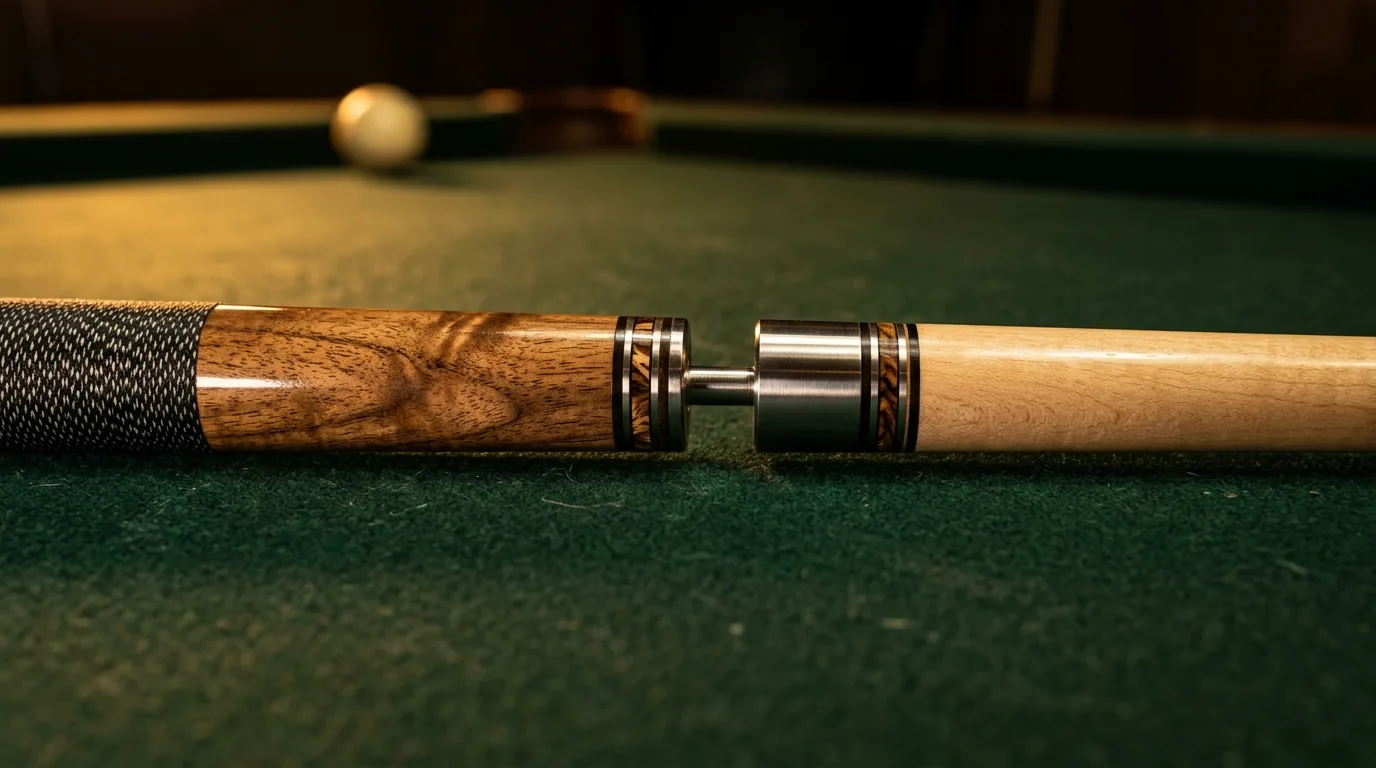
Viper pool cues sit at the budget end of the market, typically running between $20 and $80. They’re made by GLD Products, the same company behind Fat Cat tables and Casemaster accessories. If you’re wondering whether these cues are worth buying or if you should save up for something pricier, here’s what we’ve found after looking at the full lineup.
Build Quality and Materials
Every Viper cue uses a hard Canadian maple shaft. That’s the same wood species you’ll find in cues costing two or three times as much. The difference is in the selection and finishing. Higher-end manufacturers hand-pick straighter grain patterns, but the base material is solid.
Standard 13mm Le Pro leather tip on every shaft. That’s a decent starter tip: it holds chalk reasonably well and gives you enough grip for basic spin shots. More experienced players will probably want to swap it for a Kamui or Tiger, but for learning the game it works fine.
Most models use a stainless steel joint connecting the shaft to the butt. The joint feels sturdy enough, though it doesn’t have the same smooth feedback you’d get from a wood-to-wood or Uni-Loc joint on a higher-end cue. The Diamond line uses an Implex joint instead, which gives a slightly softer hit.
The Different Viper Lines
Four lines split the range, and they differ more in artwork than in how they play.
The Sinister Series
The Sinister is Viper’s most popular line and the one I’d point a new player at, sitting at the upper end of the $20 to $80 range. A removable tip scuffer sits in the butt end, which is a practical touch you rarely see this cheap. The inlay work is detailed for a budget cue and the Irish linen wrap feels good in the hand. If you’d rather have bare wood under your fingers, wrap versus no wrap is worth reading first, because the Sinister doesn’t give you that option. See the Sinister on Amazon.
The Diamond Series
The Diamond goes for a cleaner look, skipping the flashy artwork in favor of smooth, simple designs. It uses the Implex joint mentioned earlier, so the hit is a touch softer than the rest of the lineup. Good pick if you want something understated that still plays fine.
The Revolution Series
The Revolution is for players who want their cue to stand out. Tattoo-style artwork under a heavy varnish build, mostly spiders and skulls. Removable scuffer, and a felt wrap instead of Irish linen for a different stroke feel. Some owners have reported tip cracking on Revolution models, so that’s worth keeping in mind.
The Elements Series
The Elements rounds out the lineup with nature-themed designs. Build specs match the Sinister (Canadian maple shaft, Le Pro tip, stainless joint, same butt construction) with different artwork on top.
Where Viper Cues Fall Short
Warped shafts out of the box are the complaint that comes up most. Canadian maple can warp during shipping or storage, and at this price point, GLD’s quality control isn’t as tight as what you’d see from Players or McDermott. The good news is that customers who’ve contacted GLD about warped cues generally report fast replacements.
The Le Pro tip is functional but basic. It dries out faster than premium tips and doesn’t hold chalk as long during extended sessions. Players who practice regularly will want to upgrade the tip within the first few months, and a better tip changes how a Viper plays more than anything else you can do to it. Our pool cue tip guide covers which ones are worth the install fee.
The finish on some models can feel slightly sticky when new. This usually goes away after a few weeks of play, but it’s noticeable compared to cues with a more refined coating.
Who Should Buy a Viper Cue
Buy a Viper if you’re a complete beginner who wants your own cue but isn’t ready to spend $100 on one. It also makes sense as a house cue: something for guests to grab off the rack, or a backup that lives in your trunk. Casual players who shoot a few times a month get their money’s worth too. If you fall in the first camp, our best pool cues for beginners guide covers what the next $50 buys you.
If you’re shooting league nights and practicing between them, you’ll outgrow a Viper fast. Stepping up to something like the Players HXT15, which lands north of $100 with a low-deflection shaft already fitted, buys you consistency the Viper can’t give you. Our guide to the best pool cues for the money walks through that next tier.
How Viper Compares to Other Budget Brands
Players and Action fight Viper for the same under-$80 shopper, with Aska in the mix too, and none of them wins by much. Our best pool cues under $100 roundup ranks the whole tier if you want the head-to-head. A step up from there, Viking cues compete with Players for the next-tier-up market, so they’re worth knowing about even if they don’t fit the same budget.
| Brand | Typical price | Shaft | Joint | Quality control |
|---|---|---|---|---|
| Viper | $20-$80 | Hard Canadian maple, 13mm | Stainless steel (Implex on Diamond) | The weak spot. Warped shafts turn up. |
| Players | $40-$60+ | Hard rock maple, 13mm | Stainless steel | Best of the four. Straighter out of the box. |
| Action | $20-$80 | Canadian maple | Stainless steel | About even with Viper. |
| Aska | $20-$80 | Maple, some models 12.75mm | Stainless steel | About even with Viper. |
Players is the one I’d actually buy. The C-series and HXT line have tighter quality control, so you’re less likely to open the box to a banana, and the fit and finish is a visible step above. You pay for it, and comparable models start around $40 to $60 rather than $20.
Action sits right alongside Viper on both price and quality. The real difference is design preference and which tip the cue ships with.
Aska gives you more weight options, and a few models use a 12.75mm shaft that some players like for precision. Build quality is comparable to Viper.
If the extra $20 isn’t there, pick on looks and stop agonizing: playability across these four is close enough that nobody’s game is being held back by the badge. What actually decides your experience is whether the cue arrives straight and whether the tip holds up, which is why Players is worth the stretch when you can make it.
The Bottom Line
Viper cues deliver decent value at a low price. The Canadian maple shafts are legit and the construction holds up to casual play, with a 3-year GLD warranty behind it. They won’t turn heads at a tournament, but they’re a perfectly fine starting point for someone getting into the game. Just be prepared for the possibility of a warped shaft on arrival, and budget for a tip upgrade down the road if you stick with playing.
If I’m buying a cue for someone who has never owned one, it’s a Sinister and a decent tip, and I don’t feel bad about it. If they can stretch to a Players, that’s the better cue, and I’d tell them so.
Related Articles
For more on this topic, check out the best pool cues under $100, the best pool cues for beginners, our best pool cues for the money guide, the Players cues Q&A, and are Viking pool cues any good.
Browse our full Cues hub for tested picks, buying guides, and head-to-heads.