

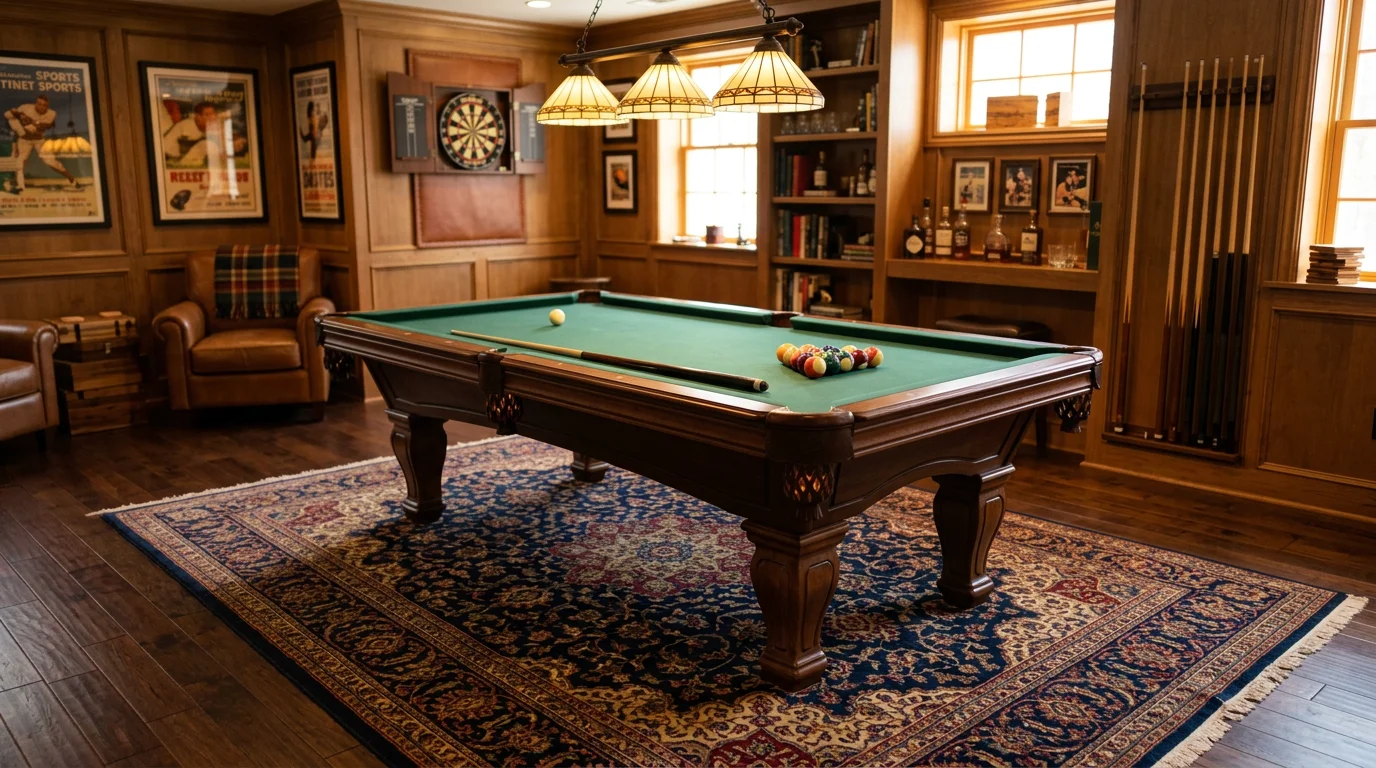
Putting a game room or man cave together is fun, but it takes a little planning, and the pool table is the biggest piece you’ll deal with. If you’re still picking a table, our guide to the best pool tables for home covers the sizes that actually fit a room. A pool table is heavy and a pain to move once it’s down, so it pays to get the floor right first. That’s where one question comes up a lot: should you put a rug under a pool table?
Putting a rug under a pool table is a great option. It protects hard flooring, dampens sound, adds some aesthetics, and ties the room together. For the best result you want a big enough rug in a low or medium pile, plus a little patience when you re-level after it settles.Protects the Floor
This is the reason most people do it. A slate table puts hundreds of pounds onto a handful of small feet, and over the years that pressure dents or scratches a hardwood or tile floor. Even a thin rug puts a buffer between those feet and your finish. A big enough rug also catches the occasional ball that jumps the rail, and billiard balls are heavy and hard enough to crack tile or dent wood when one hits the floor.
On size: all four legs should sit on the rug with a couple of feet to spare, so the table settles evenly instead of tilting off the rug’s edge. For a standard 7- or 8-foot table, that works out to a 9-by-12 at minimum. Bigger is better, since it also covers the spots where players actually stand.
Dampens Sound
Pool isn’t a loud game, but the crack of the break and the balls dropping into pockets reverberate, especially on a hard floor in a finished basement. A rug soaks up a good chunk of that noise. Your family or roommates will notice the difference when you’re playing for a couple of hours straight.
Easy on the Feet
A large rug around your pool table provides some padding for your feet. If you’re on your feet all day at work, or simply don’t like standing on hard floors for hours at a time, a rug under the table is the way to go. And it doesn’t have to be a particularly thick rug. Even a little bit of padding helps.
Provides Warmth and Aesthetic Appeal
A rug warms up the room in both senses. It adds a bit of insulation against a cold basement or garage floor, and it pulls the space together the way a rug does in any room. With the range of designs out there, you can find one that suits the table and the rest of the room.
Protects Dropped Balls and Cues
A rug protects the balls and cues as well. When a ball or a cue hits a bare hard floor it can chip or crack, and a rug gives it a softer place to land, which saves you from replacing gear over one clumsy moment.
Pool tables on hard floors also tend to creep over time. A table won’t run away on you, but people lean on it for shots and bump it walking past, and it slowly skews until you have to square it up again. A rug grips the feet enough to stop most of that drift.
That covers the upside. Now the downsides.
Takes Time to Settle
Any time you put a pool table on a rug or carpet, it takes a little time to settle. The weight compresses the pile, and once it does, the table drops slightly out of level. Level it, wait 2 or 3 weeks, then check it again and adjust the legs if it has shifted. If you’re setting the table up from scratch, do your leveling pass with the rug already down rather than on the bare floor. And if your room is wall-to-wall carpet to begin with, can you put a pool table on carpet covers that scenario separately.
May Present a Tripping Hazard
If you get a rug that’s too thick, you can create a tripping hazard. This is why low or medium-pile rugs are preferable for use under pool tables. Most people won’t trip over a thin rug. Thick, fluffy rugs are a different story.
Worth checking out: If you’re still putting the room together, our best pool table lights guide covers the overhead fixture, which is the other half of getting the space right.
Related Articles
For more on this topic, check out how to play pool, how far a pool table needs to be from the wall, how to set up a pool table, billiard game types, and best cues for beginners.
Browse our full Pool Tables hub for tested picks, buying guides, and head-to-heads.