

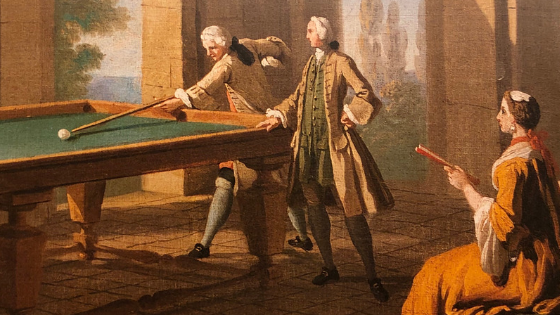
You’re bent over a pool table at your local bar. The cue slides through your bridge. The 8-ball goes in. Nobody thinks about King Louis XI at that moment, but they should. Because six centuries ago, that king decided to move his lawn game indoors during French winters, and billiards never stopped spreading.
The road from royal hobby to Tuesday-night bar game runs through palace hallways and patent offices.
Where billiards actually came from
Billiards didn’t arrive fully formed. It started as something that looked nothing like what’s on the table in front of you. Around the 1400s in France and Northern Europe, people played something closer to croquet. You’d roll wooden balls across a lawn toward hoops. When winter showed up and froze everything, the game moved inside.
The name itself comes from French. “Billart” meant stick, and “bille” meant ball. The French weren’t shy about naming things after what they did.
King Louis XI’s 1470 inventory (the one that survives in historical records) lists the first indoor billiard table. It had a boundary rail to keep the balls from flying off. Still a far cry from the cloth-covered slate bed you know today, but it was a start. The wealthy were playing this inside, on crude wooden tables, using what looked like shuffleboard sticks instead of cues.
This was a completely different game from pool as we know it now. About the only thing that carried over is the basic idea: hit a ball with a stick and try to make something happen.
When kings started obsessing over it
Once billiards moved inside, the aristocrats couldn’t get enough of it. This is where the game exploded among European royalty, because the table doubled as a status symbol. You played billiards if you had money, power, leisure time, and the right social connections. All four.
King Louis XIV, called the Sun King, brought billiards into Versailles in the late 1600s. Tables started appearing in the hallways of actual palaces. France had no monopoly on the obsession either. England’s King James had billiard rooms built. Across Europe, if you were nobility, you played.
One name that shows up constantly is Mary Queen of Scots. She played regularly. Historical accounts mention her at the table, which was unusual for a female player at the time. The fact that we know her name in connection with billiards tells you how much the game mattered to the royals.
Even military guys got obsessed. Napoleon Bonaparte allegedly played between strategy sessions to clear his head while remaking Europe’s political map. Whether that’s true or legend, it stuck around enough to keep getting repeated. Billiards was serious business for serious people.
But exclusive games played by kings never stay exclusive forever.
The equipment that changed everything
For the first two centuries, billiards was limited by its gear. You hit wooden balls with a mace (literally a stick with a wide head). The tables were made of wood. The cushions were just raised rails. It was finicky and inconsistent.
Then came the 1600s, and someone figured out that a tapered stick worked better than a mace. The cue was born. Players could control the ball more precisely and put spin on it. The game tilted toward skill. That shift mattered because it made billiards something you could actually get good at instead of just a rich person’s game of chance.
But the real revolution happened in the 1800s.
In 1807, a French officer named François Mingaud came out of a Paris prison with a leather cue tip he’d spent his sentence perfecting. Rubbed with chalk, that tip gripped the cue ball instead of sliding off it. The chalked leather tip made English possible. That’s the spin you put on the ball. It changed the whole strategy of the game.
In 1839, someone figured out vulcanized rubber. That’s when cushions actually started bouncing consistently. Instead of a wooden rail that absorbed impact unpredictably, you got rubber that responded the same way every time. For the first time, you could actually calculate a shot.
Then came slate beds. Replacing the wooden table with slate meant a genuinely flat, durable playing surface. Wood warps. Slate doesn’t. It was expensive and heavy, but it was worth every penny because suddenly the game was fair. The table wasn’t cheating you. You could play the same shot the same way and get the same result.
Together, these innovations transformed billiards from a rough approximation into a real sport with real precision.
How it stopped being just for rich people
The story shifts from palaces to pubs once the equipment stopped being a luxury.
The democratization of billiards happened gradually during the 1800s. As industrial production got better, equipment got cheaper. A slate table used to cost a fortune. Then it cost less.
Rubber cushions became manufacturing commodity items instead of hand-crafted luxuries. Cues didn’t need to be personally commissioned anymore. Brunswick has been making tables since 1845, riding exactly this shift, and the same name still shows up in our best pool table brands guide today.
More importantly, bar owners realized billiards attracted customers. Put a table in your establishment and you had a draw. People would come, play, buy drinks, and come back. By the mid-1800s, pool halls and billiard parlors were opening in cities across America and Europe. Working people could finally access the game.
This is when it stopped being billiards (the game of kings) and started becoming pool. The terminology matters because billiards stayed somewhat formal and refined while pool became the rough-and-tumble version for regular guys. Pool halls became social centers, some respectable and some decidedly not. Gamblers showed up, and players started taking the game seriously.
Different variations emerged once you had large numbers of people playing seriously. In England, they developed snooker. In America, you got straight pool, nine-ball, eight-ball, and bar-box variants. Each variant emerged because players in different places started experimenting with rules. What worked in a London pub didn’t work the same way in a New York pool hall. The games evolved locally.
The modern era produced names like Efren “The Magician” Reyes, whose shot-making still defines what’s possible on a pool table.
Why it stuck around
Most games don’t survive five centuries. Billiards did because it appeals to something basic in how humans think. The game is geometry and physics dressed up as competition, and it never demands that you be twenty years old or physically massive. You play until you’re seventy or eighty, and the game doesn’t care.
It also adapted when it needed to. When equipment was inconsistent, innovations made it reliable, and when it was exclusive, economics opened it up. The game itself stayed the same. You’re trying to make balls do what you want. Everything around it transformed to match what people actually needed.
That’s why you can still go shoot a game tonight and you’re doing something that shares DNA with what King Louis XI was doing in 1470. Not exactly the same, obviously. But the basic idea (a cue, a ball, a table, strategy) has held up for six hundred years.
Worth checking out: If reading this made you want to go hit some balls with distinctly modern gear, take a look at the Players Technology Series HXT15 Cue on Amazon.
FAQ
What does “English” mean in billiards? It’s the spin you put on the ball using a specific cue stroke. It became possible once the chalked leather cue tip arrived around 1807, letting the tip grip the cue ball instead of sliding off. Before that, you couldn’t generate that kind of controlled spin. The term “English” stuck around even though players worldwide use it now.
When did pool become separate from billiards? Technically around the 1800s as bar games and pool halls started distinguishing their variants from the more formal billiards played in private clubs and among the wealthy. Today billiards usually refers to carom games (hitting other balls), while pool is about sinking balls in pockets.
Did women actually play billiards in royal courts? Mary Queen of Scots definitely played, and she’s well-documented. But she was an exception. It was considered unseemly for women to play publicly in that era. Some did it privately, but it took until much later for women to be openly competitive in pool.
Why is slate so important for pool tables? Slate doesn’t warp or absorb moisture, and it gives you a playing surface that stays genuinely flat for decades. Wood tables warp constantly depending on humidity. When slate became standard in the 1800s, it meant the game finally became consistent. Two players could shoot the exact same shot in two different years and it would play the same way.
Want to understand the differences between games? Check out snooker vs pool. What’s actually different? to see how the variants diverged.
Learning to play? Start with the beginner’s guide to pool.
Shopping for a table? Learn about standard pool table sizes and dimensions first, then see our picks for the best pool tables for home.
Shopping for a cue? Today’s sticks run from $50 bar cues to $500 carbon shafts. Our guide to the best pool cues for the money covers every budget.
Related Articles
For more on this topic, check out snooker vs pool, is snooker harder, snooker cues for pool, billiard game types, and bumper pool.