

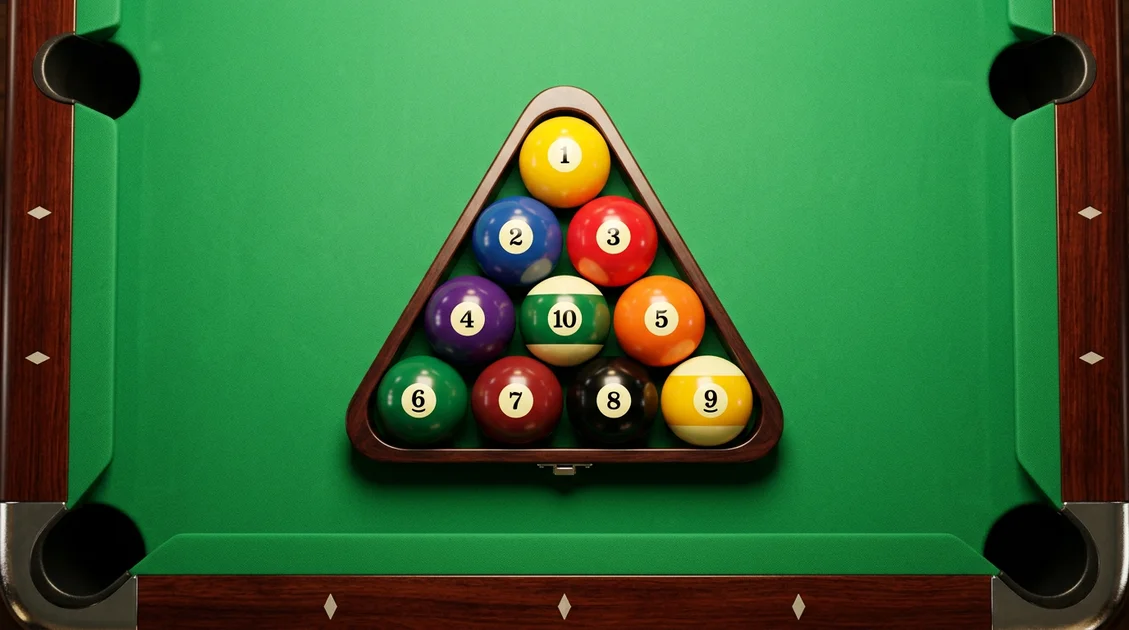
The 10-ball rules work like 9-ball with one more ball and one more rule. The rotation is the same, and those two additions make it a much harder game to win by luck.
The added rule is the called shot. You name the ball and the pocket before every shot after the break.
In 9-ball, you can slop the game-winning ball into a pocket you weren’t even looking at and it counts. In 10-ball, if you call the 10 in the corner and it rattles into the side instead, the 10 comes back up on the foot spot and your opponent decides who shoots next. Luck counts for a lot less in 10-ball, and I think that’s the whole appeal.
Pros play it for world titles. The WPA runs a world 10-ball championship, and Ko Ping Chung won the 2025 men’s title in Ho Chi Minh City.
This guide follows the current WPA Rules of Play (effective September 15, 2025). It also flags every spot where the CSI rules used in BCAPL and USAPL leagues play 10-ball differently, because the two books disagree on how the 10 can win.
| Details | |
|---|---|
| Players | 2 |
| Balls | 10 object balls (1-10) + cue ball |
| Rack | Triangle, 4 rows; 1 at the apex on the foot spot, 10 in the center of row 3 |
| Order | Always hit the lowest-numbered ball first |
| Called shot | Yes, every shot except the break (ball and pocket) |
| Win | Pocket the 10 on a called shot as the last ball (WPA); CSI also counts an early called 10 |
The Rules in 30 Seconds
- Rack 10 balls in a 4-row triangle. 1-ball at the apex on the foot spot, 10-ball in the center of row 3.
- Break from behind the head string and hit the 1 first. If nothing drops, at least 4 object balls must reach a rail or it’s a foul.
- On every shot after the break, hit the lowest-numbered ball first and call the ball and pocket.
- After a foul-free break, the next shooter may call “push” once and roll the cue ball anywhere (the push-out).
- Make the called ball in the called pocket and keep shooting. Miss and your inning ends; drop the wrong ball and your opponent picks who shoots next. A foul gives them ball in hand anywhere.
- Pocket the 10 on a called shot when it’s the last ball and you win. A 10 that drops earlier gets spotted, unless you play CSI rules and called it.
What You Need
Ten object balls numbered 1 through 10, plus a cue ball. Any table size works. 7-foot bar tables and 8-foot home tables play 10-ball the same as a 9-foot tournament table does. A standard numbered ball set already covers you, since 10-ball just uses the first ten and leaves the rest in the box (our ball-count guide lists what every other game needs).
You’ll also need a cue and a triangle rack. Any straight cue works. If you use sidespin a lot, a low-deflection shaft pushes the cue ball less off your aim line when you apply it.
That matters in 10-ball, because a near-miss ends your inning and a lucky pocket won’t save you. If you want that in a modern shaft, low-deflection carbon cues are the category to compare.
A standard 15-ball triangle works fine. Fill the first four rows and leave the back row empty.
How to Rack
The rack forms a triangle with 4 rows: 1 ball in the first row, 2 in the second, 3 in the third, 4 in the fourth (10 balls total).
Two balls have assigned positions under WPA rules. The 1-ball sits at the apex of the triangle, centered on the foot spot. The 10-ball goes in the center of the third row. WPA rule 6.2 says the others go in “without purposeful or intentional pattern,” so mix them up.
CSI rules, used by BCAPL and USAPL leagues, add one more requirement. The 2-ball and 3-ball go on the two back corners, and it doesn’t matter which one sits left or right. In a WPA event the 2 and 3 land wherever they land.
Rack it tight. WPA rules ask for the balls “as tightly as possible,” and CSI rules say each ball should touch every ball next to it. A loose rack changes how the balls spread on the break. WPA rules also allow a racking template in 10-ball, and our full racking guide walks through the technique for getting a tight set every time.
Breaking
The breaker starts with the cue ball in hand behind the head string (the “kitchen”) and must hit the 1-ball first, since it’s the lowest-numbered ball on the table.
For the break to be legal, a ball has to drop or at least 4 object balls must contact a cushion. Fall short and it’s a foul under both WPA and CSI rules, so your opponent gets ball in hand anywhere on the table. Neither rulebook gives the incoming player a re-rack option for a weak break.
A 10-ball made on the break doesn’t win. WPA rule 6.8 and CSI rule 4-3 both put it back on the foot spot, and the game goes on. If your bar plays a 10 on the break as a win, that’s a house rule, so settle it before you play for money.
If the cue ball scratches on the break, that’s a foul too, and the incoming player gets ball in hand anywhere on the table. A foul on the break also takes away the push-out, which only follows a foul-free break.
Since a weak break hands over ball in hand, it pays to hit the 1 squarely with real speed. Our guides to breaking in pool and break cues cover the technique and the gear.
How to Play
Every shot in 10-ball follows two rules at once: rotation and called shot.
Rotation means you must always contact the lowest-numbered ball on the table first. If the 1, 4, 7, and 10 are left, you must hit the 1 first. You can’t skip ahead.
Called shot means you name which ball goes in which pocket before shooting (e.g., “4-ball, side pocket”). The route doesn’t matter, and kisses or cushion contacts along the way are irrelevant as long as the called ball drops in the called pocket.
Both rulebooks let you skip the announcement on an obvious shot. CSI rules require a call on every combination, and on every bank or kick shot too. WPA rules tell you to call those shots whenever there’s any chance of confusion.
If you pocket the called ball and other balls fall on the same shot, those other balls stay down. The one exception is the 10, which gets spotted. You only need to call the ball you’re intentionally pocketing.
There’s no “safety” call in 10-ball under WPA rule 6.5. You can still play safe. Just know that any ball you pocket without making a called shot hands your opponent the choice of who shoots next.
The Push-Out
After a legal break, whoever is at the table (the breaker if they pocketed a ball, or the incoming player if the breaker didn’t) has one special option: the push-out. If the break was a foul, the option is gone.
Calling a push-out takes three steps.
- Before shooting, announce “push” (or “push-out”) to your opponent. CSI rules also require your opponent to acknowledge it. Skip this step and it’s a regular shot.
- Shoot the cue ball anywhere on the table. You don’t have to hit the 1-ball first, and you don’t have to drive any ball to a rail or pocket anything.
- After the balls stop, your opponent chooses: shoot from the new position, or make you shoot again.
Two things are NOT a foul during a push-out: not hitting the lowest ball, and not driving a ball to a rail. Everything else still applies, so a scratch still gives your opponent ball in hand. Any ball you pocket on a push-out stays down, except the 10, which is spotted.
The push-out is the most underused weapon in amateur 10-ball. Use it when you don’t see a clear shot off the break. Park the cue ball somewhere awkward, like frozen on a rail with no angle or hooked behind a cluster, so your opponent is tempted to shoot but unlikely to succeed.
The option exists only on the first shot after the break, so you get one push-out per rack at most.
Fouls
A foul gives your opponent ball in hand anywhere on the table under both WPA and CSI rules. That’s huge in 10-ball: a ball in hand against a skilled player usually means game over.
The main fouls:
| Foul | What it means |
|---|---|
| Wrong ball first | The cue ball touches another ball before the lowest-numbered one. If the 3 is lowest and you hit the 5 first, it’s a foul even if the 3 drops. |
| No rail after contact | Nothing is pocketed, and no ball reaches a cushion after the cue ball hits the object ball. The rule keeps safety battles from stalling out. |
| Scratch | The cue ball goes in a pocket or off the table. |
| Object ball off the table | It stays off the table, unless it’s the 10, which gets spotted. |
| Balls still moving | You shoot before every ball has stopped. |
Our full breakdown of what counts as a scratch covers the edge cases.
Missing your call doesn’t count as a foul. If you call the 6 in the corner and it goes in the side, your opponent gets no ball in hand. The 6 stays down (a 10 would be spotted), and your opponent chooses who shoots next: they can take the table as it lies or make you shoot again.
Three-Foul Rule
If a player fouls three times in a row without a legal shot in between, they lose the game. The three fouls have to come in the same rack (WPA rule 3.13, CSI rule 4-9).
The player has to be warned that they’re on two fouls before the third one counts. WPA rules put that job on the referee, and CSI rules let the opponent or a referee give the warning. Without the warning, the next foul counts as only the second.
The rule stops a player from fouling on purpose over and over as a defensive tactic. It rarely decides a game, but it’s there as a deterrent.
Winning
You win 10-ball by legally pocketing the 10 on a called shot, and the rulebook decides when that’s allowed.
Under WPA rules, the 10 only wins when it’s the last object ball on the table. That means:
- Balls 1 through 9 are already off the table
- You called the 10-ball and the pocket
- The 10-ball went in the called pocket without a foul
A 10 that drops any earlier, even on a called combo or on the break, gets spotted on the foot spot and play continues (WPA rule 6.8).
CSI rules, used by BCAPL and USAPL leagues, are looser. Rule 4-1 lets you win by pocketing the 10 on any legal shot after the break, so a called 10 is live all rack long. Hit the lowest ball first, call the 10 and the pocket, combo it in, and the game is yours. A 10 that drops on a shot where you called a different ball still gets spotted (rule 4-5).
That makes early combos on the 10 a real weapon in CSI play. If you see a clean path from the lowest ball to the 10, calling it can end the rack in one shot. In a WPA event the same shot only gets the 10 spotted.
WPA vs CSI 10-Ball Rules
WPA and CSI rules agree on most of 10-ball. Where CSI matches WPA the table says “Same,” and “Same, plus” marks a small CSI addition. The real splits are the back corners of the rack, who racks and the early 10. The APA’s league divisions play 8-ball and 9-ball only, so for 10-ball the comparison comes down to these two books.
| Rule | WPA (effective Sept. 15, 2025) | CSI (BCAPL, USAPL) |
|---|---|---|
| Rack | 1 on the foot spot, 10 in the middle, rest random | Same, plus the 2 and 3 on the back corners |
| Who racks | Players agree, or rack for each other | Breaker racks their own |
| Legal break | Hit the 1 first; pocket a ball or drive 4 to rails | Same |
| Failed break or scratch | Foul: ball in hand anywhere | Same |
| 10 on the break | Spotted (rule 6.8) | Same (rule 4-3) |
| Push-out | Once, after a foul-free break | Same, plus the opponent must acknowledge it |
| Calling shots | Every shot but the break, obvious ones unannounced; no safety call | Same, plus combos, banks and kicks must always be called |
| Wrong ball or wrong pocket | Opponent chooses who shoots next | Same: opponent takes the table or makes you shoot again |
| Early 10 on a called shot | Spotted; only a last-ball 10 wins | Wins the game |
| Extra 10 that drops with your called ball | Spotted | Same |
| Three fouls in a row | Loss of the game, after a warning from the referee | Same, but the opponent can give the warning |
Sources: WPA Rules of Play sections 3.13 and 6.2 to 6.10, WPA Regulation 28, and CSI Official Rules 1-14, 1-16, 1-22 and section 4. If you’re playing in a bar or a local league with its own format, ask before the first rack which way the early 10 goes.
10-Ball vs. 9-Ball
10-ball differs from 9-ball in two ways: one more ball on the table, and a called shot on everything after the break. The second change also takes away the cheap wins.
| 9-Ball | 10-Ball | |
|---|---|---|
| Balls | 1-9 | 1-10 |
| Called shots | No (slop counts) | Yes |
| Game ball on a legal break | Wins | Spotted |
| Game ball made early | Wins on any legal shot | WPA: spotted; CSI: wins if called |
| Run-out difficulty | Moderate | Higher |
| Luck factor | Higher | Lower |
| Break advantage | Stronger | Weaker |
| Average rack length | Shorter | Longer |
The extra ball adds traffic. A 10-ball run-out needs one more made shot and one more position play than a 9-ball run-out, and that tenth ball can block a route all rack long. Add the called-shot rule, and the break no longer wins games on its own, so most of the luck drains out.
Strategy Tips for Beginners
Don’t try to run the table. In your first 10-ball games, focus on making 2-3 balls and playing safe. Running 10 balls with called shots is extremely difficult, and even pros miss plenty of run-outs in this game.
Learn the push-out early. Most amateurs never use it, which wastes the one free move the rules hand you after every legal break.
Know your rulebook before you go for the 10. In a CSI league, scan for a called 10 combo every inning. In a WPA event, play the balls in order and treat the 10 as the last shot of the rack.
My advice for new players is to treat safety play as half the game. Because every shot has to be called, a safety that leaves your opponent only banks and kicks is worth more in 10-ball than in 9-ball, where a lucky roll still counts.
Combos punish small aiming errors, and a miscue wrecks them outright, so keep your tip chalked before every attempt. Our best pool chalk roundup covers what actually holds.
FAQ
What are the basic rules of 10-ball?
10-ball is a rotation game with balls 1 through 10. You must hit the lowest-numbered ball first and call the ball and pocket on every shot except the break. Under WPA rules you win by legally pocketing the 10 as the last ball on the table; CSI leagues also let a called 10 win earlier.
What is the difference between 9-ball and 10-ball?
10-ball adds a tenth ball and makes you call your shots. In 9-ball a lucky 9 still wins, and so does a 9 made on a legal break. In 10-ball a 10 made on the break or by accident gets spotted and the game goes on.
Do you have to call every shot in 10-ball?
Yes, every shot except the break, though an obvious shot needs no announcement. You name the ball and the pocket, and the route doesn’t matter. If a ball drops but the called shot doesn’t, the 10 gets spotted, any other ball stays down, and your opponent chooses who shoots next.
How do you rack 10-ball?
Rack the ten balls in a four-row triangle with the 1-ball at the front on the foot spot and the 10-ball in the middle of the third row. WPA rules leave the rest random. CSI rules also put the 2-ball and 3-ball on the back corners.
Can you win on the break in 10-ball?
No. Under both WPA and CSI rules, a 10-ball made on the break is spotted on the foot spot and the game goes on. A bar that counts it as a win is playing a house rule.
Can you win 10-ball early on a combination?
It depends on the rulebook. Under WPA rules the 10 only wins when it is the last ball on the table, so an early 10 gets spotted. CSI rules, used in BCAPL and USAPL leagues, let a called 10 win on any legal shot after the break, combos included.
Related Reads
If you’re new to rotation pool, start with our 9-ball rules guide. It’s simpler and teaches the same rotation fundamentals. If 8-ball is your usual game, our 8-ball rules guide makes a useful contrast for understanding why rotation games play so differently.
For other rule sets, cutthroat pool is a great 3-player option and bank pool is a defensive grinder’s game. Our billiard games roundup covers straight pool (14.1) if you want a longer game.
To sharpen the skills 10-ball demands most, our guides on how to aim and how to rack apply directly. And if you’re still learning the basics, how to play pool is the place to start.