

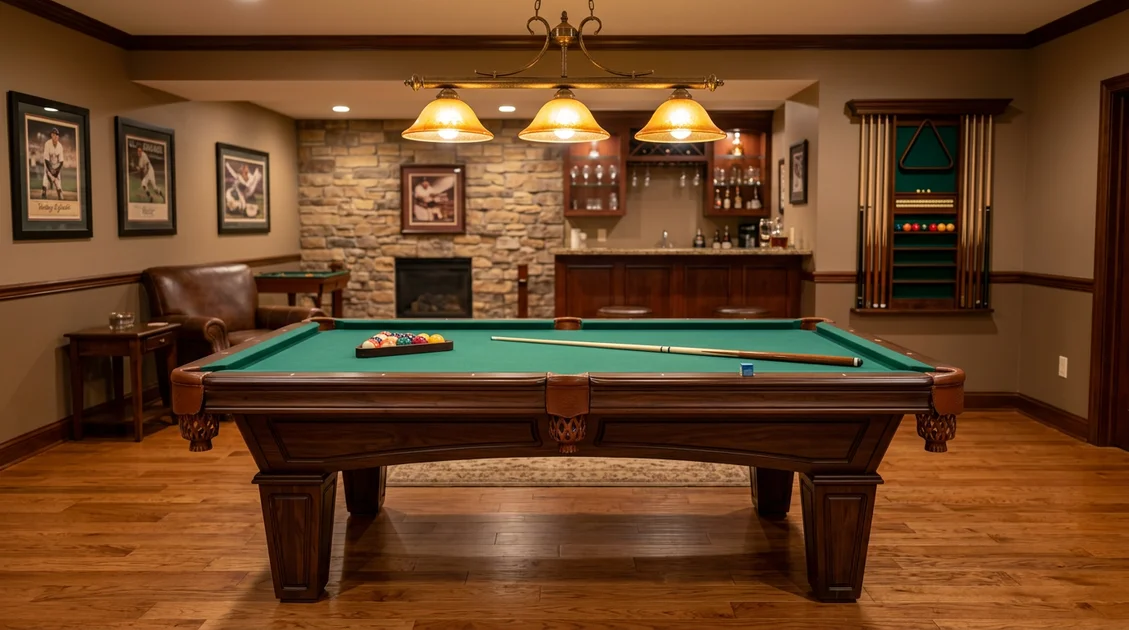
An 8-foot pool table is the one most people picture when they think about owning a table.
The 44” x 88” playing surface gives you enough room to work the cue ball without feeling cramped, and it’s small enough that casual players don’t feel lost. Pro events and big 9-ball tournaments run on 9-footers. Most of the pool played in home game rooms and finished basements happens on 8 feet.
The catch is space. An 8-footer with standard 58-inch cues needs a room at least 13’4” x 17’, which rules out a lot of spare bedrooms and narrow basements. If you’ve got the room, this is the size to put your money into.
How We Picked
We picked these six 8-foot tables on published specs and price, using Amazon listings and retailer pages checked in October 2026. We haven’t played on these exact tables, so where a maker doesn’t publish a spec, we say so. Our top pick is one of the cheapest real slate tables we could find from a known brand, because slate is the one upgrade every player feels. We skipped non-slate 8-footers priced above it, such as the Hathaway Montecito (about $1,600 in October 2026), since real slate costs less.
What Separates an $800 Table from a $5,000 Table
The bed is the dividing line: tables under $1,000 use MDF or another non-slate bed, and real slate starts around $1,250. Down at the low end, rail rubber is basic too. Expect a few years of regular use before the surface goes soft in spots, though the balls roll mostly true until then.
The Mizerak Donovan II marks where slate starts, pairing a real slate bed with K-66 nose rubber. A slate bed stays flat once a pro levels it.
From about $2,500 up, name-brand tables pair 1-inch 3-piece slate with solid wood frames and better finish work. At $5,000+, the extra money mostly buys exotic woods and a famous name on the rail.
The playing gap between a $3,000 slate table and a $5,000 slate table is small, since past the first slate tier you’re mostly paying for looks. If you want the best-playing table for the money, buy the cheapest slate table from a reputable manufacturer. If you want furniture, budget accordingly.
What to Look for in an 8-Foot Table
Slate matters most, followed by the cushions and a proper install, and the smaller details below can break a tie between two tables.
Slate or MDF
MDF is fine for casual play and parties. For a table you’ll actually practice on, go slate. Slate stays flat for decades, while our MDF lifespan guide puts most MDF tables at 6-8 years in a climate-controlled room and as little as 3-4 in a damp basement.
Slate Thickness
The standard is 1-inch 3-piece slate. Some cheaper imports cut costs with 3/4-inch slate, which rolls fine on a level floor. The 1-inch version has a small edge in stability over the years, but you won’t see the difference in how the balls roll.
Cushion Rubber
K-66 is the most common cushion profile, and both the Donovan II and the Parsons use it. It gives consistent rebounds and straight rails. Some makers use their own cushions, like Olhausen’s Accu-Fast. A table with K-66 is good enough to move on to other details.
Weight
Slate tables run 550+ lbs, and non-slate tables usually run 150-300 lbs. Heavier tables sit solid when you lean into a shot, while lighter frames can flex under your weight and throw off softer shots.
Cloth
Strachan and Simonis are the names to know, and both make wool-nylon blends that play fast. The APA World Pool Championships play on Simonis 860 Tournament Blue. Polyester cloth on cheaper tables grabs and slows the cue ball. When a spec sheet says “tournament-grade cloth,” ask which brand.
Pocket Cut
The WPA equipment specs call for corner pocket openings of 4.5 to 4.625 inches and side pockets of 5 to 5.125 inches, and pockets cut much looser make cut shots feel off. In a showroom, shoot a few easy balls into each pocket to see whether they drop cleanly.
Leveling and Seams
Three-piece slate tables ship with seams that get filled with beeswax, and a professional installer levels the slate and fills those seams before stretching the cloth. An unlevel table plays badly no matter what it cost. Budget $200-$300 for installation and leveling, and book it before the table arrives.
The Picks
Three of these six ship from Amazon, including our top pick, the Mizerak Donovan II slate model. Olhausen sells through local dealers, Brunswick through dealers and its own store, and Plank & Hide through furniture and billiards retailers. Their buttons run an Amazon search, so check the dealer or retailer for the actual price.
GoSports 8’ Wood Finish (~$800)
GoSports ships this table with the top already assembled, so setup is four legs and a level. It weighs about 238 lbs on fixed legs with foot levelers. GoSports recommends a 17 x 14 ft room, close to the 13’4” x 17’ minimum we use.
The company doesn’t publish the bed material, the cushion rubber, the cloth or the playfield size, and a 96-inch frame likely leaves the playfield a little under the regulation 44” x 88”. Treat it as a non-slate table for casual games and parties. Anyone trying to groove a bank-shot stroke will want slate.
There are no cues or balls in the box. Our best pool cues for the money guide has options starting around $30.
Check Price on Amazon →Mizerak Donovan II 8’ Slate (~$1,250)
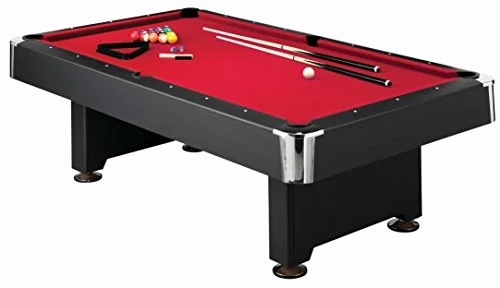
Mizerak sells the Donovan II two ways: model P5223W1 with a slate bed, and P5223W2 with Slatron, Mizerak’s non-slate substitute. Both share the red wool-blend cloth and the black cabinet with chrome corners. Both also use 3-5/8-inch rails with K-66 nose rubber, and two cues and a ball set come in the box.
On Amazon in October 2026, the Slatron model listed for about $1,370, while the slate listing showed about $1,250. With the slate version cheaper, we see no reason to buy the Slatron one. Our slate vs slatron explainer covers how the two surfaces play.
Know the trade-offs before you buy. Mizerak doesn’t publish the slate thickness on Amazon, and retailers list it anywhere from 3/4 inch to about 1 inch. The cabinet and rails are laminate over a metal frame, a step down from the solid wood on the pricier tables here. The slate listing also sells through a third-party seller whose stock comes and goes.
Plan on a $200-$300 professional install, since slate seams and cloth tension decide whether a budget slate table plays like one.
Check Price on Amazon →Plank & Hide Parsons 8’ (~$2,550-$4,000)
Plank & Hide designs for modern rooms. The Parsons is a solid-wood table in a burnished black finish, with one-piece legs and wide 6.5-inch wood top rails over leather drop pockets. Under the styling sit a 1-inch framed slate bed and K-66 cushions, per the spec sheets at Clover Home Leisure and Scioto Valley.
In October 2026, Clover Home Leisure listed it at $2,549 and Wayfair at $3,399 (marked down from $3,999), and the Wayfair listing includes professional installation. With prices that far apart, get several quotes before you buy.
Search Amazon →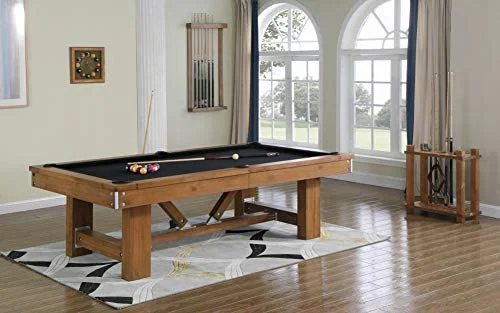
Playcraft Willow Bend 8’ (~$3,900)
The Willow Bend is a full-spec slate table sold straight through Amazon. Playcraft lists a 1-inch, 3-piece slate bed honed to within 1/1000 of an inch on an 18mm wood backing. The cushions are gum rubber, and the 21 oz wool-blend cloth comes in 25 colors.
Playcraft calls the frame solid hardwood, finished in a hand-applied toffee stain with black hammered hardware, and the table also comes in a 7-foot size. At around $3,900 for the 8-footer, it costs a little less than an Olhausen Classic, and the case for it is convenience: you pick the cloth color online and skip the showroom. The listing had only two reviews in October 2026, so there’s little owner feedback to go on. Playcraft itself tells buyers to hire an experienced billiard installer instead of a furniture-assembly service, and that advice is right.
Check Price on Amazon →Olhausen Classic 8’ (~$4,450-$4,900)
Olhausen builds its tables in Portland, Tennessee, and company president Donny Olhausen told Manufacturing Today in 2012 that it had become the largest pool table manufacturer in the world. The Classic is one of its best-known designs, with 1-inch framed slate in a solid tulipwood cabinet with hard maple rails and Olhausen’s Accu-Fast cushions.
Olhausen backs its tables with a lifetime warranty. Buying one means going through a dealer, and in October 2026 Robbie’s Billiards had the Classic at $4,450 on sale (regular price $4,890), with Gebhardt’s starting it at the same $4,450. That’s more than three times what the Donovan II slate costs, and finish options push it higher.
Search Amazon →Brunswick Gold Crown VII 8’ (~$12,500)
Brunswick has been building pool tables since 1845, and the Gold Crown is its flagship. The 9-foot version hosted decades of professional tournament play. The current Gold Crown VII puts 30mm Brazilian slate on a steel base frame, with Gold Crown K-55 cushions made by Artemis. Its 4.75-inch corner pockets are a touch more generous than the WPA tournament spec.
Brunswick’s own store listed the 8-footer at $12,495 in October 2026, the most expensive table on this list by a wide margin. The Olhausen Classic gives you slate on a solid wood frame for well under half that. With the Gold Crown, you’re paying for the Brunswick name and the table’s pro-room history.
Search Amazon →Quick Comparison
The Donovan II slate is our top pick for value, and the Olhausen Classic is the upgrade pick for buyers with a local dealer.
| Table | Price | Surface | Rubber | Buy From | Best For |
|---|---|---|---|---|---|
| GoSports 8’ | ~$800 | Not listed (non-slate) | Not listed | Amazon | Casual / party table |
| Mizerak Donovan II 8’ Slate | ~$1,250 | Slate | K-66 | Amazon (third-party seller) | Best value slate |
| Plank & Hide Parsons | ~$2,550-4,000 | 1” slate | K-66 | Furniture and billiards retailers | Modern design |
| Playcraft Willow Bend | ~$3,900 | 1” slate | Gum rubber (profile not listed) | Amazon | Slate ordered online |
| Olhausen Classic | ~$4,450-4,900 | 1” framed slate | Accu-Fast | Local dealer | Best dealer-sold table |
| Brunswick Gold Crown VII | ~$12,500 | 30mm slate | K-55 (Artemis) | Brunswick store or dealer | Heritage brand |
Where to Buy
Buy a slate table from a local dealer who installs it when you can, and buy non-slate tables like the GoSports on Amazon. Slate tables are a harder Amazon purchase. They weigh 550 lbs or more and need professional installation: assembling the frame, leveling the slate, waxing the seams, and stretching the cloth. Olhausen and Brunswick sell through authorized local dealers who fold delivery and setup into the price, and Brunswick also sells from its own online store.
Check local first. A local dealer who installs the table and relevels it for free in the first year is worth $200-$300 more than a shipped table you have to figure out yourself. If you do order the Donovan II or the Willow Bend online, book an installer before the freight truck arrives.
Non-slate tables come in boxes, and two people can handle setup without hiring anyone.
Room Size Reference
An 8-foot table needs 13’4” x 17’ with standard 58-inch cues. Each row below is the 44” x 88” playing surface plus one cue length on every side.
| Cue Length | Min. Room for 8’ Table | Notes |
|---|---|---|
| 58” (standard) | 13’4” x 17’ | Full stroke everywhere |
| 52” (short) | 12’4” x 16’ | Mild restriction at rails |
| 48” (short) | 11’8” x 15’4” | Tight but workable |
Our standard pool table size guide has the same chart for 7- and 9-foot tables. If your room falls short with standard cues, read our 7-foot pool table guide before settling for short cues, which get cramped on shots near the walls.
For complete room planning, see how far a pool table needs to be from the wall. If your room has space to spare, the 8 ft vs 9 ft pool table verdict covers whether the extra foot is worth it.
Common Questions About 8-Foot Tables
What is the best 8-foot pool table for home use?
For most home buyers, the Mizerak Donovan II 8’ slate model is the best value: real slate and K-66 nose rubber for about $1,250. With about $4,500 and a local dealer, the Olhausen Classic 8’ adds 1-inch framed slate on a solid tulipwood frame, plus a lifetime warranty. Under $1,000, the GoSports 8’ (around $800, no accessories) is the fixed-leg non-slate pick.
How much room do I need for an 8-foot pool table?
With standard 58-inch cues, you need a room at least 13’4” x 17’. The playing surface is 44” x 88”, plus 58 inches of clearance on each side. Using 52-inch short cues drops the room to 12’4” x 16’, and 48-inch cues drop it to 11’8” x 15’4”.
Is an 8-foot or 7-foot pool table better?
Eight-foot tables are better for home play. You get more room to work the cue ball, and 8 feet is the standard size for home recreation. Seven-foot tables are the bar and league standard and fit smaller rooms. If your room fits an 8-footer, go with 8.
How much does a good 8-foot pool table cost?
A non-slate 8-footer runs from about $800 for the GoSports to about $1,600 for the Hathaway Montecito. Slate starts near $1,250 for the Mizerak Donovan II slate model, the Plank & Hide Parsons lists from about $2,550, and the Olhausen Classic starts around $4,450. Brunswick’s Gold Crown VII 8’ lists at $12,495. Professional installation adds $200-$300.
Should I buy a 3-piece or 1-piece slate pool table?
For an 8-foot home table, 3-piece slate is the standard and the smart choice. Each piece weighs about 150 lbs instead of a single 450-lb slab, so it’s easier to move and easier to level. The seams get filled with beeswax for a smooth, continuous playing surface. One-piece slate is more common in 7-foot bar tables.
The Bottom Line
Buy the Donovan II slate model (P5223W1) for real slate on a budget, or the Olhausen Classic through a local dealer if you can spend about $4,500. Whichever you pick, measure for 13’4” x 17’ first and set aside $200-$300 for a slate install.
Related Reads
If your budget sits outside this range, start with pool tables under $1,000 or under $2,000. Our best pool tables for home guide covers every size, and the slate vs. MDF breakdown explains the differences between the two surfaces. Once your table arrives, the pool table setup guide walks you through leveling and cloth care.
Most new tables also deserve better gear than what came in the box. A proper set of balls and a good table light change how the table plays and looks more than anything else you can bolt on.
The #1 recommendation from this guide, chosen for quality, value, and real-world performance.