

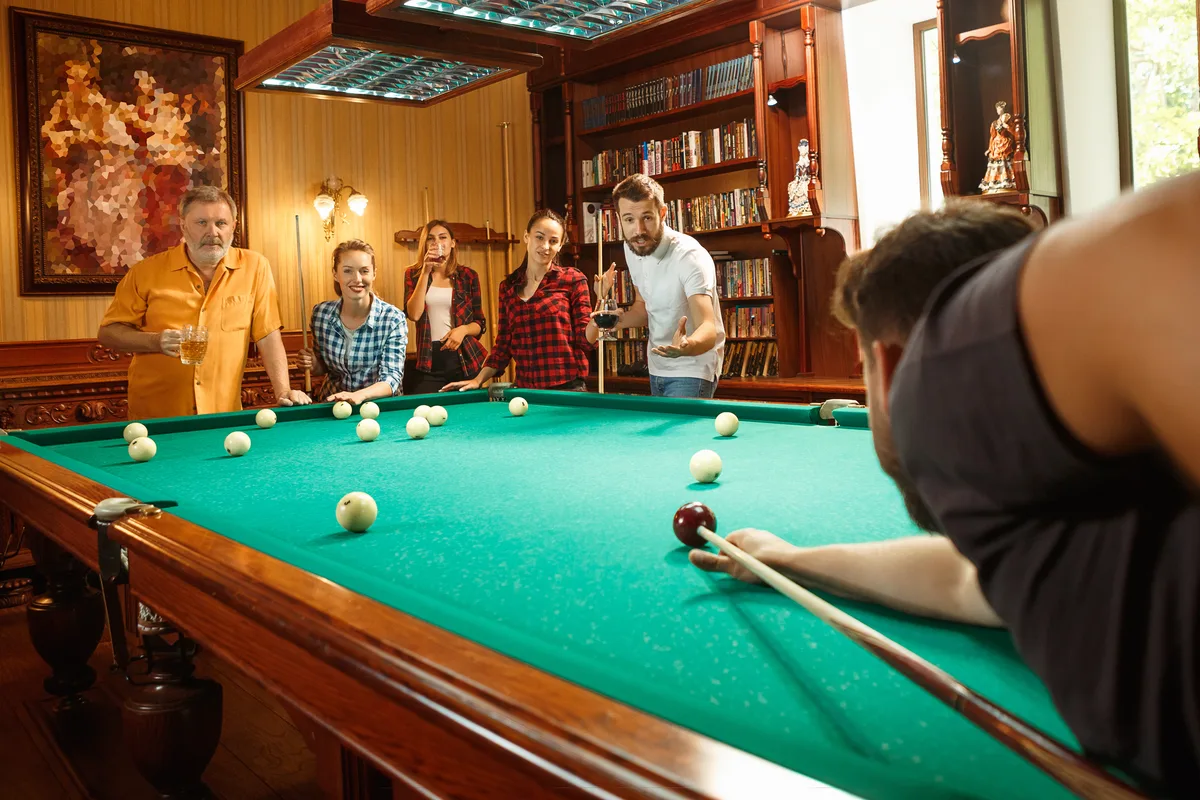
Unless you’ve seen a pool table assembled or re-felted, how the felt is held down stays a bit of a mystery. You can’t tell by looking at a finished table. The surface under the cloth is so smooth that nothing seems to be holding it in place.
Yes, pool table felt is often glued down, though that’s not the only method. Staples are also common, and which one you’ll find comes down to how the table is built. The glue isn’t the kind you keep around the house either; it’s a specialized adhesive made to bond cloth at the edges without bleeding through to the playing surface.
Staples vs Glue
When people do glue felt down, two adhesives come up most often: 3M Super 77 and 3M Scotch-Weld. Super 77 is a spray adhesive, while Scotch-Weld goes on with a brush or a roller. Both are also designed to work on cardboard, plastic, metal, and wood. Neither solidifies for several minutes, so if you misplace the felt, you can reposition it before the glue dries.
Both are permanent glue, though, so a mistake you don’t catch until the adhesive sets can be a costly one.
Both glue and staples secure pool table cloth to a table. Which one is better comes down mostly to how the table is built, which is what the next section covers.
Re-Felting
Most pool table manufacturers use staples if the table has a wooden backing under the slate, as is often the case. Some tables don’t have that wood backing, which makes staples impossible to use on the hard slate surface.
Both staples and glue get the job done, but many people prefer glue these days because it provides uniform adhesion all along the felt, whereas staples only provide pressure at intervals. The assumption is that glue holds the felt tight for longer, while staples can let the felt loosen slightly and affect play. For casual players, either option is likely fine. What matters more than the fastener is the quality of the cloth itself, which our pool table felt guide breaks down by grade and color.
Staples also put more holes in the wood backing underneath the table, which can make future re-felting difficult. For this reason, many people use glue even when the manufacturer used staples, though it would take many re-feltings for this to affect the pool table in any significant way.
How Felt is Glued Down
For those who have tables with no wood underneath the slate, their only real option is to use glue when re-felting.
While you may think that glue is used on every part of the felt to glue it to the table, this is not quite true. In fact, the cloth over the playing surface doesn’t typically have any glue on its underside.
When applied properly, the glue only touches the felt at the edges of the table. These parts are then covered by the rails, so when you actually play pool on the table, the balls don’t encounter any places where glue has been used. The reason for this is twofold:
- The table cloth needs to be stretched tight during installation. Gluing only the edges allows the installer to properly stretch the cloth tight over the playing surface.
- Second, the cloth doesn’t actually need to be glued down on the playing surface itself. Doing so would only make changing the cloth in the future more difficult.
Re-felting MDF Tables
Generally, by the time an MDF table needs to be re-clothed, it’s better to replace it with a new budget table. Since they are so cheap, the cost of getting the table re-clothed is only slightly less than the cost of a new table. And MDF tables have a shorter lifespan than slate tables.
So, if you are considering an MDF table, or you have one you want re-felted, check to see if it’s possible by inquiring with the manufacturer or a professional pool table service company. If an MDF table can be re-felted, it’s likely that you can use either glue or staples, depending on the type of table.
As a rule of thumb, it’s best to use whichever technique the manufacturer used to felt the table in the first place.
What to Use When You Re-Felt
If you’re re-felting, match whatever the manufacturer used the first time. Slate tables with a wood backing take staples easily, while tables with no wood under the slate need glue. A lot of people switch to glue regardless, because it tensions the cloth more evenly and leaves the wood intact for the next re-felt. Either way, the adhesive only grips the cloth at the edges under the rails, never across the playing bed, so your balls never roll over a glued seam.
Worth checking out: If you need replacement felt, take a look at the Championship Saturn II Billiard Felt on Amazon.
FAQ
Is pool table felt glued down or stapled?
Both. Pool table felt is often glued down, but staples are also common, especially on slate tables that have a wood backing. Tables with no wood under the slate have to be glued. Either way, the adhesive or staples only fasten the cloth at the edges under the rails, never across the playing surface.
What kind of glue is used on pool table felt?
A spray or brush adhesive made for the job, such as 3M Super 77 or 3M Scotch-Weld. Regular household glue won’t hold up. The adhesive goes on at the edges only, so it bonds the cloth under the rails without affecting how the balls roll.
Can you re-felt a table that was stapled?
Yes. Many people switch to glue even when the manufacturer used staples, because staples leave holes in the wood backing that make future re-felting harder. Glue also holds the cloth under more even tension.
Related Articles
For more on this topic, check out pool table felt guide, best felt color, how long felt lasts, refelting costs, and ironing pool table felt.
Browse our full Pool Tables hub for tested picks, buying guides, and head-to-heads.