
Most pool advice online boils down to “practice more.” That’s not wrong, but it’s useless. It’s like telling someone who wants to cook better to “spend more time in the kitchen.” Without structure, you’ll just reinforce bad habits for more hours.
Here’s what actually moves the needle, in the order it matters.
Fix Your Stance Before Anything Else
Your stance is the platform for everything. If it’s wrong, nothing else works consistently.
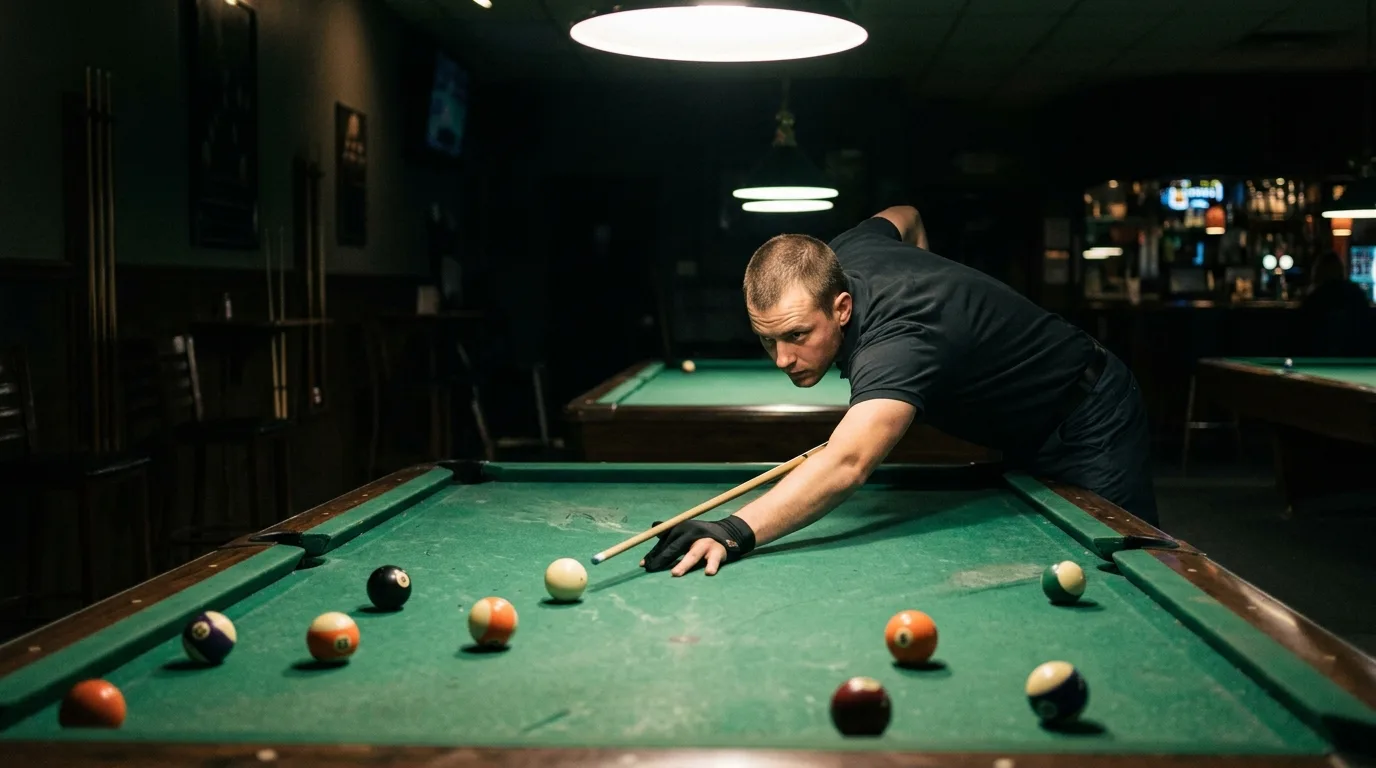
Stand with your dominant foot forward, roughly shoulder-width apart, with about 60% of your weight on your front foot. Your chin should be directly over the cue, close enough that you’re sighting down the shaft like a rifle barrel. Most beginners stand too upright. Get lower. Your chin should be 6-8 inches above the cue, not 12-15 inches.
The test: if someone pushed your shoulder sideways during your stance, would you stumble? If yes, widen your base and redistribute weight until you’re stable. Pros can maintain their stance under any pressure because it’s physically solid, not just comfortable.
One thing nobody tells you: your stance will feel uncomfortable when it’s correct, at least for the first week. If you’ve been standing wrong for months, correct form feels weird. Trust the mechanics and give it 10 sessions before you adjust.
Your Bridge Hand Is Probably the Problem
The bridge (your front hand that guides the cue) controls accuracy more than your stroke does. A shaky bridge makes every shot a guess.
For a closed bridge: loop your index finger around the shaft, press your thumb against your middle finger, and flatten your other three fingers on the cloth. The cue should slide through the loop with zero wobble. If the shaft moves up and down or side to side in your bridge, the loop is too loose.
For an open bridge: spread your fingers on the cloth, raise your knuckles slightly, and rest the cue in the V between your thumb and index finger. This is easier for beginners but less precise for shots requiring spin.
The rule: use a closed bridge whenever possible. Open bridge only for shots where the cue ball is near a rail or you need to raise the cue butt. Read our full guide on how to hold a pool cue for detailed positioning.
Your bridge hand should be 6-8 inches from the cue ball. Too close (under 4 inches) and the cue wobbles because there’s not enough shaft to stabilize. Too far (over 10 inches) and you lose control over the tip placement. Measure it with your hand a few times until 7 inches feels automatic.
The Stroke Drill That Fixes Everything
Set up a straight-in shot: cue ball directly behind the object ball, both lined up with a corner pocket, about 2 feet of distance between them. Make 10 in a row. Not 10 total. 10 consecutive.
If you miss, start over at zero.
This drill is brutal and boring. It’s also the single most effective practice exercise in pool. Here’s why: a straight-in shot removes every variable except your stroke. There’s no cut angle to calculate, no english to apply, no position to worry about. If you miss, your stroke is crooked. Period.
Most beginners can make 3-4 in a row before missing. Intermediate players make 7-8. If you can consistently make 10, your stroke is mechanically sound and you’re ready to work on position play.
Once you can hit 10 from 2 feet, move the object ball to 3 feet. Then 4 feet. Then 5 feet. The distance at which you can no longer make 10 in a row is your current skill ceiling for straight stroke accuracy.
Learn Stop Shots Before Learn Spin
A stop shot is a center-ball hit at medium speed where the cue ball stops dead after contacting the object ball. It’s the foundation of cue ball control because it proves you can hit exact center on the cue ball.
Set up the same straight-in shot as the drill above. Hit the cue ball with a smooth, level stroke, aiming at the exact center of the cue ball. If your stroke is straight and your hit is center, the cue ball will slide forward, contact the object ball, and stop within an inch of where contact was made.
If the cue ball rolls forward after contact, you hit above center. If it draws back, you hit below center. If it drifts sideways, your stroke is crooked. The stop shot tells you exactly what’s wrong with your mechanics in real time.
Practice stop shots from 1 foot, 2 feet, 3 feet, and so on. At longer distances, you’ll need a firmer stroke to keep the cue ball sliding (rather than rolling) by the time it reaches the object ball. Speed control on stop shots translates directly to every other type of position play.
Position Play: Think One Ball Ahead
Once your stroke is consistent and you can stop the cue ball at will, start thinking about where the cue ball goes after each shot.
Start simple: after pocketing a ball, try to leave the cue ball within one diamond of where you want it for the next shot. Don’t try to land on exact spots. Just get close. “Close” with the right angle is far more useful than “exact” with the wrong angle.
The 90-degree rule is the first position concept to internalize: on a cut shot with no spin, the cue ball travels approximately 90 degrees from the line between the object ball and the pocket. This means you can predict where the cue ball goes by drawing a perpendicular line at the contact point. Knowing this one rule lets you plan position on 70% of shots without any english.
Draw and follow are the next tools. Draw (hitting below center) pulls the cue ball back after contact. Follow (hitting above center) pushes it forward. Together with the 90-degree rule, these three concepts cover 90% of position play below the advanced level.
Practice Routine That Works
Structure beats quantity. A focused 45-minute session beats 2 hours of random shooting. Here’s a framework:
Spend the first 15 minutes on straight-in shots. This is your warm-up and your diagnostic. If you can’t make your usual consecutive count, something is off mechanically. Fix it before moving on.
Spend 15 minutes on a specific skill drill. Pick one: stop shots at increasing distance, the L-drill for cut shot angles, or the 3-ball position drill (pocket three balls in sequence while controlling cue ball position for each next shot).
Spend the last 15 minutes playing a game against yourself. Rack a full game of 8-ball or 9-ball and try to run the table. Keep score. Track how many balls you pocket before missing. Your average will climb over weeks and months.
Record your numbers. Write down your straight-in streak, your drill completion rate, and your run-out averages. You won’t notice daily improvement. You will notice monthly improvement if you track it.
The Equipment Checklist
Bad equipment creates bad habits. If your cue is warped, your stroke adapts to the warp and becomes crooked on a straight cue. If your tip is bald, you’ll unconsciously avoid english shots. Get the basics right:
Your cue should be straight. Roll it on a flat table and watch the tip end. If it wobbles, the shaft is warped. Replace the shaft or buy a new cue.
Your tip should be shaped and scuffed. A flat, glazed tip slips on the cue ball. A properly shaped tip (dime radius) with light scuffing holds chalk and grips the ball on contact. Check your tip every few sessions.
Your table should be level. An unlevel table teaches you wrong angles. Put a ball in the center and see if it drifts. If it does, level the table before practicing. Learn about proper table maintenance to keep the surface consistent.
Good lighting matters. If you can’t see the contact point clearly on the object ball, your aiming suffers. A proper pool table light makes every shot easier to read.
The Mistakes That Keep Players Stuck
Practicing only their strengths. If you always shoot the shots you’re good at, you stay good at those shots and bad at everything else. Spend 50% of practice time on shots you miss.
Ignoring speed control. Pocketing balls is half the game. The other half is how fast the cue ball travels after contact. Most missed position plays are speed errors, not angle errors. Practice the same shot at three different speeds and watch how differently the cue ball behaves.
Playing only competitive games. Competition is fun but it doesn’t develop skills efficiently because you only shoot the balls the layout gives you. Drills let you practice specific weaknesses repeatedly. Play games 30% of the time, drill 70%.
Watching without analyzing. YouTube is full of pool instruction, and watching Shane Van Boening run a rack is entertaining. But watching isn’t practicing. If you watch a tutorial, immediately go to a table and try the technique 20 times. Watching without doing is just entertainment with extra steps.
Blaming equipment prematurely. Yes, a good cue helps. No, it won’t fix a fundamentally flawed stroke. If you’re missing straight-in shots from 3 feet, the cue isn’t the problem. Fix your mechanics first. Upgrade your gear when your skills have outgrown your equipment, not before.
The Bottom Line
Get your stance right. Get your bridge solid. Make 10 straight-in shots in a row. Everything after that is built on those three things. Skip them and you’ll plateau forever. Nail them and the rest of the game opens up faster than you expect.
Pool isn’t complicated. It’s a physics game played on a rectangle with 6 holes. The ball goes where the cue ball sends it, and the cue ball goes where your stroke sends it. Make your stroke consistent and the game gets simple.
Check out our top-rated gear picks — selected and reviewed by billiards enthusiasts.