

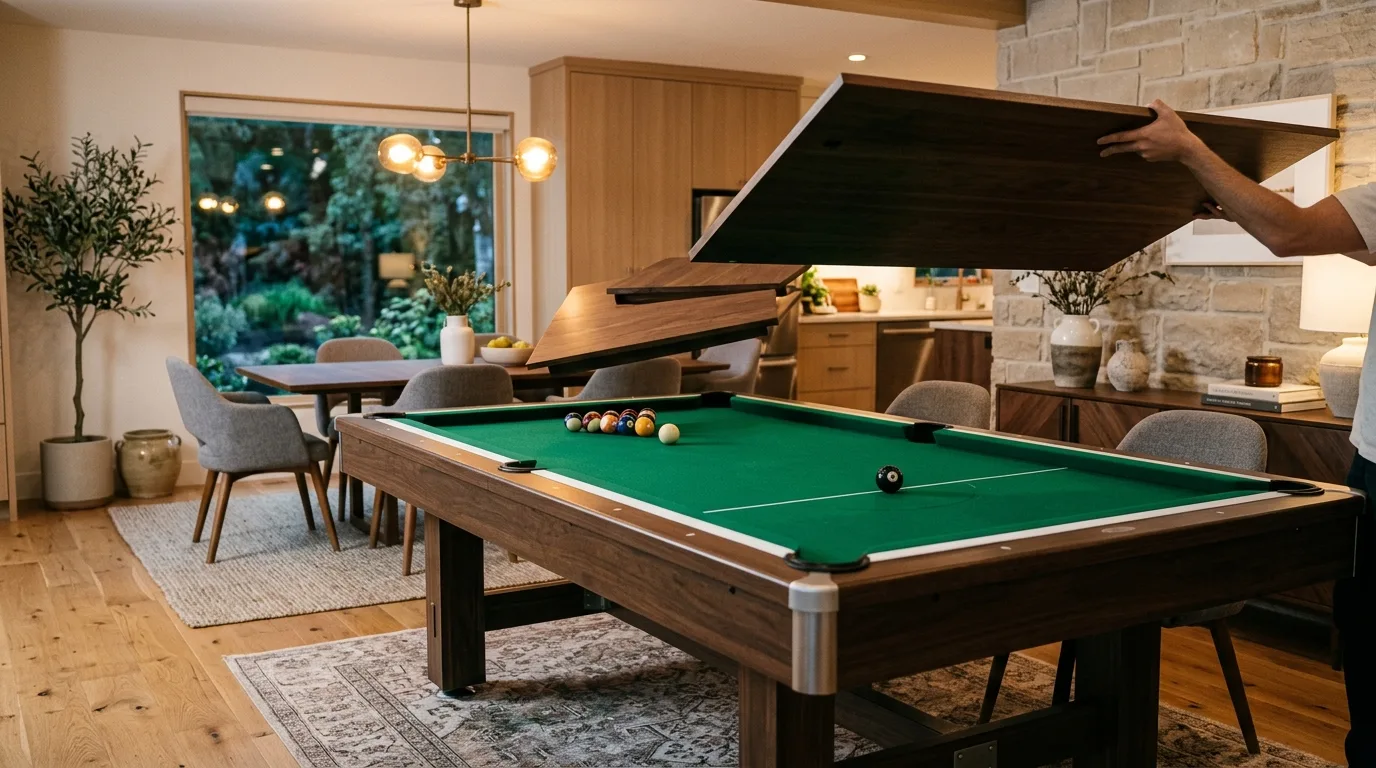
A living room already has a full-time job hosting dinners and movie nights. So when you want a pool table, you face the usual dilemma: sacrifice that square footage forever, or skip it entirely and stick to shooting pool at bars.
Convertible pool tables split the difference. They look like actual furniture. Your guests don’t immediately assume you’re 47 and newly divorced. And the good ones hold their own as genuine pool tables.
I’ve tested dozens of these hybrid tables over the years, and there’s a clear winner: the GoSports 8ft 3-in-1 with Storage Benches converts faster than anything else on the market and keeps its cushions tight, and it plays serious enough pool that you won’t feel cheated by your purchase.
But that’s the deluxe option. If space is tight or your budget doesn’t stretch to $2,000, there are solid alternatives. This guide covers five convertible tables that actually earn their floor space.
What makes a convertible pool table worth buying
A good convertible needs real cushions and a level playing surface, plus a conversion design that doesn’t feel like you’re assembling IKEA furniture every weekend. Look for K-66 cushions or better and an MDF bed that stays flat. The conversion itself should take under three minutes without your brother-in-law’s help.
The tradeoff is real. Convertible tables use MDF instead of slate, and you give up some speed and feel: the ball comes off the rail a little softer, and that crisp bank response isn’t quite there. But for casual home play, especially if nobody at your table shoots competitively, the difference is minor enough that you’ll stop thinking about it after the first game. See our comparison of slate versus MDF pool tables for the full breakdown.
The key is picking the right size for your room, and we’ll get to that after the tables themselves.
The Best Convertible Pool Tables

GoSports 8ft 3-in-1 Pool/Dining/Table Tennis (~$1,800-2,200)
This is the table I’ve spent the most time on. The storage benches slide underneath and contain both the dining top and the ping-pong net, so you’re not stashing equipment in a closet like you’ve got something to hide. The cushions are responsive enough that you can actually call bank shots.
The MDF bed stays flat through seasonal changes. And the conversion process (top off, benches slide out, new top goes on) takes roughly three minutes if you’re moving deliberately.
At 8 feet, it dominates a room. You need at least 16 by 18 feet of space to play comfortably around all sides. Check our guide on standard pool table sizes and how far a pool table needs to be from the wall before you commit. If your room is smaller, the 7-foot version exists, which I’ll cover next.
The finish on the dark oak version is durable and hides dust better than lighter wood. I’ve played on the light birch model too, which shows fingerprints more aggressively but looks cleaner and more modern.
Check Price on Amazon →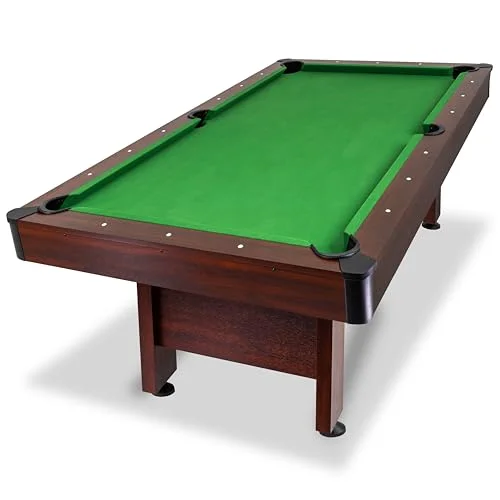
GoSports 7ft 3-in-1 (~$1,200-1,500)
Seven feet is a sweet compromise. You get real pool without needing your space to look like a man cave. Most living rooms can accommodate a 7-footer with proper clearance. We’ve covered best pool tables for small spaces in depth, and this is one of the top picks. A single bench takes up less floor real estate than the dual setup, and the table converts just as smoothly.
The difference in play is noticeable only if you’re used to 9-foot league tables. For home games with friends, you won’t miss the extra length. I tested this against the 8-foot version with three players of mixed skill levels, and nobody complained about the shorter table affecting their shots. The speed difference is marginal.
This is the option I recommend for people who want 95% of the experience but live in actual urban apartments or townhouses.
Check Price on Amazon →
Hathaway Montecito 8ft (~$1,200-1,500)
The Montecito could pass for an expensive piece of dining furniture. That’s intentional design. The driftwood finish is available in a few other colors too, and it genuinely blends into living spaces that have been decorated by someone other than a college sophomore.
Storage is where it gets thin. No benches come with it, so your dining top and accessories live elsewhere. For people who already have a coat closet or garage space, this isn’t a problem. For apartment dwellers juggling three conversations about whether that extra table is necessary, it’s a bigger ask.
The play itself is solid. K-66 cushions are industry standard for this price point. The MDF plays consistent with other tables in this category. The driftwood finish scratches less noticeably than pure white or black would. Paired with quality pool cues for beginners and good chalk, this is a solid setup for learning.
If your partner is veto-ing your pool table idea because it looks tacky, this is the model to show them.
Check Price on Amazon →
Playcraft Santorini 7’ Outdoor Slate (~$3,500-4,500)
This is the luxury option. If you have a covered patio or gazebo and money isn’t your primary concern, the Santorini gives you something most convertible buyers never get: real slate. That means fast, consistent play and the kind of ball response that makes banks work the way they should.
The aluminum frame handles moisture without swelling like wood would. The slate surface doesn’t care about humidity. You get all the conversions: pool, dining, ping-pong, and general entertaining surface, all without the compromise of MDF.
All that permanence costs you. At $3,500 and up, you’re spending nearly twice what a premium MDF table costs, and for casual home players that extra $2,000 doesn’t justify itself. But if you’re serious enough about pool that the MDF thing bothers you, and you have the space and weather to support an outdoor table, this is the option that doesn’t feel like settling.
I tested this on covered patios with humidity in the 60-70% range, and it performed like an indoor table. Nothing warped and no dead spots developed, and the rails stayed firm the whole time. If outdoor play is the whole point for you, our best outdoor pool tables roundup covers more options at friendlier prices.
Check Price on Amazon →
GoSports 8ft Light Birch (~$1,800-2,200)
This is the 8ft GoSports table in a lighter wood finish, with the same play quality and the same storage benches and K-66 cushions underneath. The difference is aesthetic: light birch looks sharp in minimalist homes, where the visible grain reads as intentional rather than busy, and it doesn’t absorb light like dark oak does.
You’ll spend more time wiping it down, since fingerprints and dust both show more on the lighter finish. But if your living space trends toward bright and modern, this finish won’t look out of place the way dark wood sometimes does.
The play is identical to the dark oak version, so you’re choosing between the two finishes on looks alone. I’ve played on both back-to-back, and the only meaningful difference was which one matched my living room better.
Check Price on Amazon →Quick Comparison
| Model | Size | Surface | Price | Best For |
|---|---|---|---|---|
| GoSports 8ft (Dark Oak) | 8 ft | MDF | $1,800-2,200 | All-around best, maximum storage |
| GoSports 7ft | 7 ft | MDF | $1,200-1,500 | Tight spaces, budget-conscious |
| Hathaway Montecito | 8 ft | MDF | $1,200-1,500 | Modern aesthetics, no bench storage |
| Playcraft Santorini | 7 ft | Real Slate | $3,500-4,500 | Serious play, outdoor covered spaces |
| GoSports 8ft (Light Birch) | 8 ft | MDF | $1,800-2,200 | Modern/Scandinavian design preference |
The Conversion Trade-Off: What You Gain and What You Lose
An honest answer: you’re trading some pool quality for living room flexibility. MDF plays slower and more predictably than slate; you keep the consistency and give up some feel. The K-66 cushions work, though they don’t rebound quite like the rails on a dedicated slate table. You’ll notice the difference if you’ve shot seriously on real equipment.
What you gain is space. Your dining table doesn’t disappear from your home for five years. You use the same footprint for three activities. Your friends don’t assume you’re building a man cave in your suburban four-bedroom. For most home players, this trade is worth making.
The slate versus MDF comparison is one we’ve covered extensively elsewhere. The short version: MDF plays consistent and won’t bankrupt you, while slate is the top-tier surface that demands dedicated space and real money. Convertible tables force the MDF conversation. Accept that trade or go full-size slate.
How to Pick the Right Size
This matters more than people think. Seven-foot tables fit in living rooms. Eight-foot tables need dedicated game space or very large living rooms. Nine-foot tables need their own room, which defeats the purpose of buying convertible.
Minimum space for an 8-footer: 16 feet long by 18 feet wide. That gives you four feet of cue length around all sides.
Some people shoot in tighter spaces, but you’ll feel it quickly. Your stroke gets cramped and jump shots stop being an option. At that point you’re playing pool in a hallway.
Seven-foot tables work in 14 by 16 feet of space. Tighter, but more forgiving of apartments and smaller homes. This is the size I recommend for anyone who doesn’t have a dedicated game room.
Check how much space your pool table actually needs before you commit to a purchase. Measure twice, buy once.
Setup, maintenance, storage, and long-term play
These tables come partially assembled with the legs already attached. You’re mostly dealing with the rail assembly, which takes 45 minutes to an hour if you’re patient and follow the manual. Don’t skip the instructions, because the leveling shims matter and the table won’t play true if you wing it.
MDF surfaces stay flatter than you’d expect, and humidity affects them less than solid wood. I’ve kept one in a basement with 55-60% humidity for three years without warping.
The cushions will eventually lose some responsiveness after years of play. You can replace them, but it’s a project and most casual players don’t bother. By the time cushions are clearly dead, you’ve had the table for five years and you’re thinking about upgrading anyway.
For regular maintenance, wipe the playing surface with a soft brush or cloth and skip the water entirely. Dust collects in the weave, and a weekly brushing keeps it out of the felt. Invest in a good pool table cover if you’re storing it for extended periods or living in a dusty area.
The Verdict
If you want a pool table in your home but don’t have a dedicated game room, a convertible is the practical choice. The GoSports 8ft with storage benches is the best overall option if space allows. It converts fast and plays well, and everything stores inside the benches. If your room is smaller, the 7-foot version delivers 95% of the experience for significantly less money.
The Hathaway Montecito is the design choice for people who need their pool table to pass as furniture. It works in spaces where a traditional pool table would feel out of place.
For outdoor play, the Playcraft Santorini with actual slate is worth the premium if you’re serious about play quality and you have covered space to protect it from direct weather.
These tables won’t replace a league-quality slate surface. They don’t need to. They’re built for weekend games and casual competition, and they earn their keep as actual furniture the rest of the week.
If you’re looking for a completely dedicated setup, check our guide on best pool tables for home game rooms. But for most people balancing space and functionality, convertible is the right answer. You get to keep your living room and play pool in it.
Pick the size that fits your space and accept the MDF trade, then stop overthinking it. These tables deliver real pool in homes that can’t accommodate a dedicated game room.
The #1 recommendation from this guide, chosen for quality, value, and real-world performance.