

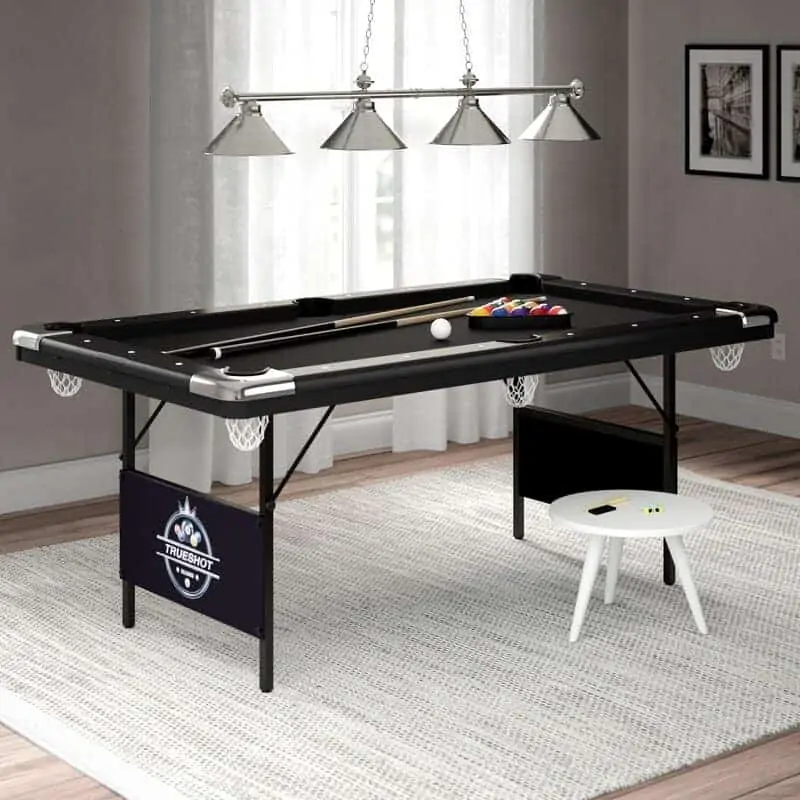
You’re measuring your apartment floor with your hands like an idiot, thinking “yeah, a pool table would fit.” In a small space it almost certainly won’t, at least not the way you’re picturing it.
Everyone runs into the same problem: pool tables need way more room than you expect. The table itself might squeeze in, but that’s a long way from being able to shoot at it. You need room to pull a cue back for a full stroke, and room for two people to move around without constantly bumping into each other.
The answer is usually no. The good news is that there are real options if you know what you’re looking for and you’re honest about your space.
The Real Space Math (Don’t Skip This)
The space math comes down to one rule: the room has to fit the stroke, and the stroke needs roughly a cue’s length of clearance behind every rail.
6-foot table: Needs at least 12 feet by 15 feet of open floor space. The table itself is only 6 feet long by 3 feet wide, but center it in a 12x15 room and you get about four and a half feet between each rail and the wall. A standard cue runs 58 inches, so you’re a few inches short whenever a shot lines up dead into the wall. You can play in 12x15, but it’s the absolute minimum, the kind of room where a short cue lives in the corner for emergencies.
Aim for 14x17 if you want a full-length stroke from every position.
7-foot table: Jump to 13 by 16 feet minimum. You’re looking at bar-box dimensions now, since 7-footers are what most bars and amateur leagues run. It’s worth it if you have the space, and miserable if you don’t.
What most people get wrong: They measure the table, see it fits, then realize mid-shot that they can’t get a full stroke in. Suddenly they’re contorted against a wall, reaching for a stubby jump cue just to make the shot.
Be honest with the tape measure. If your room barely meets the minimums, you’ve already got a problem. Buy a smaller table than you think you need.
How to Actually Measure Your Space
Stop eyeballing it. Get a tape measure.
Measure the length and width of your actual usable floor space. Account for furniture, closet doors that open, radiators, anything solid. Exclude those from your measurements.
Mark out the table dimensions on your floor with painter’s tape. The table takes up its footprint, but now walk around it with an imaginary cue in your hands. Check whether you can shoot from every position, and whether you can stand on the short end and draw the cue back fully.
This takes five minutes. It saves you from a $400 mistake.
The Best Small-Space Pool Tables (Real Recommendations)
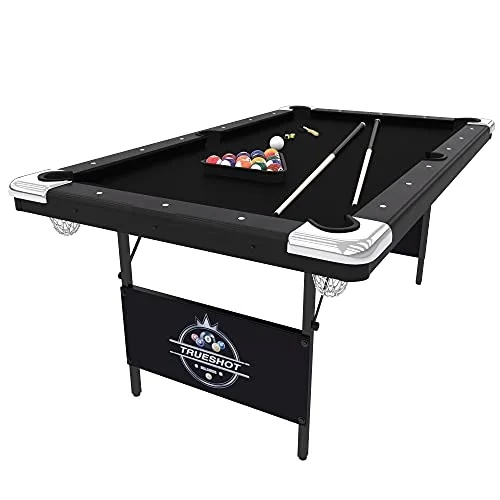
Fat Cat Trueshot 6-Foot (~$300-400)
Perfect for 12x15 spaces, since folding legs let you tuck it against a wall when not playing. Composite slate plays fine for casual use, and it comes with everything you need. For casual apartment play, it holds up.
Check Price on Amazon →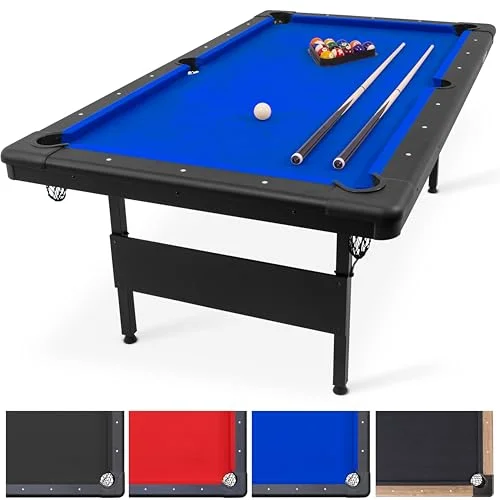
GoSports Mid-Size 6-Foot (~$250-350)
Great budget play without the brand-name markup. The folding mechanism is smooth, unlike many fold-leg tables that are nightmares to set up. Playable felt and composite slate, no drama for $250-350.
Check Price on Amazon →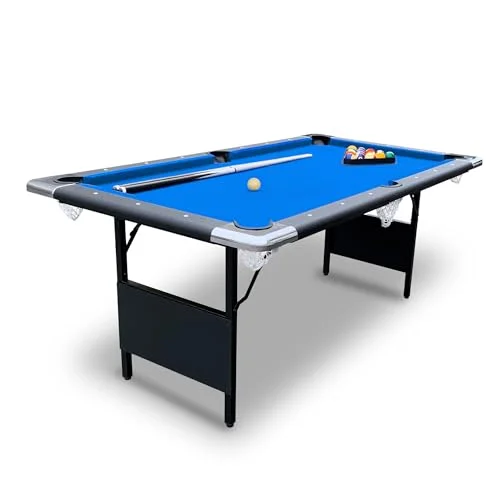
Hathaway Fairmont 6-Foot (~$350-500)
The quality jump from budget models is immediate: better felt on a more substantial frame, with legs that don’t wobble. Shots play more true, and the felt slides smoothly for running tables. It still folds for small spaces, though the sturdier frame makes it heavier to fold away than the budget options. The $350-500 price is the fair cost of that quality bump.
Check Price on Amazon →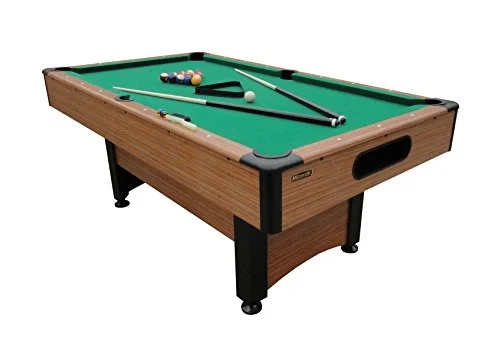
Mizerak Dynasty 6.5-Foot (~$850-900)
This is where serious practice begins. The Dynasty is the most battle-tested table in its class, with over 1,075 Amazon reviews holding a steady 4.0 rating. The automatic ball return keeps games moving, and leg levelers handle the uneven floors most apartments hide. At 6.5 feet, you fit it in 12.5x15.5 feet without the space demand of a full 7-footer.
The trade-off is permanence. No folding legs here, so it owns its footprint around the clock.
Check Price on Amazon →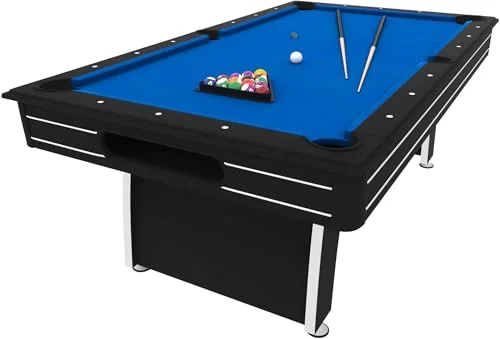
Fat Cat Reno 7.5-Foot (~$800-1,100)
Only if you’ve actually confirmed the room with a tape measure: at 7.5 feet it needs more floor than a 7-footer’s 12’11” x 16’2”. The slate-composite bed is a real step above MDF, and the bigger playfield means your game actually improves instead of giving you excuses about the table. It’s worth the $800-1,100 only when the room cooperates; don’t force it into a space that fails the tape-measure test.
Check Price on Amazon →The Short Cue Workaround (And Why It’s Limited)
Standard cues are 58 inches. In tight spaces, you might see 48-inch cues mentioned as a solution.
In reality, a 48-inch cue does take up less space, but you pay for it in reach, and your stroke suffers. At best it’s a compromise you make when nothing else will fit.
If you can fit a real table and use real cues, do that instead. A 48-inch cue bandages a space problem without curing it.
Still, if your room is legitimately tiny and you’ve decided on a 6-foot table anyway, keeping a 48-inch cue around for the tightest shots is pragmatic. Just don’t expect it to play great.
What You Sacrifice in Small Spaces (And How to Accept It)
Smaller tables play differently, and that’s simply how it is.
The angles are tighter. Bank shots don’t have as much room to develop. Long draw shots are practically impossible (the table’s too short). You get more scratches per game because the cue ball’s closer to everything.
If you’re coming from a pool hall where you play on 9-footers or even 7-footers, a 6-footer will frustrate you for the first week. Then you adjust. Your game changes, and you get better at kick shots because the tighter geometry demands it.
A smaller table just plays its own game. You either embrace that or you keep hunting for space that doesn’t exist.
The other sacrifice: you can’t have a pool table and other furniture in that room. The table is the room. Choose accordingly.
Mini and Tabletop Pool Tables (Don’t Bother)
You’ll see 3-foot and 4-foot tables marketed as space solutions. They’re novelties.
The pockets are tiny and the felt is thin, with smaller balls to match. It looks like a pool table but plays like a toy. You’ll get bored in two weeks.
If your space is so small that a 6-footer truly doesn’t fit, a mini table won’t fix that. It belongs on the man-cave wall that’s been empty, when you want something there. That’s the use case.
For serious play in a small apartment, get a real 6-foot table and make the space work.
What Folding Legs Actually Buy You
The three 6-foot picks above all fold, which is useful when you need to push the table against a wall or move it occasionally. The Mizerak and the Reno don’t; they’re built to stay put.
Folding legs let you reclaim floor space when you’re not playing, and they make moving the table easier (though still not easy, since a 6-foot table with its legs folded is awkward as hell to move).
Don’t expect more than that. A folding mechanism can’t fix bad construction, and it doesn’t shrink the room you need for a full stroke. Use the fold, but judge the table.
Setup Tips for Tiny Rooms
Once you’ve bought your table, this is how to actually live with it in a small space.
Angle it intelligently. In most apartments, one corner is dead space (a radiator or an awkward alcove). Put a corner of the table there. You reclaim wall space.
Lighting matters more than you think. A pool table in a dark room plays worse. A proper overhead light is cheaper than upgrading the table. Go to Home Depot and buy a cheap-ish shop light; hanging it is a one-afternoon job.
Cue storage: A wall-mounted cue rack takes up less space than a standing one. Measure first, but they’re not expensive.
Shoe policy: No shoes on the felt, seriously. It matters more in small rooms because you’re tracking dust with every movement.
The brush is your friend. Brush the felt before play. Brush it after. You’ll extend the felt’s life and the table will play faster and truer.
Final Call
A 6-foot pool table in a 12x15 foot apartment is viable. It’s snug, and a few wall-facing shots will want the short cue, but it works.
A 7-footer is worth the upgrade if you have 13x16+ feet and you’re serious about the game. It plays so much better that the space investment pays for itself in how much you’ll actually use it.
Budget tables like the Fat Cat Trueshot and GoSports are honest products at honest prices. They get you playing, and they hold up well enough for what they cost.
If you’re going to spend more, step up to the Hathaway or the Mizerak. The playability is worth the extra money.
Stop shopping for space solutions and start measuring your actual space. Build from there. The table that fits your room is the right table, even if it’s not the size you wanted.
Quick Comparison
| Table | Price | Size | Folds? | Best For |
|---|---|---|---|---|
| Fat Cat Trueshot | ~$300-400 | 6 ft | Yes | Budget option |
| GoSports Mid-Size | ~$250-350 | 6 ft | Yes | Compact spaces |
| Hathaway Fairmont | ~$350-500 | 6 ft | Yes | Quality jump |
| Mizerak Dynasty | ~$850-900 | 6.5 ft | No | Practice table |
| Fat Cat Reno | ~$800-1,100 | 7.5 ft | No | Full-size play |
FAQ
Q: How much space do I actually need for a 6-foot pool table?
A: A 6-foot table needs a minimum room size of about 12 feet by 15 feet. That’s the absolute minimum with short cues. If you have that exact space, movement will be tight. Ideally, aim for 14x17 feet for comfortable play.
Q: Can I use a 7-foot table in a small space?
A: Only if you have at least 13x16 feet of open floor space. Most people underestimate how much room a 7-footer needs. Test it out first by marking the table dimensions on your floor with tape.
Q: What’s the deal with 48-inch cues for small rooms?
A: Standard cues are 58 inches. A 48-inch cue gives you about 10 inches less to work with, which matters when you’re close to a wall. You sacrifice some control and reach, but it works if space is truly limited.
Q: Are folding-leg pool tables actually good?
A: Folding legs are practical for tight spaces where you need to move the table occasionally. Judge the table first and the fold second, because a mediocre table with folding legs is still a mediocre table.
Q: Should I just buy a mini pool table instead?
A: Not if you want an actual game. Mini tables (3 or 4 feet) are novelties. They’re fun to have around, but with tiny pockets and rough felt they’re frustrating to actually play on. Get a real 6-footer and make the space work.
Related Articles
For more on this topic, check out pool table reviews, standard pool table sizes, how heavy slate pool tables are, how long pool tables last, and pool table room clearance.
The #1 recommendation from this guide, chosen for quality, value, and real-world performance.