

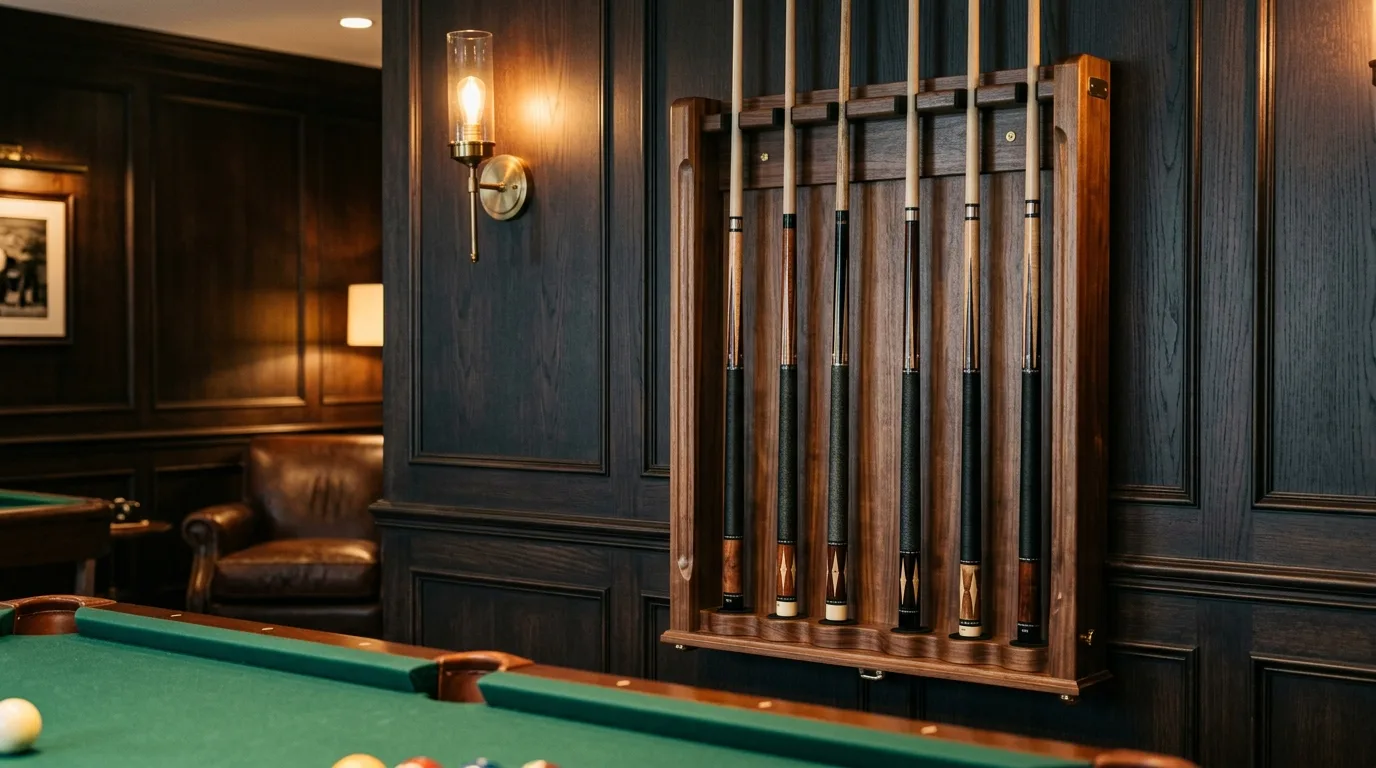
I’ve owned way too many pool cues over the years. At one point I had nine quality sticks scattered across my apartment, leaning in corners and stacked in a closet, basically a tripping hazard everywhere I walked. That’s when I realized I genuinely needed a decent cue rack. I grabbed an EXTCCT Floor Stand and within weeks, I could see my apartment again, with my cues kept straight and no longer getting dinged up from falling over.
After years of trying different storage solutions, I’ve learned that not all cue racks are created equal. Some destroy your cues, and others look nice but can’t hold anything. The best ones combine functionality with actual protection. This guide walks you through exactly what separates a good rack from a waste of money.
Wall mount vs floor stand: which is better
Wall mounts save space in smaller rooms and hold 4-6 cues; floor stands accommodate 8-9 cues and work better for serious players with limited wall space.
Think about your actual living situation, because I’ve tested both and the answer depends on the room. Wall mounts are genuinely perfect if you’re renting or live in a smaller place. They disappear against the wall so completely that nobody walking in notices them, and you get 4-6 cues stored vertically in maybe a foot of wall space.
The limit is capacity, since you can only fit so many. Installation matters too: skimp on the anchors or pick a bad spot and your cues could end up on the floor.
Floor stands work the opposite way. You need space, sure, but you get real capacity and flexibility in return. Nine cues standing there look sharp, with extra room for balls and chalk and no wall drilling required. I’ve moved mine around rooms multiple times without any hassle. The trade-off is they take up actual floor space.
These days I run a floor stand and haven’t looked back. But I know plenty of players in small apartments who swear by a wall mount. Honestly, your space dictates this choice more than anything else.
The racks

EXTCCT Floor Stand (9-Cue, Oak) (~$80-120)
The EXTCCT hits that perfect spot between affordable and genuinely well-made. You get solid oak that won’t warp on you and nine slots with proper spacing between them, plus dedicated storage below for your balls, rack, chalk, and spare accessories. No assembly headaches either. I’ve recommended this exact model to five people at my local pool hall, and every single one came back asking where I found it.
The construction quality is obvious the moment it arrives. It’s solid wood with a clean finish, built to sit in a game room for years without falling apart. The cue slots are wide enough to accommodate different shaft thicknesses without forcing cues in or out. I tested it with everything from basic house cues to my nicer custom shafts. Everything fits properly.
Storage capacity is substantial. Nine cues take up most of the stand, but you’ve still got room for your triangle, bridge, a good chunk of chalk, and spare tips if you keep them around. I store six cues actively and keep three specialty cues in the lower storage. It’s all accessible without removing other cues first.
Floor space is the thing to check before you order. This stand has a footprint of about 18 inches by 18 inches, and it needs a dedicated spot. If you’re tight on room, a wall mount makes more sense. For everyone else, this deserves serious consideration.
Check Price on Amazon →
GACCO Freestanding (8-Cue, Mahogany) (~$70-100)
GACCO’s mahogany stand is the rack I’d recommend if budget matters. It costs real money, but it’s genuinely well-made, and you can feel where the money went. Mahogany looks great and resists warping, with that classic billiards-room aesthetic. Cues you actually care about deserve this kind of storage.
Eight cues is perfect for players who have a main lineup without going overboard. I’ve used this model during testing, and the build quality surprised me for the price point. The wood is finished nicely and the slots are cut to sensible sizes. Nothing about it feels like a shortcut. Mahogany develops character over time, aging beautifully in game rooms.
The footprint is slightly smaller than the EXTCCT, making it viable in more room configurations. If you’re weighing floor stands and budget is a real constraint, this is where I’d spend the money. Construction quality holds up all the way down the price gap; the only thing you give up is the ninth slot. Same trade-off as any floor stand though: it claims its corner of the room permanently, so make sure you have one to give.
Check Price on Amazon →
Flintar 6-Cue Wall Mount (~$25-40)
I tested the Flintar in my brother’s apartment, where space was tight and he had maybe two feet of available wall space in his game area. It was perfect for that spot: six cues mounted vertically on hardwood that upgrades the wall it hangs on. His game area went from cluttered to organized in one afternoon.
The mounting system is nothing exotic, and standard wall anchors work fine. I watched my brother install it in maybe fifteen minutes with the included hardware.
The hardwood won’t scratch or mark your cues, which matters more than people realize. I’ve seen cheap wall racks with rough edges that actually scarred expensive cues. Flintar also includes slots for your triangle and other small accessories, so you get everything you need in a couple square feet of wall.
Capacity is where it pinches: six cues is the hard ceiling, and if your collection grows past that you’re drilling more holes for a second rack. It suits apartments and dorms, anywhere floor space is already spoken for. Performance-wise, I haven’t seen any cue damage or warping issues after months of use in my brother’s place.
Check Price on Amazon →
Moyan 2-Piece Wall Clips (6-Cue) (~$15-25)
Sometimes you just need to hang your cues. Moyan’s clips do exactly that without pretense. Two separate mounting pieces hold three cues each. They’re dead simple, and a pair costs little enough that buying two isn’t really a decision.
I had these installed in my garage for a while. They take up minimal wall space and keep cues organized, holding standard sticks without slipping. Installation is a few screws per piece, and they hold. They’re plain metal clips that keep cues visible and easy to grab.
These make the most sense when you already have a wall-mounted rack and need extra capacity, or when you’re in a temporary spot and don’t want to commit to a permanent installation. Five different finishes are available, so you can match existing hardware or decor.
You give up any storage for balls or accessories, so if you need more, upgrade to the Flintar. As a cheap way to keep a handful of cues on the wall, though, they do the job.
Check Price on Amazon →
XCSOURCE 2-in-1 Wall Rack (Pine, 6 Cues + Ping Pong) (~$30-50)
Say you play both pool and table tennis. XCSOURCE solved that problem, with six cue slots on one side and paddle storage on the other, one wall mount doing double duty. I tested this in a friend’s recreation room where he had both tables.
The pine is solid. It requires a bit more humidity control than hardwood, but it’s not like it’s going to spontaneously warp. Proper room conditions keep everything stable. Pine is lighter weight, making installation easier on drywall. The combined functionality is genuinely convenient if you actually use both games.
The design is plain but tidy, and both sport sections feel like they belong. Storage capacity for cues is solid, and the paddle slots are spaced properly without touching your cues.
It earns its place in a basement or rec room that hosts more than one table game. Dedicated pool players should stick with a dedicated cue rack. Anyone bouncing between pool and ping pong, though, gets to skip buying and installing a second mount.
Check Price on Amazon →Quick comparison
| Rack | Price | Type | Capacity | Material | Best For |
|---|---|---|---|---|---|
| EXTCCT Floor Stand | $80-120 | Floor Stand | 9 cues | Solid Oak | Serious players, large collections |
| GACCO Freestanding | $70-100 | Floor Stand | 8 cues | Mahogany | Budget-conscious quality seekers |
| Flintar Wall Mount | $25-40 | Wall Mount | 6 cues | Hardwood | Apartments, limited floor space |
| Moyan Wall Clips | $15-25 | Wall Clips | 6 cues | Metal | Ultra-tight budgets, temporary use |
| XCSOURCE 2-in-1 | $30-50 | Wall Mount | 6 cues + paddles | Pine | Multi-game rooms |
Why cue storage actually matters
A proper cue rack prevents warping and finish damage by supporting cues vertically, keeping stress off the wood and humidity exposure stable.
I made mistakes early on. I stored cues horizontally in a case and left them near a basement window through winter, when I wasn’t leaning them against walls in corners. Within a year, I had warped cues that cost hundreds to replace. That’s when I learned that storage is basic maintenance you don’t get to skip.
Your cue is wood, and wood moves as temperature and humidity fluctuate, especially in basements and game rooms. A proper rack minimizes that movement by supporting the cue vertically and distributing weight evenly along its length. Horizontal storage creates pressure points that encourage warping over time, while vertical storage lets the cue breathe.
Racks also protect finishes. I’ve seen beautiful custom cues get dinged from being stacked or leaning against hard surfaces. A dedicated slot with proper spacing prevents that entirely, and the finish survives no matter how crowded the game room gets.
Climate control matters too. A quality wooden rack absorbs and releases moisture gradually, stabilizing humidity around your cues. Cheap plastic racks or metal-only solutions don’t buffer humidity changes. Your cues experience direct exposure. That’s when warping accelerates.
The investment in a solid rack pays for itself quickly. One warped premium cue costs more than a quality floor stand. I learned this the hard way. Now I’m obsessive about storage because I’ve already paid the tuition.
What to look for in a cue rack
Choose racks with solid hardwood construction, appropriate cue slots for your shafts, proper ventilation, and sufficient capacity for your collection.
Material quality is non-negotiable. Oak and mahogany are ideal: durable, stable, naturally humidity-resistant, and gentle on your cues. Pine works if you’re careful about humidity.
Avoid anything with rough edges or cheap finishes that might scratch your cues. Run your hand across potential racks before buying. A smooth surface is what you want, and any splintering is a dealbreaker.
Capacity should match your actual situation. Don’t oversell yourself. I’ve seen people buy nine-cue racks and only own five cues, which wastes space and money. Count your sticks and add two or three slots for headroom. For most players, six to eight cues covers everything.
Spacing matters more than people think. Slots should be wide enough to accommodate different shaft sizes without forcing cues in or out. My break cue has a thicker grip and my jump cue is more streamlined, and both need to fit comfortably.
What separates a break cue from your playing cue is mostly shaft thickness and tip hardness, so size your slots for the thicker one. Tight slots damage finishes, while loose ones let cues shift around every time the stand gets bumped.
Ventilation and air circulation keep humidity stable. Wall racks have natural advantages here because of air movement. Floor stands need open sides and proper spacing. Sealed backs or enclosed designs trap moisture. That’s the opposite of what you want.
For wall mounts specifically, check the mounting hardware, because good anchors matter more than the rack itself. Your rack is holding seven or eight pounds of wood and cue, and bad anchors fail.
Confirm your wall type before buying, since drywall needs different anchors than plaster or stone. Solid mounting gives peace of mind.
The verdict
A proper cue rack is one of those purchases that seems unnecessary until you actually own one. Then you wonder why you waited so long. Your cues stay straight, and your room stops looking like a lumber pile. The financial case is simple: a quality rack prevents warping and damage that costs way more to fix.
For serious players, the EXTCCT Floor Stand is the pick: nine slots of solid oak at a price that doesn’t sting, with a finish that actually improves a game room’s appearance. It’s what I use, and it’s what I recommend.
If budget matters, the GACCO stands next to it in quality while costing less. Eight cues in mahogany that looks timeless. Either one will outlast the cues you put in it.
Wall mounts make sense if space is scarce. The Flintar quality is there without requiring floor space. Moyan clips are the basement garage solution when aesthetics don’t matter, and the XCSOURCE handles dual-sport rooms nicely.
Check out our related guides on why pool cues warp and how to care for your investment. Understanding pool cue anatomy helps you appreciate why storage matters. If you’re hunting for new cues to fill that rack, we’ve got recommendations for beginners, budget options under $100, and premium choices under $200.
Don’t forget quality cue cases for transporting cues outside the house. You’ll also want proper chalk and good table lighting to complete your setup.
Stop treating cue storage as an afterthought. Get a rack and get the sticks off the floor. In five years, when every one of them is still straight, you’ll be glad you did.
The #1 recommendation from this guide, chosen for quality, value, and real-world performance.