

You’re shopping for a pool table and the question hits you: can my floor handle it? Your apartment’s above another unit. The basement isn’t reinforced. That’s when slate’s weight becomes real.
Most slate pool tables weigh 700 to 1,000 pounds, with commercial monsters hitting 1,500-2,000. An 8-foot residential table runs ~850 lbs, a 9-foot ~1,100. Slate alone is half that weight — three slabs of 125-150 lbs each on a residential 8-footer. These aren’t approximations — they’re why you call movers instead of recruiting your buddies.
Here’s what actually matters: where that weight comes from, how different table types compare, and whether your space can handle it.
Slate Is Half the Weight Right There
The slate itself makes up roughly 50% of any pool table’s total weight. That’s what makes the difference. A single piece of slate from a 9-foot table can weigh 250 pounds. Three pieces for a residential 8-foot? Expect 125-150 pounds each.
Here’s how manufacturers work with this. They start with one massive piece of slate and precision-grind it down to within ten-thousandths of an inch. That gets you a flat playing surface. Then they cut it into three pieces — easier to move and less risk of ruining the entire table if something goes wrong in installation.
Most quality residential tables use 1-inch thick slate. Commercial tables often use 3/4-inch slate because it’s just as good for play while shaving off some weight. Doesn’t sound like much until you’re moving it.
The rest of the table — frame, rails, cushions, legs — fills out the remaining weight. But slate is what makes the table what it is. You can’t cheap out on slate and expect tournament-quality play.
7-Foot vs. 8-Foot vs. 9-Foot: The Numbers
A 7-foot residential slate table sits around 550-600 pounds. That’s still substantial. You’re not casually moving that.
8-foot tables are the standard for most homes. That’s 800-900 pounds for a decent residential model. The Olhausen Chicago (around $3,500-$4,500) hits close to this range. You need proper installation. Installers typically charge $400-$800 to set up a slate table because they have to account for slate placement, felt installation, and leveling. For mid-tier slate without the Olhausen markup, our best pool tables under $3,000 splits the picks by build quality.
Jump to 9-foot and you’re looking at 1,000-1,200 pounds for residential. That’s the sweet spot for tournament play if you have the space. Most pool halls and serious players run 9-foot tables exclusively. The extra surface area is worth the weight.
Commercial 7-foot tables? Around 700 pounds. The extra weight comes from the reinforced cabinet and sometimes a coin mechanism. A professional bar or pool hall table needs that durability because it gets abused eight hours a day, every day.
Why Commercial Tables Can Weigh More Than Residential Ones
This seems backwards at first. A commercial 7-footer (700 pounds) weighs less than a residential 8-footer (850 pounds). But look closer and it makes sense.
Commercial tables use a single piece of slate instead of three. Why? Bars and pool halls move tables around. One solid piece of slate stays level during transport. Three separate pieces can shift and throw off the playing surface.
But commercial tables have heavy-duty frames. The cabinet is solid wood or reinforced composite, built to take years of abuse. Coin mechanisms add weight. The cushions are often thicker rubber built for consistent rebound after thousands of impacts.
A commercial 9-foot table at a pro shop? Expect 1,100-1,500 pounds. That’s museum-quality equipment meant to last 20+ years in constant use. The Brunswick Gold Crown sits around $5,000-$7,000 and weighs 1,100+ pounds. Every single pound is there for a reason.
Residential Tables: The Three-Piece Setup
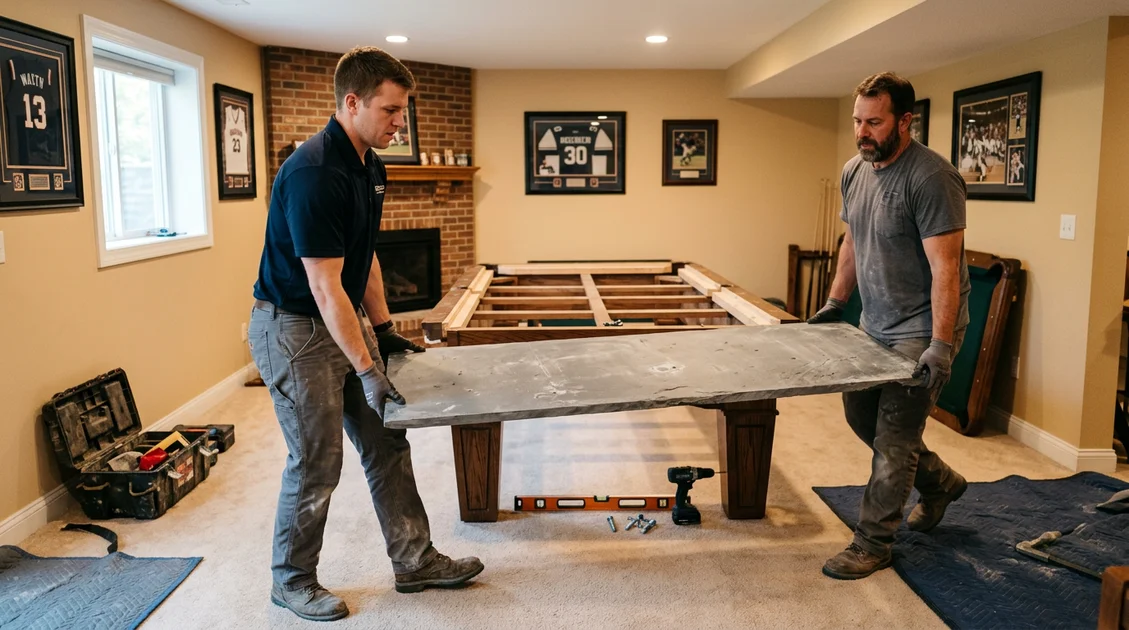
Residential tables come with three pieces of slate for a reason: they’re easier to handle and install. Each piece weighs maybe 150 pounds instead of a single 450-pound monster. That’s manageable for a professional installer, and it means if something cracks during transport, you replace one piece, not the whole table.
Problem? If installation goes wrong, you’re replacing individual pieces. Or if you move the table down the line, the pieces can shift and throw off the playing surface completely. Bad installation creates decades of wonky play. Good installers know how to reassemble and level everything perfectly using precision tools.
The Brunswick Gold Crown V is the industry standard — around $4,000-$6,000, and it weighs about 1,000 pounds. Every pound is premium wood, competition slate, and precision engineering. You’re buying a table that will outlive your marriage if you take care of it.
The best pool table brands all use true 3-piece slate rather than slatron — that’s where the weight (and the play) comes from.
MDF tables, by contrast, weigh 300-500 pounds total. Way lighter. Much cheaper. Most of the decent picks under $1,000 sit in this MDF range. But they won’t last. A slate table lasts 30+ years with basic care. MDF might last 5-10 years before the playing surface starts warping and cupping. Are MDF pool tables any good? — yes, for casual play, once you know what you’re trading off.
Moving a Slate Table Without Destroying It
Get professional movers. Seriously. Don’t gamble.
A good moving crew charges $500-$2,000 depending on distance and table size. That’s less than repairing a cracked slate or having the playing surface go uneven forever. Professional movers have slate dollies that distribute weight properly and pneumatic equipment to handle the load.
They’ll disassemble the table (rails and legs come off), transport the slate flat and properly supported, and reassemble on-site with leveling equipment. DIY moving is how valuable tables get destroyed. I’ve seen amateur moves crack slate and ruin felt. Not worth it.
For local moves within the same room? You might get away with four people and furniture sliders if you’re careful and methodical. But between floors or between homes? Call the pros.
Stability Comes From Weight
Heavy matters because stable matters. A 900-pound table doesn’t wobble when you shoot hard. The balls track consistently shot to shot. A light table (like MDF) can move slightly under impact. Over 100 shots, those micro-movements add up and throw your aim off.
The weight distribution across four legs matters too. A quality frame spreads the load evenly. Cheap frames put too much pressure on one or two legs, causing the table to lean over time.
Put your weight on the rail of a good slate table—it barely moves. Try that on an MDF table and you’ll feel the give immediately. The difference is night and day. Serious players feel it within five minutes of shooting on a bad table.
The Weight And Longevity Connection
Heavier doesn’t automatically mean better, but in pool tables it usually does. Slate’s weight is a byproduct of density. Dense slate doesn’t warp over decades. It stays flat. Cheap, light tables use thin particleboard and the playing surface starts cupping after five years. The weight of slate keeps it true.
You can play the same 9-foot slate table in 2026 that was installed in 2000 and it’ll play exactly the same. Try that with an MDF table from 2000 and you’re looking at a surface that’s warped beyond playable condition.
The Practical Takeaway
If you’re buying a slate table, know the weight before delivery day. Check your floor’s load rating if you’re in an upstairs room. Most residential spaces can handle 800-1,000 pounds concentrated in one area, but it doesn’t hurt to verify. Old apartment buildings sometimes have limits.
Hire movers. Most serious installers offer moving services or can recommend crews they trust. Budget $500-$1,000 for the move, not $200 from your neighbor with a truck.
If weight is truly an issue, MDF tables exist. You’ll replace the felt more often, buy new rail cushions sooner, and the playing surface won’t last, but they’re genuinely lighter and cheaper. A Hathaway pool table runs $400-$800 and weighs 400 pounds. We’ve got plenty of budget pool table options that are lighter if space or floor load is a real concern. Know what you’re trading.
For serious players who plan to keep a table for years? The weight is a feature, not a problem. Heavy slate tables play better. They last longer. They hold value. That 900-pound 8-footer might be the best investment you make for your rec room—and your game.
Check the specs before buying. Know how much each slate piece weighs if you’re moving it yourself (you shouldn’t). And remember: weight correlates directly with how good that table will play and how long it will last. You get what you pay for, and you carry what you buy.
Related Articles
For more on this topic, check out pool table reviews, best pool tables for small spaces, standard pool table sizes, how long pool tables last, and pool table room clearance.
Browse our full Pool Tables hub for tested picks, buying guides, and head-to-heads.