
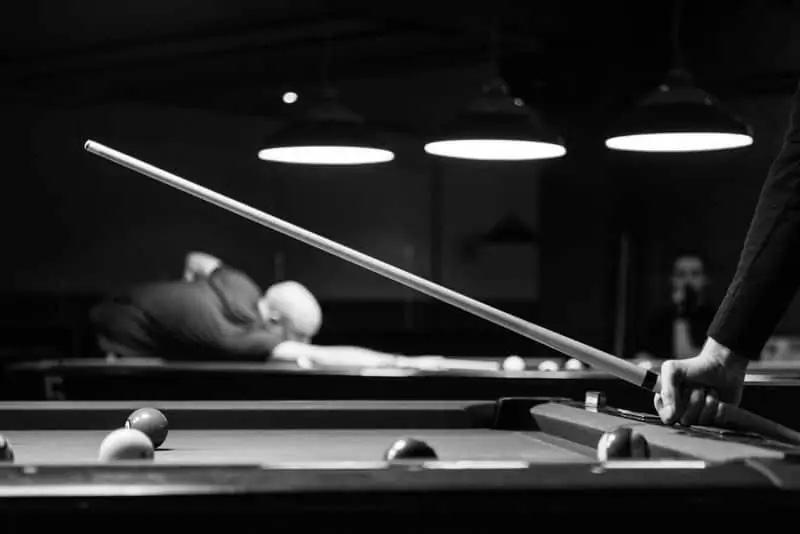
To hold a pool cue correctly, you need two things: a loose grip on the butt end with your dominant hand, and a stable bridge with your other hand on the table. Your grip hand controls the stroke (think of it as a pendulum swinging from your elbow). Your bridge hand guides the cue in a straight line toward the ball. Get these two things right and you’ll shoot straighter than 90% of casual players.
Here’s the complete breakdown of each hand, plus stance and body position.
The Grip Hand (Back Hand)
Your dominant hand holds the back end of the cue (the butt). This hand provides the power and controls the stroke. The most common mistake beginners make is gripping too tightly. You want the cue to move freely through your fingers, not be locked in a death grip.
How to find the right grip position: Stand at the table in your shooting stance with the cue tip near the cue ball. Look at your grip hand. Your forearm should hang straight down, perpendicular to the cue, forming a 90-degree angle at the elbow. If your hand is too far forward, slide it back. Too far back, slide it forward. For most people, this puts the grip about 4-6 inches from the butt end. Grip position depends on cue length, so adjust until your arm is at that 90-degree angle.
How to grip correctly:
Hold the cue with your thumb and index finger. These two fingers do 90% of the work. Your middle finger provides light support underneath. Your ring finger and pinkie should rest gently against the cue without squeezing. Think of cradling an egg: firm enough that it won’t roll away, soft enough that it won’t break.
Your wrist should stay loose and relaxed. During the stroke, the cue pivots through your fingers as your forearm swings like a pendulum from the elbow. Your upper arm stays still — only the forearm moves. This pendulum motion is the foundation of a consistent stroke.
Grip pressure: About 2 out of 10. If 1 is “the cue is barely staying in your hand” and 10 is “crushing a tennis ball,” you want to be at 2. Maybe 3 on a hard break shot. I spent my first year gripping way too tight. The day I loosened up, my accuracy jumped overnight. Never go higher.
If your bridge hand sweats during long sessions, a pool glove keeps the cue sliding the same way every stroke. The Predator Second Skin is the standard pick — three-finger fit, runs about $25, and you’ll feel the difference on the second stroke.
The Bridge Hand (Front Hand)
Your non-dominant hand goes on the table about 6-8 inches from the cue ball. This hand creates a channel that guides the cue in a straight line. There are two main bridge types: open and closed.
Open Bridge
The open bridge is the easiest to learn and works well for most shots. Here’s how to form one:
- Place your non-dominant hand flat on the table, fingers spread comfortably
- Bend your hand upward at the knuckles, creating an arch with your palm (like a tent)
- Press your thumb against the side of your index finger, near the first knuckle
- Lift your thumb slightly to create a V-shaped groove between your thumb and index finger
- Rest the cue shaft in that V-groove
The cue should slide smoothly through the V without wobbling. For stability, spread your rear fingers wide on the table. The wider the base, the more stable the bridge. You can raise or lower the V by adjusting how high you press your thumb to control the cue’s angle.
Closed Bridge
The closed bridge is more accurate and gives you better control on shots with english (spin). It takes practice to feel natural:
- Make a loose fist with your non-dominant hand and place it on the table
- Spread your pinkie, ring, and middle fingers out on the felt for a stable base
- Slide the tip of your thumb against the middle of your middle finger, forming a V
- Loop your index finger over the cue shaft and rest it on top of your thumb, creating a closed ring
- The cue passes through this ring, resting in the V between thumb and middle finger
The closed bridge keeps the cue from lifting or shifting sideways during your stroke. It feels awkward at first. That’s normal. The closed bridge took me about two weeks of practice before it felt natural. Stick with it. Most experienced players switch between open and closed bridges depending on the shot.
Rail Bridge
When the cue ball is near a rail, you can’t use a normal bridge. Instead, place your hand on top of the rail cushion and form a V with your thumb and index finger along the flat surface. The cue rides along the top of the rail with your thumb guiding it. It’s less stable than a table bridge, but it’s the best option when space is limited. See pool cue anatomy to understand the shaft and butt parts you’re working with.
Raised Bridge
When the cue ball is close to another ball and you need to raise the cue to shoot over the obstructing ball, raise your bridge hand higher. Plant your fingertips on the felt (not your palm) and form a tripod with your spread fingers. Create the V-groove higher up. This gives the cue a downward angle. Use a raised bridge sparingly. Angled shots are harder to control, so only use them when you have no other choice.
Stance and Body Position
Your stance creates the foundation for everything else. A wobbly or unbalanced stance ruins even perfect grip and bridge technique.
Foot Placement
Stand with your feet roughly shoulder-width apart. Your front foot (on the same side as your bridge hand) should point toward the shot line. Your back foot angles out 45-60 degrees for balance. Your weight should be evenly distributed or slightly favoring the front foot.
Body Alignment
Your cue, your grip arm, and your dominant eye should all be aligned along the shot line. Lean forward from the waist until your chin is about 6-8 inches above the cue. This gets your eyes directly over the line of the shot, which is critical for aiming.
Your bridge arm should be slightly bent (not locked straight) with your elbow pointing down, not out. Your grip arm hangs straight down at the shoulder, with only the forearm moving during the stroke.
Head and Eye Position
Look at the object ball (the ball you’re trying to pocket) during your final stroke, not the cue ball. Your eyes should be level — don’t tilt your head. Keep your chin close to the cue so you’re sighting down the shaft like a rifle.
The Stroke
Once your grip, bridge, stance, and alignment are set, the actual stroke is simple: pull the cue back slowly, pause for a beat, then accelerate smoothly through the cue ball. Follow through. Don’t stop the cue at the point of contact. Your cue tip should travel 4-6 inches past where the cue ball was sitting. Good stroke mechanics carry over directly to the break, so see how to break in pool to apply these fundamentals.
Common beginner mistakes:
- Jerking the cue forward (practice slow, smooth acceleration)
- Lifting your head to watch the shot before you’ve finished the stroke (stay down)
- Moving your body during the stroke (only your forearm should move)
- Gripping tighter as you shoot (maintain the same light pressure throughout)
Practice Tips
The best way to improve your grip and bridge is repetition with a simple drill: place the cue ball on the head spot and shoot it straight to the far rail and back. If the ball returns to the same spot (or close to it), your stroke is straight. If it drifts left or right, something in your alignment or stroke is off. Do this 20 times before every practice session.
As you build consistent grip and bridge habits, the cue you’re using starts to matter more. House cues are usually warped, mistipped, and weighted wrong — none of which makes a 2-out-of-10 grip feel natural. We reviewed beginner cues at every price point if you’re ready to move past them.
The two cues I point new players at:
- Floor pick (~$50): AKLOT Maple Pool Cue. Canadian maple, Irish linen wrap, 13mm leather tip. Cheapest cue worth owning.
- Step-up (~$150–$200): see our picks for the best beginner pool cues. The Lucasi Hybrid LH-series and the Cuetec budget low-deflection lineup are both there with current prices and warranty notes. The right step-up cue depends on whether you’re playing 8-ball, 9-ball, or focusing on the break — the hub article covers those tradeoffs.
See how to get better at pool for more ways to accelerate your improvement, and how much a good pool cue actually costs before you spend more than you need to.
FAQ
What’s the difference between an open and closed bridge?
An open bridge forms a V-groove between your thumb and index finger. The cue rests in the groove but isn’t enclosed. A closed bridge loops your index finger over the cue for more stability. Open bridges are easier for beginners; closed bridges are more accurate for experienced players.
How should my grip hand hold the cue?
Hold the cue loosely with your thumb and index finger about 4-6 inches from the butt end. Your forearm should hang perpendicular to the cue so your arm swings like a pendulum from the elbow. Never squeeze. A tight grip kills accuracy.
Why is a tight grip bad in pool?
A tight grip creates tension in your forearm and wrist, which prevents the cue from traveling in a straight line. The cue needs to pivot freely through your fingers during the stroke. Grip pressure should be about 2 out of 10. Just enough to keep the cue from falling.
Where should I grip the cue?
Your grip hand should be positioned so that when the cue tip is near the cue ball, your forearm hangs straight down at a 90-degree angle to the cue. For most people, this means gripping 4-6 inches from the butt end, but it varies with arm length.
Should beginners use an open or closed bridge?
Start with the open bridge. It’s easier to learn and works well for most shots. Once you’re comfortable, practice the closed bridge for shots that need more accuracy or where you’re using english (spin). Many experienced players use both depending on the situation.
Related Articles
For more on this topic, check out how to aim in pool, English in pool explained, beginner’s guide to pool, pool cue wrap vs no wrap, and best pool cues for beginners.
Browse our full Cues hub for tested picks, buying guides, and head-to-heads.