

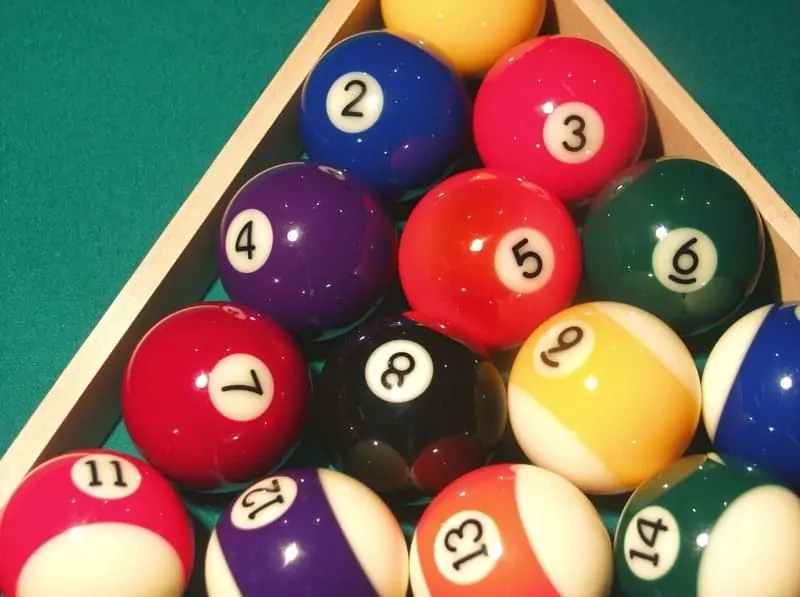
A standard American pool set has 16 balls: 7 solids (numbered 1-7), 7 stripes (numbered 9-15), the solid black 8-ball, and a white cue ball. Each number always has the same color. The 1-ball is always yellow, the 2-ball is always blue, and so on. Here’s the complete reference chart:
Pool Ball Color Chart
| Number | Color | Type |
|---|---|---|
| Cue ball | White | Cue ball |
| 1 | Yellow | Solid |
| 2 | Blue | Solid |
| 3 | Red | Solid |
| 4 | Purple | Solid |
| 5 | Orange | Solid |
| 6 | Green | Solid |
| 7 | Maroon (dark red-brown) | Solid |
| 8 | Black | 8-ball |
| 9 | Yellow stripe | Stripe |
| 10 | Blue stripe | Stripe |
| 11 | Red stripe | Stripe |
| 12 | Purple stripe | Stripe |
| 13 | Orange stripe | Stripe |
| 14 | Green stripe | Stripe |
| 15 | Maroon stripe | Stripe |
Notice the pattern: each striped ball shares its color with the solid of the same base number. The 1-ball (solid yellow) matches the 9-ball (yellow stripe). The 2-ball (solid blue) matches the 10-ball (blue stripe). This pairing runs all the way through the set.
Standard American Pool Balls: The Basics
A complete pool set has 15 object balls plus the cue ball (16 total). The cue ball is pure white with no number. You’re the only one who hits it with your cue during play; everything else gets struck indirectly through the cue ball.
The 15 object balls split into two groups. Balls 1-7 are solids (one uniform color with a small white circle displaying the number). Balls 9-15 are striped (a colored band around the middle with white on top and bottom, plus a number on the stripe). The 8-ball is solid black and sits in its own category. You don’t pocket it until you’ve cleared all your assigned balls first.
Why These Colors? A Brief History
Manufacturers chose these specific colors because they were cheap to dye in the 1800s and easy to distinguish under yellow bar lighting. When billiards took off in the 1800s, dye technology limited the options. Red, yellow, blue, and green were reliable and affordable. Black for the 8-ball gave maximum contrast against the felt.
The color pairs (yellow-blue, red-purple, orange-green, maroon-maroon) were also chosen because they’re distinguishable under various lighting conditions. Pool halls traditionally had yellow-tinted overhead lights, which changed how colors appeared. The color selection needed to work regardless of whether you were playing under incandescent bulbs or natural daylight.
Eventually, standardization happened around the late 1900s. Before that, some regions used different color schemes, but American pool settled on this system, and it stuck.
Materials and Construction
Modern pool balls are phenolic resin or polyester. Phenolic is denser, rounder, and lasts years longer — it’s what every serious player uses. These synthetics replaced the original ivory, which came from elephant tusks and is now illegal. Phenolic resin is denser and more durable than polyester, which is why serious rooms use phenolic balls.
The quality difference matters. Cheap polyester balls wear faster, develop dead spots where they don’t roll true, and feel different when you hit them. Premium phenolic balls cost more upfront but last years under regular use. If you’re buying a set for home use, phenolic beats polyester.
The balls are hollow inside with a cork center. The weight distribution is important. Every ball should have the same mass distribution so they roll predictably. Manufacturing tolerances are tight. A ball that’s 0.1 inches off in diameter can throw off your stroke.
The numbering on balls is inlaid, not painted. Numbers are actually pressed into the ball surface and filled with paint. This means they don’t wear off after a few thousand impacts. You can play with a 30-year-old set and still read every number clearly.
9-Ball vs 8-Ball: Does It Matter?
9-ball and 8-ball use the same 15 object balls plus cue ball. The difference is game rules, not equipment. Learn the ball colors for 8-ball and you know them for 9-ball.
The main difference is this: in 8-ball you can pocket balls in any order as long as they’re from your group (solids or stripes). In 9-ball you have to pocket balls in numerical order, 1 through 9. The balls look the same. The game rules change how you use them.
If you’re learning, start with 8-ball. It’s more forgiving and doesn’t require you to think strategically about ball order while you’re still learning stroke fundamentals. See how to play pool for beginners for a detailed breakdown.
Snooker: A Completely Different System
Snooker looks like pool, but uses a totally different ball set and rules. A snooker table is bigger, the balls are smaller, and there are 21 balls in play instead of 15.
Snooker sets have 15 red balls (unnumbered and all the same), a white cue ball, and six colored object balls: yellow (2 points), green (3 points), brown (4 points), blue (5 points), pink (6 points), and black (7 points). The point values matter. You’re trying to score points, not just pocket balls.
The balls are about 2.06 inches in diameter versus 2.25 inches for American pool balls. That’s not a huge difference but it affects how the balls move. Snooker balls are slightly heavier for their size, which changes ball behavior when you’re practicing shots.
The main visual differences: snooker balls include multiple reds (all identical), while pool has variety in the numbered balls. Snooker’s colored balls are brighter and larger in size relative to the table. American pool balls on a snooker table would look tiny. The proportions would be completely off.
Snooker is popular in the UK and Asia. If you see a table with a lot of reds and a much bigger playing surface, you’re looking at a snooker setup, not American pool. Want to know more? Check snooker vs pool comparison.
Carom Billiards: The Minimalist Approach
Carom billiards uses only three balls: two cue balls (one white, one yellow or dotted) and one red object ball. No pockets — you score by making your cue ball contact both other balls in sequence. Carom balls are bigger than pool balls (2.4 inches diameter) and unnumbered. It’s huge in Europe and Asia but rare in the US. Billiard games covers the full rules.
British Blackball: A Middle Ground
British blackball (or British pool) splits the difference between American pool and traditional billiards. It uses 15 object balls plus a white cue ball like American pool. However, the balls are colored differently and numbered differently.
You get 7 reds, 7 yellows, and a black 8-ball. The balls are smaller than American pool balls. Sometimes 2 inches in diameter versus 2.25 inches. The cue ball is even smaller, around 1.875 inches.
The table is also smaller than an American pool table, and the pockets are tighter. This changes how the game plays. Shots that would be routine on an American table become challenging on a British table.
British blackball is the standard in the UK, Ireland, France, and parts of Europe. If you travel and see a smaller table with red and yellow balls, you’re playing blackball, not American 8-ball. The rules are similar enough that a competent American pool player can pick it up, but the equipment differences take adjustment.
Choosing Your Set
If you’re buying balls for home use, you need: 15 object balls, 1 cue ball, and ideally a ball return system if you have a table with side pockets.
Phenolic resin beats polyester. Tournament-grade phenolic sets cost $150-300. Mid-range phenolic around $80-150. Budget polyester sets run $30-60.
The gold standard is the Aramith Premium set — runs about $180 and it’s what most pool halls use. I’ve seen Aramith sets last 10+ years of weekly play without losing their roundness or color.
The difference shows up fast. Cheap polyester balls start rolling inconsistent after six months. My Aramith set still plays true after two years of weekly games.
Make sure the set matches your table. American standard balls (2.25 inches) on a British table (which has smaller pockets) will drop and clunk. British balls on an American table will rattle in oversized pockets.
If you’re not sure what you’ve got, measure the ball diameter or compare it to the pocket openings. The ball should be slightly smaller than the pocket opening. If it’s bigger or barely fits, something’s mismatched.
Quick Reference: What Matters
Pool balls use color and pattern (solid vs. striped) to distinguish groups. This makes the game immediately clear to new players. Snooker uses a different ball set and table size entirely. Carom uses three unnumbered balls and focuses on geometry. British blackball is a size variant between American pool and traditional billiards.
For 99% of players reading this, you care about American pool balls. Learn the solid and stripe colors, understand that solids are 1-7 and stripes are 9-15, and remember that the 8-ball is last. Everything else follows from there.
Related Articles
For more on this topic, check out how many balls in pool, Aramith ball review, cleaning billiard balls, cue ball size, and cue ball red dots.
Check out our top-rated gear picks — selected and reviewed by billiards enthusiasts.