

You already own a cue. Maybe it’s the Viking Valhalla you bought for $30 after reading our under-$100 guide. Maybe it’s a hand-me-down that came with the table. Either way, you’ve been playing long enough to know this: the cue matters.
Not in the way gear snobs think it matters. A $200 cue won’t fix your stroke. But it will stop punishing you for a good one. When you pocket a clean cut shot and the cue ball drifts two inches off your intended path, that’s not you. That’s the stick.
The $100-$200 range is where cues stop being “good enough” and start being good. You get tighter construction tolerances, actual low-deflection shaft options, wraps that don’t unravel after six months, and joints that stay straight. It’s the single biggest upgrade-per-dollar in pool equipment after your first cue purchase.
Why $100-$200 Is the Sweet Spot
The performance jump from a $30 cue to a $150 cue is enormous. The jump from $150 to $400 is noticeable but much smaller. That’s the math that matters here.
Under $100, cues use acceptable maple and basic construction. They work. But the tolerances are loose, the shafts have more deflection, and the joints are functional rather than precise. Above $200, you’re paying for exotic wood inlays, premium finish work, and brand cachet. The playing surface improvements above $200 come in smaller increments.
Between $100 and $200, manufacturers put the money where it counts: shaft quality, joint precision, and tip consistency. CCSI is a major manufacturer that owns multiple brands including Players and Lucasi. Their $100-$200 cues use the same Canadian hard rock maple grading as their $300+ lines. The difference is cosmetics, finish work, and marketing budget. The actual materials and playability stay consistent across price points.
The Picks
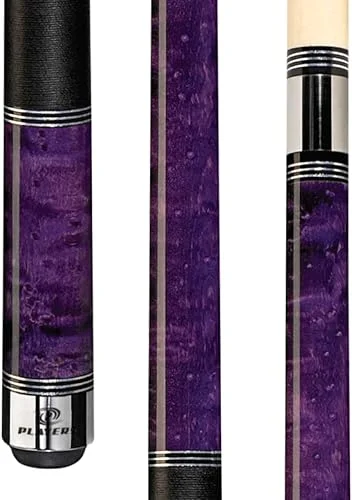
Players G-3401 (~$120)
The most recommended cue on AZBilliards in this price range. If you’re upgrading from a sub-$50 cue, you’ll feel the biggest difference here: the hit is crisper, the shaft is straighter, and the stainless steel joint is tight with zero wobble.
Check Price on Amazon →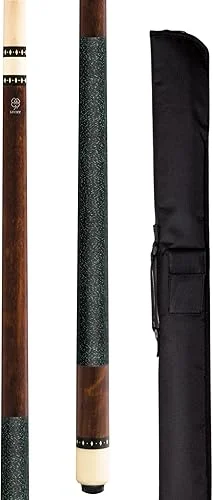
McDermott ES-1 (~$130-$150)
The finish and leather wrap are noticeably cleaner than the Players, with performance nearly identical—except the 12.75mm shaft gives marginally less deflection. The real story: McDermott replaces warped cues for free, forever. That lifetime warp warranty is rare below $200.
Check Price on Amazon →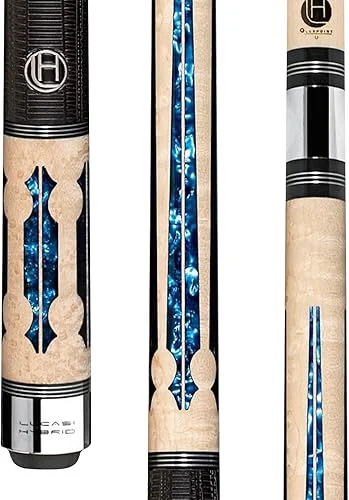
Lucasi Hybrid LH7 (~$175-$190)
The Zero Flexpoint shaft cuts cue ball deflection from 2-3 inches (standard maple) to under an inch on off-center hits. The 11.75mm diameter and Kamui Black soft tip ($25 value on a $180 cue) give it a carbon fiber feel at a fraction of the cost. It won’t look as nice as the McDermott, but it plays better.
Check Price on Amazon →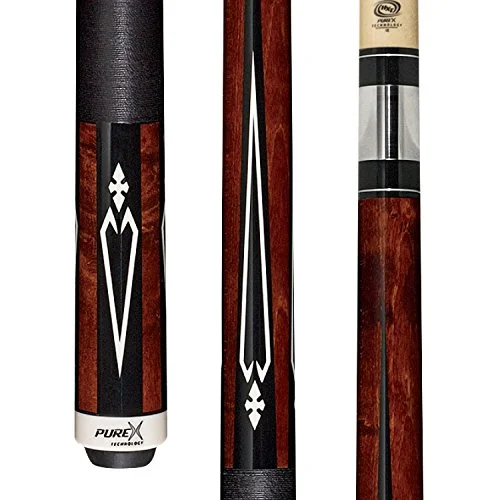
Players HXT15 (~$130-$160)
Same parent company as Lucasi, similar low-deflection engineering, but simpler cosmetics keep the price at $140. For league players who want LD performance without jumping to $200+, the shaft quality delivers what matters.
Check Price on Amazon →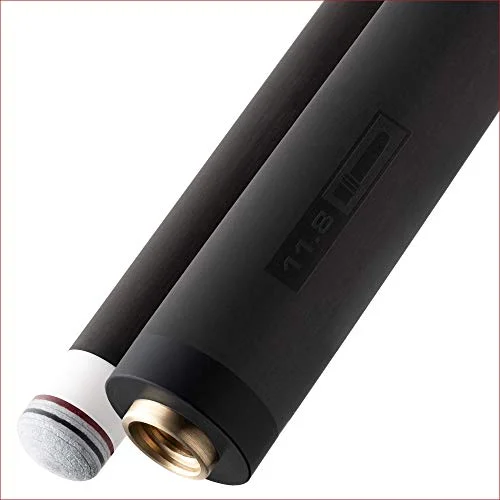
Cuetec Cynergy CT-15K (~$160-$180)
Carbon fiber at this price is a compromise: you get deflection benefits but lose some feel. The hit is stiffer. Cuetec claims 95% straightness; it’s closer to 80%, but still noticeably better than standard maple. If you’re committed to carbon fiber under $300, this is the move.
Check Price on Amazon →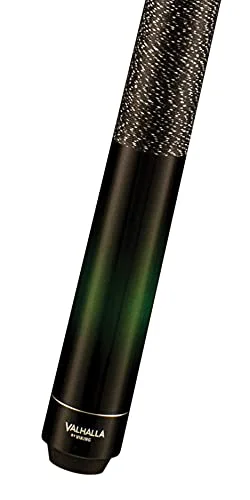
Viking Valhalla 200 Series (~$100-$120)
The upgrade from the 100: better shaft grade, leather wrap, and noticeably improved consistency shot-to-shot. At $100-$120, the Players G-3401 wins on shaft quality and hit, while the Viking wins on aesthetic variety and brand loyalty.
Check Price on Amazon →Quick Comparison
| Cue | Price | Shaft | Tip | Tip Size | Best For |
|---|---|---|---|---|---|
| Players G-3401 | ~$120 | Maple | Le Pro | 13mm | Best all-around value |
| McDermott ES-1 | ~$130-150 | i-2 Maple | Dexter | 12.75mm | Best warranty + finish |
| Lucasi Hybrid LH7 | ~$175-190 | Zero Flexpoint | Kamui Black | 11.75mm | Best performance |
| Players HXT15 | ~$130-160 | Hybrid LD | Kamui Black | 12.75mm | Budget low-deflection |
| Cuetec Cynergy CT-15K | ~$160-180 | Carbon fiber | Tiger Everest | 12.5mm | Carbon on a budget |
| Viking Valhalla 200 | ~$100-120 | Maple | Standard | 13mm | Upgrade from Valhalla 100 |
What Changes When You Spend $100-$200
The biggest difference you’ll notice moving up from a sub-$50 cue isn’t power or speed. It’s consistency.
A $30 cue hits differently depending on where you grip it, how hard you stroke, and whether Mercury is in retrograde. A $150 cue hits the same way every time. That consistency is what lets you develop muscle memory. You stop compensating for the cue and start working on your actual game.
Specific upgrades at this price: tighter joint tolerances (less energy lost at the connection), better-graded maple (fewer imperfections that cause micro-vibrations), higher-quality tips (better chalk retention, more consistent contact), and wraps that don’t deteriorate after 200 hours of play.
The one thing $200 doesn’t buy you: a dramatically better tip. Most cues in this range ship with good tips. But if you want to understand the difference between tip types, our breakdown covers the options.
What $200 Actually Gets You vs $100
Here’s the thing nobody talks about: the gap between a $100 cue and a $200 cue is real, but it’s smaller than you’d think. Let me break down exactly what changes.
Shaft performance. At $100, you’re getting solid maple with standard deflection. That’s about 2-3 inches of cue ball movement on an off-center hit. At $200, you’re either getting a hybrid shaft (maple mixed with fiberglass or graphite) or premium maple with tighter grain selection. The Lucasi Hybrid LH7 at $175 cuts that deflection to under an inch. The Players HXT15 at $140 sits in the middle. The practical difference is professional accuracy. If you’re shooting a bank shot or a kick shot, that deflection matters. For casual pool, it’s less critical. For league play, it changes everything.
Joint tightness. A $100 cue has a joint. A $200 cue has a precise joint. Standard tolerance at $100 might be 0.015 inches of play. At $200, you’re looking at 0.005 inches or less. That doesn’t sound like much. But when you’re transferring force from a 21-ounce stick through 58 inches of wood, micro-movements matter. You feel the difference the moment you bridge a $100 Players cue against a $150 McDermott. The McDermott doesn’t shift.
Wrap quality. Below $100, most cues ship with nylon wraps or cheap leather. At $100, you get real Irish linen (Players G-3401) or quality leather (McDermott). At $200, you get premium leather wraps (Viking Valhalla 200 Series) or specialty fiberglass wraps (Lucasi). The wrap affects grip, chalk retention, and how the cue feels in your hand during long sessions. A good wrap can be the difference between 30 minutes of play and 3 hours without your hand getting sore.
Tip engineering. The $100 cue tip is solid. The $200 cue tip is engineered. The Lucasi Hybrid LH7 ships with a Kamui Black soft tip that retails for $25 separately. The Cuetec Cynergy comes with a Tiger Everest tip. These aren’t stock items. They’re chosen to complement the shaft. At $100, the tip is often the last thing the manufacturer thinks about. At $200, it’s part of the package design. That precision matters when you’re trying to draw, follow, or control the cue ball.
Sight and balance. Most $100 cues play fine but look generic. At $200, you start seeing better grain visualization, cleaner cosmetics, and cues that actually look like you care about your game. This seems superficial, but confidence matters in pool. If you feel good shooting a cue, you shoot better. The Vikings and McDermotts in this range look expensive. They are, but not because of playability alone.
Is it worth it? If you play once a week or more, yes. If you play casually (once a month), the jump from $50 to $100 matters way more than $100 to $200. If you’re in a league, absolutely go for $150-$200. The deflection reduction and joint precision directly impact tournament play.
Tips for Buying Your First Upgrade Cue
You’ve decided to spend real money on a cue. Here’s how to not waste it.
Test it if you can. This is the most important step and nobody does it. A 30-minute session at a pro shop tells you more than 20 reviews online. You’ll discover whether a 13mm shaft feels like a putter or a pool stick to you. You’ll find out if you prefer the weight of the LH7 (lighter) or the G-3401 (heavier). Most pro shops don’t charge for test sessions, and they want your sale anyway. Use that advantage.
Match your shaft preference. If you’ve been playing with 13mm shafts, a switch to 11.75mm (Lucasi) feels alien. It’s not worse, it’s different. Your muscle memory is built around 13mm control. Switching to something thinner means relearning draw and English. If you’re a player who values familiarity, start with 12.75-13mm options. The Players G-3401 and McDermott ES-1 both offer 13mm or near-13mm shafts. The HXT15 at 12.75mm is a fine middle ground.
Consider your playing style. If you play mostly 8-ball in a league, the Lucasi Hybrid LH7 or Players HXT15 give you low-deflection benefits that directly impact your game. If you play casual 9-ball with friends, the Players G-3401 plays just as well and costs $60 less. The McDermott is for people who value warranty and aesthetics as much as shaft performance. The Cuetec Cynergy is for players specifically committed to carbon fiber feel.
Don’t buy based on color. The Viking Valhalla comes in 12 different stains and finishes. They’re beautiful. The Lucasi LH7 looks like a plain maple stick. But the LH7 outplays every pretty Valhalla in this price range. Looks are fine. Playability is better. Pick the cue that plays the way you want to play, not the one that looks best hanging on the wall.
Account for the full cost. A $150 cue needs a case. Budget $30-$50 for a decent hard case. Some people buy a quality break cue separately (that’s another $50-$100 if you get serious). You’ll also spend money on chalk, replacement tips, and ongoing maintenance like retipping and refinishing. The true cost of owning a $150 cue for 5 years isn’t $150. It’s probably $250 or more when you factor in a protective case, replacement tips, professional maintenance, and the occasional repair. That’s still worth it compared to cheap cues, but don’t act surprised when the total comes up.
The Mistakes to Avoid
Buying on looks. The prettiest cue under $200 is rarely the best-playing one. Exotic wood inlays and metallic graphics eat into the manufacturing budget for shaft quality. The Lucasi LH7 looks plain next to some $120 cues, but it outplays every one of them. If a cue looks like it costs $200 and plays like it costs $100, you’ve overpaid.
Ignoring shaft diameter. If you’ve been playing with a 13mm shaft and switch to 11.75mm, the feel changes dramatically. It’s not bad, it’s different. Try before you commit if possible. Most pro shops let you test cues, and that’s worth the trip. Our guide on pool cue shaft tapers goes deeper on this.
Skipping the case. A $150 cue left leaning against a wall will warp. Period. Maple is wood. Wood reacts to gravity and humidity. Budget $20-$40 for a hard case and actually use it. Your cue will last years longer. People leave $200 cues unprotected and then complain they warped in six months. The case is insurance, not an option.
Overthinking weight. Most cues in this range are 19-21 oz and adjustable via weight bolt. The “right” weight is whatever feels comfortable after 30 minutes of play. Don’t obsess over specs on this one. Check our piece on whether cue weight actually matters if you want the data.
Rushing the decision. This is the big one. You’re spending $120-$200. Take a week. Research specs. Visit a pro shop. Hit a few balls with each option. Talking to experienced players at your pool hall costs you nothing and saves you hundreds in regret purchases. You’re going to own this cue for years. Spend an hour finding the right one instead of buying on Amazon reviews at midnight.
The Bottom Line
If you play pool once a week or more, spend $120-$180 on a cue. The Players G-3401 at ~$120 is the best value, the Lucasi LH7 at ~$180 is the best player, and the McDermott ES-1 at ~$150 splits the difference with the best warranty in the business. Any of those three will last you 5-10 years of regular play.
Already know you want something fancier? Read our best cues for the money guide for picks up to $500+. Still figuring out what kind of player you are? Start with our beginner’s cue guide and work up from there.
The #1 recommendation from this guide — chosen for quality, value, and real-world performance.