

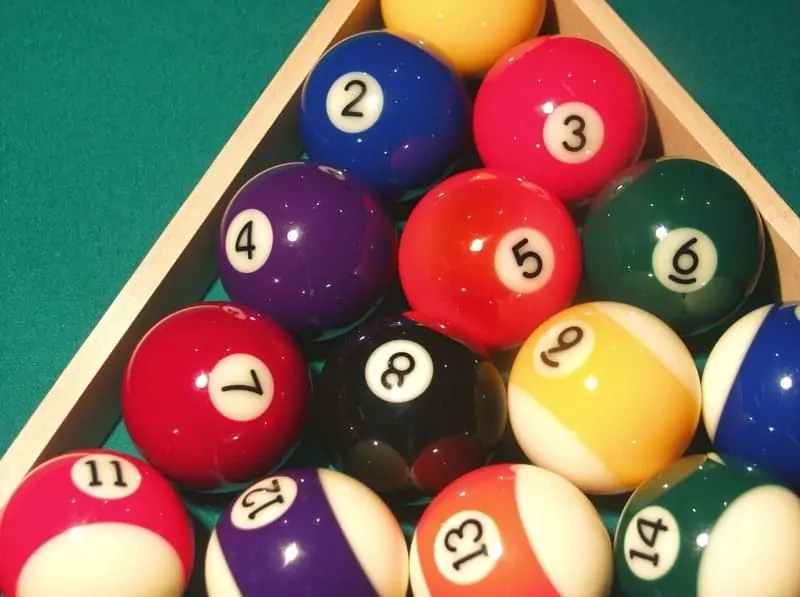
Pool balls are the part of the game you never think about until something feels wrong. A ball that rolls slightly off-line. A kick shot that doesn’t come off the rail at the angle you calculated. Colors that used to be bright but now look muddy under the light.
Cheap balls hide their problems for a while. Then one day you notice a flat spot on the 3-ball, or the cue ball doesn’t take english the way it used to, and you realize the balls have been degrading your game for months.
The good news: a quality ball set is a one-time purchase. Aramith, the industry standard, makes sets that last 30-40 years. Your cue will warp. Your felt will wear out. Your balls will outlast everything else on the table.
What Actually Matters in a Ball Set
Material is everything. Every other spec is secondary.
Pool balls come in two materials: phenolic resin and polyester. Phenolic resin (what Aramith uses) is a thermoset plastic that’s denser, harder, and more dimensionally stable than polyester. It doesn’t wear out the way polyester does. It maintains its roundness, balance, and surface polish for decades.
Polyester is what you’ll find in every set under $60. It works when new. The colors are bright, the finish is glossy, the balls roll true. But polyester absorbs impact differently than phenolic resin. Over 2-5 years of regular play, polyester balls develop micro-chips, flat spots, and surface yellowing. The balls are made of fundamentally different stuff, and you can feel it after a few thousand racks.
Weight and size should be standard across any set worth buying: 6 oz per ball (170g), 2.25-inch diameter per the BCA standard. If a set doesn’t list these specs, that’s a red flag. Cheap import sets occasionally ship balls at 2.125 inches (the “snooker-ish” size) that don’t play correctly on American tables.
Number visibility is the other thing people overlook. On a dark-colored felt, you need high-contrast numbers that stay readable after hundreds of hours of play. Budget sets sometimes use paint for the stripe and number markings that wears thin. Better sets embed the markings deeper into the material. Aramith’s numbers are essentially part of the ball, not a surface coating.
One more thing: ball-to-ball consistency within a set. In a cheap set, individual balls can vary by 1-2 grams in weight and 0.5mm in diameter. That variation affects how balls react on impact, especially in clusters. Premium sets hold much tighter tolerances. Aramith Premium specs guarantee weight consistency within 1 gram across all 16 balls. Their Tournament line tightens that to 0.5 grams.
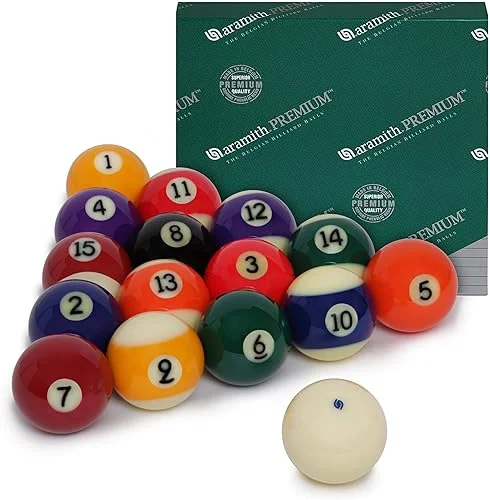
Aramith Premium ($180-$220)
Aramith is the only major manufacturer using phenolic resin, supplying every professional tour. The Premium set uses Vitrotech phenolic—5x more impact-resistant than polyester with deeply saturated colors that don’t fade. Phenolic also creates less friction on felt, reducing cloth wear. At $180-$220, it costs 4-5x more than budget polyester but lasts 10-20x longer.
Check Price on Amazon →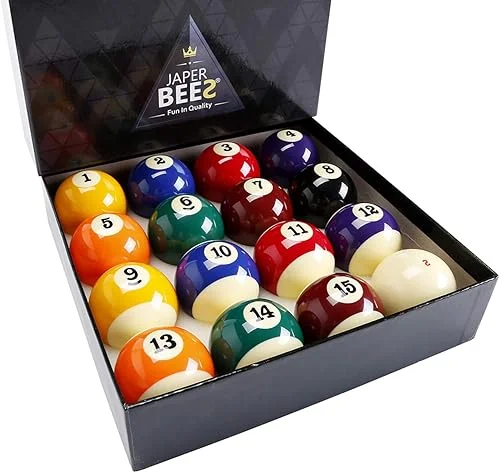
Japer Bees ($30-$40)
The Japer Bees set uses resin-blended polyester with numbers that don’t wear off like cheap imports. Expect 2-4 years of play depending on frequency. At $35 for 3 years of play versus Aramith at $200 for 35 years, Japer Bees is the smart buy if you’re not sure about long-term commitment.
Check Price on Amazon →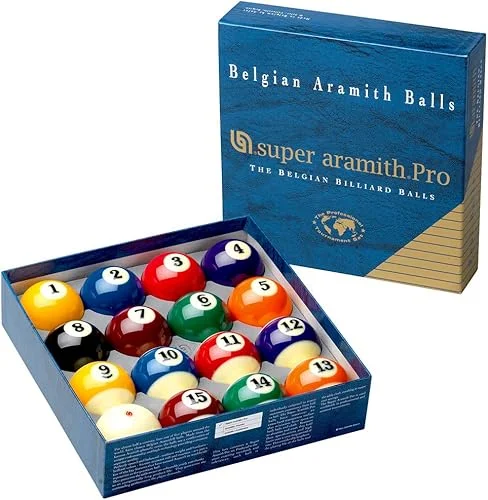
Aramith Tournament ($300-$350)
The Aramith Tournament set uses the same phenolic resin as Premium with tighter tolerances (0.5g weight consistency vs. 1g) and Duramith surface hardening. For home play, the difference is marginal. Buy Tournament only if you’re a competitive league player or want absolute best.
Check Price on Amazon →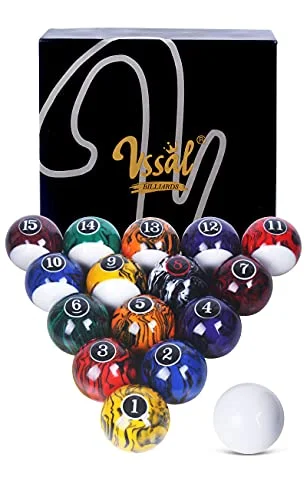
Vigma ($50-$80)
The Vigma set uses premium polyester resin harder than standard polyester with 3-5 year durability. At $50-$80, it’s positioned awkwardly between budget and Aramith. You get 60% of Aramith’s durability at 35% of the price, but saving a few more months makes the upgrade to phenolic possible.
Check Price on Amazon →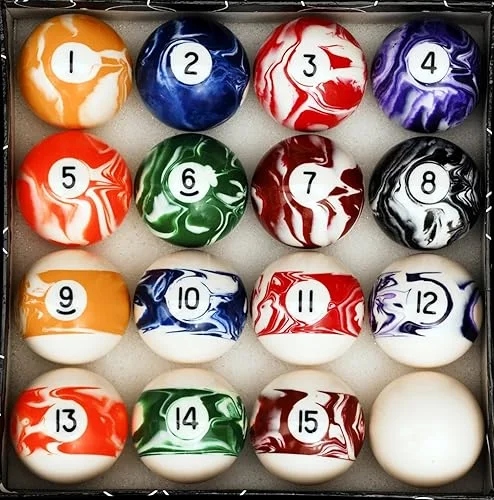
Iszy Billiards ($25-$35)
The Iszy Billiards set is the cheapest set that meets standard specs at $25-$35. Standard polyester with acceptable finish—expect 1-3 years before visible wear and fading numbers. If you can stretch to $35-$40, Japer Bees is a better buy.
Check Price on Amazon →Quick Comparison
| Ball Set | Price | Material | Lifespan | Best For |
|---|---|---|---|---|
| Aramith Premium | $180-220 | Phenolic resin | 30-40+ years | Serious home players |
| Aramith Tournament | $300-350 | Phenolic resin (Duramith) | 40+ years | Competitive players |
| Japer Bees | $30-40 | Resin-blended polyester | 2-4 years | Budget / casual |
| Vigma | $50-80 | Premium polyester | 3-5 years | Mid-budget upgrade |
| Iszy Billiards | $25-35 | Polyester | 1-3 years | Bare minimum replacement |
How to Make Any Set Last Longer
Clean your balls. Seriously. Chalk dust, hand oils, and table debris accumulate on the surface and accelerate wear. A quick wipe with a microfiber cloth after every session makes a difference. For deeper cleaning, our full guide on cleaning billiard balls covers the safe methods for both phenolic and polyester.
Don’t leave them on the table when you’re not playing. UV exposure and temperature swings affect both material types, though polyester suffers more. Store them properly in the triangle or in a drawer.
Avoid household cleaners like Windex or all-purpose spray. The ammonia in glass cleaners can strip the polish coat on polyester balls and dull the finish on phenolic resin over time. Use a dedicated ball cleaner or warm water with mild dish soap. Aramith makes their own ball cleaner and restorer kit ($15-$20) that works well on both their balls and third-party sets.
The Bottom Line
Buy the Aramith Premium. That’s the recommendation for anyone with a slate table who plans to play regularly. At $180-$220, it’s a one-time purchase that outlasts every other component in your game room. If that’s too steep right now, the Japer Bees at $35 will hold you over until you’re ready to upgrade.
Everything in between is a compromise. Not a bad compromise if your budget demands it, but a compromise nonetheless. Phenolic resin is to pool balls what slate is to pool tables: once you play on the real thing, you don’t go back.
The #1 recommendation from this guide — chosen for quality, value, and real-world performance.