

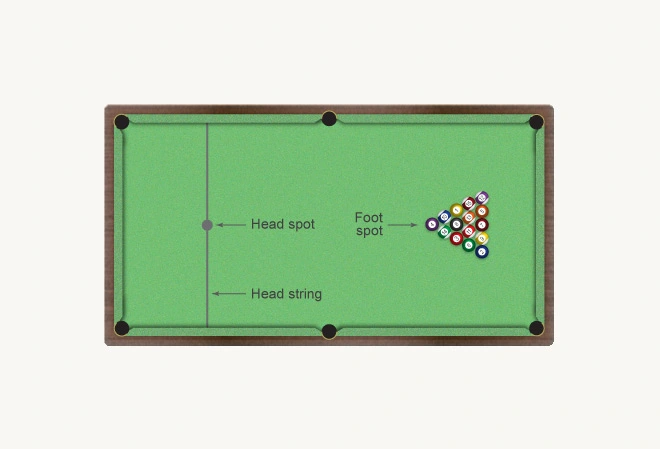
You’ve stared at those little diamonds running along the sides of every pool table you’ve ever played on. They’re there, they’re evenly spaced, and they probably feel like decoration. They’re not.
Those dots (called diamonds, sights, or markings depending on where you’re from) are a positioning system. They divide the table into measurable sections so you can calculate angles without pulling out a geometry textbook. Once you understand the system, you can actually make bank shots and kick shots that look impossible.
How the Dots Are Laid Out
Every standard pool table has 18 dots total on the rails: 3 evenly spaced dots on each of the four long and short sides, plus the corner pockets count as reference points. American tables use diamond shapes. Snooker tables use round dots. Both serve the exact same purpose.
The placement isn’t random. The three middle dots split each rail into equal sections. This creates a grid system (invisible, but real) that you can use to calculate how a ball will bounce.
The Language of the Table
Before you can use the dots, you need vocabulary. Pool tables have imaginary lines running through them:
Head and foot rails are the short ends. The head is where you stand to break. The foot is the opposite end.
Side rails are the long edges.
The center string runs lengthwise between the two side pockets.
Head string runs perpendicular across the table, halfway between the center spot and the head rail, connecting the side pockets closest to the head.
Foot string does the same thing at the foot end.
The long string runs from the center dot on the head rail to the center dot on the foot rail.
These strings don’t exist physically; you imagine them. But they matter because they divide the table into zones you can reference with the dots.
The Number System
Different players number the dots differently. Some use increments of two, some of ten. The most common system for beginners is to number each dot as a unit.
Standing at the head of the table looking toward the foot, start at the left corner pocket and call it 0. Moving down the left side rail: the next dot is 1, then 2, then 3, then the side pocket is 4. Do the same with the head rail from left to right (0 to 4). Mirror this on the opposite sides.
Once you memorize this simple numbering system, you can start making calculations.
Basic Bank Shots: The Two-to-One Rule
Here’s where the dots become useful. Let’s say you want to bank an object ball off the right rail and into the corner pocket.
The two-to-one principle says: if you hit an object ball toward a rail at a specific angle, and you know which dot it’s going to hit, you can predict where it will go based on the ratio.
For a simple one-rail bank, if the ball is two units away from the rail and you aim for a dot that’s one unit away on the opposite rail, the geometry works out. The ball travels in a predictable path. With practice, you can feel this angle without consciously calculating it.
But here’s the catch: this only works if you factor in where you’re shooting from. The distance from your position to the ball, plus the angle you’re hitting it at, determines everything.
Kick Shots Are Trickier
A kick shot is when you hit the cue ball into a rail first, then into an object ball. This is where even advanced players struggle because you’re adding a variable: the path of the cue ball.
For one-rail kicks, the same principles apply, but you’re now calculating from the cue ball’s position, not the object ball’s position. More complexity.
For two-rail or three-rail kicks, you’re basically calculating a geometry problem that would make a high school math teacher proud. The ball bounces off the first rail at a specific angle, then the second, and you’re trying to aim it at a target that might be anywhere on the table.
The dots help, but they stop being foolproof at this level. Most pros memorize the positions and develop feel through thousands of hours of practice.
Why Not Just Eyeball It?
Some players do. They develop an instinctive sense of angles over time. But using the diamond system gives you a framework. It removes guesswork. A newer player using the system will make banks more consistently than a newer player flying by feel.
The dots also help when you’re explaining a shot to someone else. “Aim for the dot at 2 on the side rail” is concrete. “Hit it kind of at that angle” is not.
Different Tables, Same Principle
The exact spacing of dots varies slightly between manufacturers: some use precise geometric divisions, others are approximate. But the principle remains the same—they mark reference points for angle calculations.
That’s why a professional player can walk up to any pool table in the world and immediately start using the dots. The system is universal.
Advanced Uses: Multiple Rails
Once you understand single-rail basics, people start asking: “What if the ball bounces three times?” That’s where the dots become complex tools rather than simple guides.
For multiple-rail shots, you essentially reverse-engineer the path. If you want the ball to end up in the corner pocket after bouncing off three rails, you work backward from the destination, bouncing the imaginary line off each rail until you find where the cue ball needs to be aimed.
This is above beginner level. Most casual players never need it. But understanding that the system can handle complex calculations explains why pros use the dots even for seemingly impossible shots.
Worth checking out: If you’re shopping for a solid home table, take a look at the Barrington Billiards 7.5ft Table on Amazon.
FAQ
Do I need to memorize the number system to play pool?
No. Casual players can improve without it. But learning it speeds up your progress dramatically, especially on bank shots and kicks.
Are the dots in the same position on every table?
Essentially yes, though precise measurements vary by manufacturer. The general system (three evenly spaced dots on each rail) is universal.
What if I’m playing on a snooker table instead of a pool table?
Same principle. Snooker uses smaller dots instead of diamonds, but they mark the same reference points. The geometry works the same way.
Can I use the dots for jump shots?
Not really. Jump shots involve making the cue ball bounce off the table surface before hitting an object ball. That introduces too many variables (spin, table condition, cue ball height) for the dot system to handle reliably.
Is using the dots considered “cheating” or unsportsmanlike?
Not at all. Every player is allowed to use them. In fact, in tournaments, you’re expected to understand the diamond system.
How long does it take to get good at using the dots?
A few weeks of regular practice and you’ll be comfortable with basic banks. A few months, and you’ll feel natural using them for most one-rail shots. Advanced multi-rail shots take years.
What if the dots on my table are worn or hard to see?
Older tables sometimes have faded dots. You can replace them or clean them up. For practice purposes, you can also mark your own reference points temporarily with chalk.
Using the System
Your next time at a pool table, pick out the dots. Count them. Memorize their positions. Take a shot that’s almost a guaranteed bank, and trace the angle from the dots. The more you do this, the more natural it becomes.
The dots transform pool from pure feel and intuition into a system you can actually calculate. That doesn’t mean you stop trusting your instincts; it means your instincts become informed by understanding geometry.
For more context, check out pool table felt and setup to understand the whole table’s architecture. You might also want to read about cue ball size since the ball’s consistency affects how accurately it responds to angles. If you’re getting serious about your game, understand why Aramith pool balls matter, and learn about high-quality cues that pair well with good technique. Predictable equipment makes learning the angles much easier.
Check out our top-rated gear picks — selected and reviewed by billiards enthusiasts.