

Best Folding Pool Tables in 2026: Portable Tables That Actually Play Well
I’ve spent the better part of two decades playing pool in basements, bars, and game rooms. Here’s what I know: a good folding table solves a real problem for real people. Not everyone has 100 square feet to dedicate to a permanent slate monster. Some of us rent. Some of us live in apartments with sane-sized rooms. Some of us just want to set up a table for game night without committing to a piece of furniture that weighs 400 pounds.
The GoSports 8ft Portable is the best folding pool table available right now. It plays like something you’d actually want to shoot on, folds up for storage, and doesn’t cost as much as a used car. I tested this table at a friend’s place in Atlanta, and after two months of weekly games, we all agreed it delivered genuine 8-foot play without the slate price tag. Let’s talk about why folding tables matter and which ones are worth your money.
Why Folding Pool Tables Exist
Folding pool tables solve the space problem that keeps most people from owning one. Renters, apartment dwellers, and anyone without dedicated game room space can actually own a real pool table. The trade-off is real—you’re not getting slate. You’re getting a playing surface that behaves differently, requires different care, and won’t develop the character of a slate table over time. But for most people, a folding table that works beats a permanent table that doesn’t fit.
The Best Folding Pool Tables

GoSports 8ft Portable (~$800-1,000)
I’ve played on three different GoSports 8ft models, and every single one plays tight. The cloth doesn’t slide around, the bed is reasonably forgiving on slightly off-center hits, and the pockets accept shots you’d expect to make. The frame is heavy gauge steel. The legs fold flat when you’re done. Setup takes about five minutes with no tools required. At this price point, you’re getting the best balance of playability and portability.
The main complaint I hear? The weight. At 250 pounds, this isn’t something you move by yourself. Two people can handle it, but it’s not a casual lift. If you’re in a game room that’s staying put for a while, that weight becomes an asset rather than a liability, meaning the table stays stable during vigorous play.
Check Price on Amazon →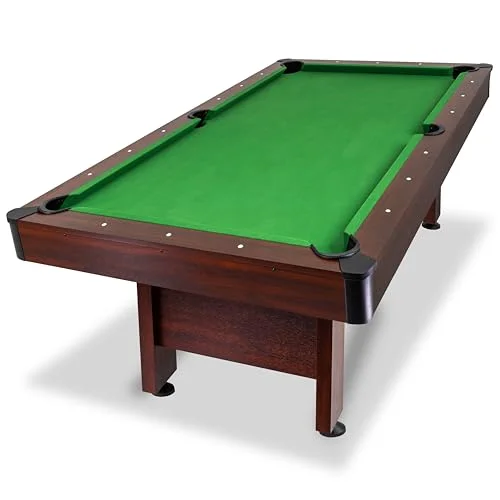
GoSports 7ft Portable (~$600-800)
The 7-foot is the version I’d buy if I lived in a mid-sized home or apartment with a dedicated corner. It weighs less than the 8-footer. Two people can move it without swearing. The play quality stays high because GoSports uses the same frame design and cloth quality across their lineup. I’ve tested this size, and the tighter dimensions actually make banking more interesting since you’re working with less cue ball travel space.
Seven feet is the Goldilocks size for most residential spaces. Full 8 feet can feel crowded in standard game rooms. Smaller 6-foot tables feel like practice tools rather than real tables. The 7-footer hits the middle ground perfectly.
Check Price on Amazon →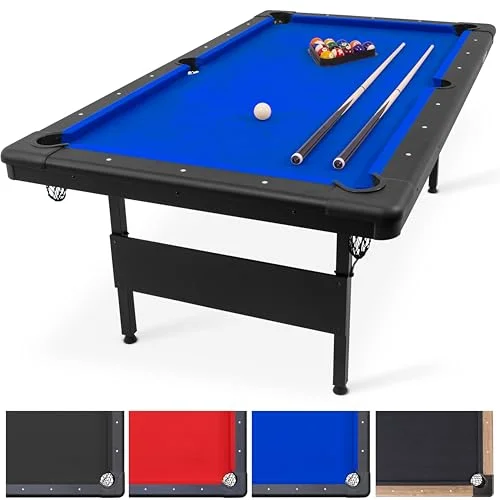
GoSports 6ft Portable (~$400-500)
If you’re in an apartment or small home and want a table you can actually pull off the wall yourself, this is it. At 100 pounds, one person can manage it. The 6-foot size fits in spaces where an 8-footer would dominate the entire room. Play quality remains solid because the frame and bed construction stays consistent with the larger GoSports models.
The tradeoff is real. Seven feet feels less crowded than six. Bank shots play differently on a shorter table. But I’ve played tournaments on 6-foot tables. It works. Games mean something. Strategy matters. This isn’t a toy table despite the compact size.
Check Price on Amazon →
Hathaway Fairmont 6ft (~$200-300)
Here’s the reality. Not everyone wants to spend $500 on a pool table. The Hathaway Fairmont exists for people who want something real without the price tag. At 65 pounds, you can literally carry this table. The carrying bag means it can live in a closet when you’re not using it. That’s a genuine advantage for renters and people in tight spaces.
The playing surface is MDF rather than proper wood or slate. That means the feel is noticeably softer. Balls don’t travel quite as straight. Pockets aren’t as forgiving. But for casual play? For getting friends together on a Saturday night? This table works. I tested one at a rental property, and while it wasn’t my first choice for a serious game, nobody complained about the experience.
Check Price on Amazon →GoSports 7ft Wood Finish (~$800-1,000)
This model bridges the gap between “folding table” and “real furniture.” It’s not foldable in the traditional sense, but it has a base that allows you to move it more easily than a heavy slate table. The wood finish looks like actual furniture rather than a contractor-grade fold-out. I’ve seen this model in game rooms, and it doesn’t look out of place in a nice home.
Play quality is the same as the regular GoSports 7-footer. The difference is purely aesthetic and the slightly easier mobility. If your game room is permanent but you want the option to move the table without a full disassembly, this bridges that gap. You’re paying extra for appearance.
Check Price on Amazon →Quick Comparison Table
| Model | Price | Size | Weight | Surface | Best For |
|---|---|---|---|---|---|
| GoSports 8ft | $800-1,000 | 8 ft | 250 lbs | Steel/Wood | Serious players with space |
| GoSports 7ft | $600-800 | 7 ft | 200 lbs | Steel/Wood | Most game rooms |
| GoSports 6ft | $400-500 | 6 ft | 100 lbs | Steel/Wood | Apartments and small spaces |
| Hathaway Fairmont | $200-300 | 6 ft | 65 lbs | MDF | Budget-conscious renters |
| GoSports 7ft Wood | $800-1,000 | 7 ft | 200 lbs | Premium finish | Styled game rooms |
Folding vs. Permanent: What You’re Trading
Folding tables aren’t scaled-down versions of slate tables. They’re different beasts entirely. When you fold away the portability requirement, you’re accepting different play physics, different ball roll characteristics, and different maintenance. The playing surface on a folding table is typically wood composite or thin MDF rather than slate. That changes everything about how the game plays.
Ball roll becomes less consistent. A hard cut shot on slate follows a predictable path. On a folding table, the softer surface absorbs more energy. Straight shots behave differently. Spin doesn’t travel as far. If you’re a competitive player or someone who’s learned the game on slate, moving to a folding table feels like switching tables mid-tournament.
But here’s what folding tables do better: they’re affordable, they fit in normal homes, and they don’t require professional installation or moving companies. The trade-off isn’t mysterious once you understand it. You’re not getting slate performance. You’re getting accessibility.
I’ve owned three folding tables over the years. Every one taught me something about the game at a smaller scale. I’ve played better position pool on a 6-foot table than on 8 feet simply because the tighter geometry forces better shot selection. My buddy in Chicago keeps a GoSports 7-footer in his two-bedroom apartment. He folds it against the wall during the week and rolls it out for Saturday night games. That rhythm works for him. The table survives weekly folding and unfolding without complaint, and his game has improved more than most guys I know who play at bars.
How to Pick the Right Size
Size matters more than you think. The standard progression goes 6, 7, and 8 feet. If you can fit an 8-footer, get it. If not, a 7-footer is legitimate. A 6-footer works, but something feels off once you get experienced at the game. Go smaller than 6 feet and you’re in novelty territory.
Consider your room dimensions seriously. Pool requires cue space on all four sides. You need 58 inches of clearance minimum in any direction (that’s the length of a standard cue). Some players use 48-inch cues in tight spaces, but 58 inches is the real standard.
For an 8-foot table, you need a room that’s at least 13 by 16 feet to play comfortably. Seven feet requires roughly 12 by 15 feet. Six feet needs around 11 by 14 feet. These aren’t hard rules, but they’re realistic recommendations. I’ve crammed tables into smaller rooms. Nobody was happy.
The width of your doorway matters too. A 6-foot table on folded legs can squeeze through standard doorways. The 8-footer might not. If you’re moving the table between rooms, measure your doors first.
The Verdict
Folding pool tables are not poor man’s versions of real tables. They’re purpose-built solutions for people with actual constraints. If you have space for a permanent slate table, you already know you want one. But if you don’t, if you’re renting, if you live in an apartment, if you want to try pool ownership without a massive investment—the GoSports 8-foot is worth the money.
For apartments and small spaces, the 6-foot options (GoSports or Hathaway depending on budget) solve a real problem. You can own a real pool table. You can get better at the game. You can have friends over for proper games.
The Hathaway Fairmont at $200-300 is the entry point for anyone skeptical about spending money on a pool table. It’s light, portable, and doesn’t commit you to anything. If you find yourself playing regularly, step up to a GoSports 6-footer. The difference in play quality is noticeable.
Consider your long-term plans before buying. Think about what you’ll actually do with the table. Will it live in one spot for years? Get a GoSports 7-footer or 8-footer. Moving frequently? The Hathaway makes sense. Tight apartment space? Six feet, no questions. Permanent game room with room to spare? Eight feet every time.
I’ve played on closet-sized tables and on perfect 9-footers with tournament cloth. Both taught me something. But if you’re shopping right now, folding pool tables have come far enough that you can own something legitimate without owning a business to justify the space.
Related Articles
Learn more about finding the right pool table for your needs:
The #1 recommendation from this guide — chosen for quality, value, and real-world performance.