
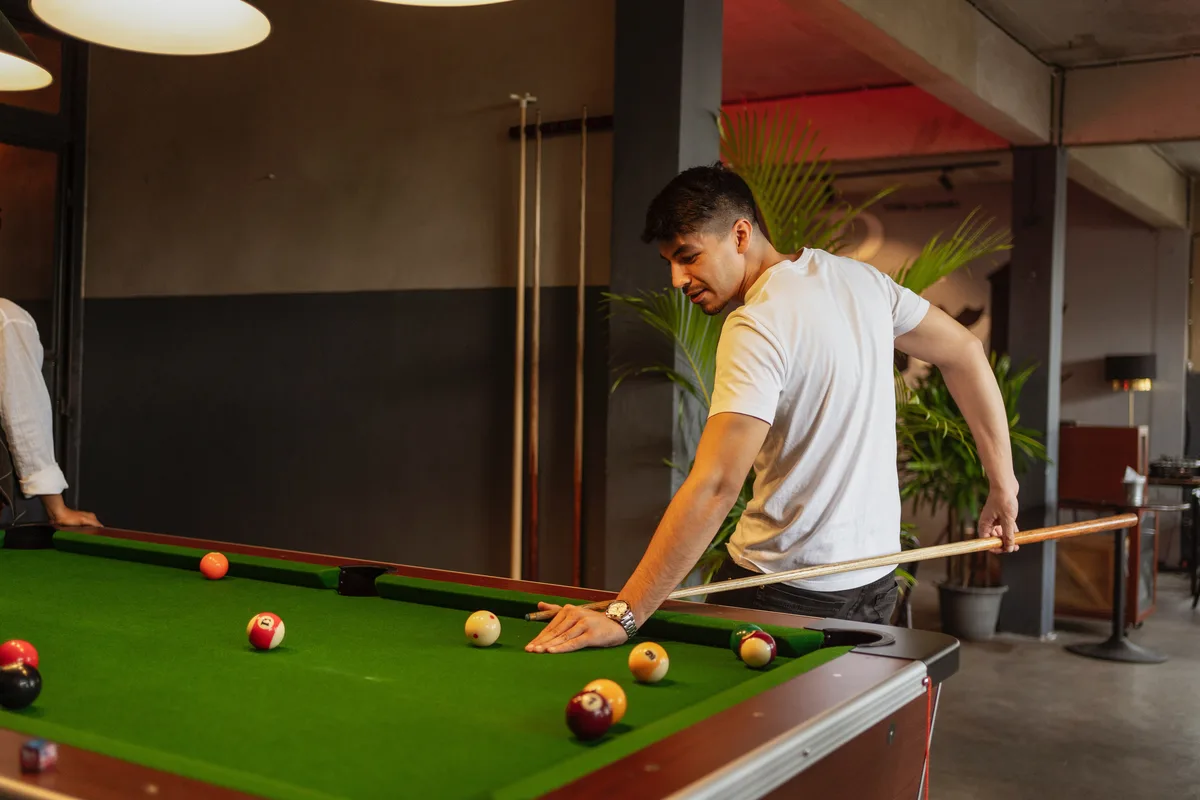
You’re lined up on what feels like a gimme shot. The cue ball is perfect. The angle looks clean. You stroke it smooth and watch your ball roll past the pocket like it’s on a different planet. That’s an aiming problem, and it’s fixable.
Most players think aiming is intuition. It’s not. It’s geometry. Once you understand the actual mechanics of how the cue ball needs to contact the object ball to send it into the pocket, you stop missing these shots.
The Ghost Ball Method: Your Aiming Foundation
The ghost ball method is the single most reliable way to aim in pool. It works for pros. It works for beginners. Here’s exactly how it works.
Imagine an invisible ball sitting directly between the object ball you want to sink and the pocket you want it to go in. That imaginary ball is your ghost ball. Your job is simple: position the cue ball so it hits the object ball at the exact spot where the ghost ball sits.
Here’s the real magic: that contact point is always the same. If the ghost ball sits at the 3 o’clock position on the object ball, then the cue ball must strike the object ball at exactly 3 o’clock. Not 2:50. Not 3:10. Exactly 3 o’clock.
To practice this, grab a ball and a pocket. Really visualize that ghost ball sitting there. It should be touching the object ball on the side closest to the pocket. Now ask yourself: which side of the object ball would the cue ball need to hit to push the object ball directly into that ghost ball?
Most beginners aim directly at the object ball. That’s wrong. The cue ball doesn’t hit the center of the object ball. It hits the edge. This edge is everything.
Contact Points and the Geometry You Actually Need
Pool is 100% about contact points. That’s it. Everything else is just setup for the right contact point.
When the cue ball hits the object ball, they touch at one single point on the object ball’s surface. That point determines the object ball’s direction. If the cue ball hits dead center, the object ball goes straight away. If it hits the edge, the object ball angles off.
Think of it like this: you’re trying to deliver the cue ball to a specific latitude and longitude on the object ball. Miss by half an inch and the ball misses the pocket.
For a straight shot. Where the object ball is directly in line with the pocket. You want to hit the object ball dead center. Dead center means the cue ball follows through the object ball in a straight line to the pocket.
For an angle shot, you don’t hit the center. You hit the edge. The sharper the angle, the more toward the edge you aim.
Here’s what that looks like in practice: if a ball sits at a 45-degree angle to a pocket, you hit roughly the halfway point on that ball’s surface. Hit exactly halfway between center and edge, and the object ball will travel toward the pocket at the right angle.
The ghost ball method makes this automatic. You visualize the ghost ball, figure out where it would sit, and boom. You know exactly where the contact point needs to be.
Eye Dominance Matters More Than You Think
Your dominant eye is your aiming eye. It’s the eye you should keep over the cue.
Here’s how to find it: hold up your arm and point at something across the room. Now close your left eye. If your finger is still pointing at the target, your right eye is dominant. Switch. Close your right eye. If your finger drifts when you close your right eye, your left eye is dominant.
Why does this matter? Because your dominant eye should be positioned over the cue. This is called the “line of sight.” When you address the shot, your dominant eye stays aligned with the cue and the target line all the way down to the object ball.
If you’re using your non-dominant eye to aim, you’re introducing a slight lateral offset. It’s small, but it’s consistent. Over 100 shots, it adds up.
Some players switch which eye they use depending on the table setup. That’s fine once you’ve got the fundamentals down. Until then, stick with your dominant eye. Get one thing working first.
Aiming for Full, Half, along with Quarter Contacts
Pool shots fall into categories based on how much of the object ball the cue ball contacts.
A full ball hit means you hit the center of the object ball. The cue ball drives straight through, and the object ball travels away from you in a straight line.
A half ball hit means you contact the object ball halfway between its center and its edge. This sends the object ball at a steeper angle while the cue ball deflects off at about a 30-degree angle from its original path.
A quarter ball hit (or even thinner) means you graze the edge of the object ball. The object ball shoots off at a sharp angle, and the cue ball barely changes direction.
Most beginners don’t realize that “thin” and “full” are on a spectrum. You’re not picking one or the other. You’re choosing exactly where on that spectrum the contact should be.
Here’s the trick: as the contact gets thinner (more toward the edge), the object ball takes a sharper angle. A half-ball hit on a ball that’s 45 degrees away from the pocket will put it in. A quarter-ball hit on the same setup will miss the pocket wide because the angle is too sharp.
Learning to read the angle and judge the contact point is practice. Do it wrong a hundred times, and you’ll start to see the pattern.
The Pocket vs. The Ball Mistake That Kills Your Game
This is the number one aiming mistake in pool.
Beginners aim at the ball. Pros aim through the ball to the pocket.
When you aim at the ball, you’re thinking about hitting the object itself. You draw a line from the cue ball to the object ball and call it a shot. But that’s not a shot. That’s a direction.
A real shot is a line that goes through the contact point on the object ball and continues all the way to the pocket. That’s what matters. The cue ball and the contact point and the pocket should all align on one invisible line.
Here’s how to fix this: when you’re setting up a shot, imagine a line running from the pocket, through the center of the hole, backward across the table. That line passes through a specific point on the object ball. That point is where you need the contact to happen.
Now work backward. What does the cue ball need to do to contact the object ball at that exact point?
This is the ghost ball method again. It forces your brain to think about the whole geometry, not just “hit that ball.”
How English (Spin) Affects Your Aim
English is side spin applied to the cue ball. If you hit the cue ball to the left of center, it spins left. This spins right. This affects where the cue ball ends up after the shot, and it also affects the contact point.
Here’s the important part: when you apply side english, the cue ball curves in the direction of the english and deflects slightly off your aim line. This means your contact point shifts.
If you aim with english in mind, you’re already ahead. Most beginners don’t. They apply english and wonder why the shot went sideways.
The practical rule: english affects the cue ball’s path after it leaves the object ball way more than it affects the contact point. Focus on the contact point first. Get the geometry right. Then add english if you need it for position.
For now, aim without english. Shoot a straight center-ball hit. Get comfortable with the basics. English is for when you’ve got the fundamentals locked in.
Draw, Follow, along with How They Affect Aiming
Draw (bottom spin on the cue ball) pulls the cue ball backward after contact. Follow (top spin) pushes it forward. These change where the cue ball goes, not really where it hits the object ball.
But here’s the catch: if you’re sloppy with your aim and relying on spin to cover for it, you’ll develop bad habits.
Aim the shot clean. Hit it clean. Then think about spin. Don’t use spin to fix a bad contact point.
Practice Drills That Actually Fix Your Aim
You can get better at aiming without a full table or without playing a full game.
The Ghost Ball Drill: Set up any ball near a pocket. Draw an invisible line from the pocket to the object ball. Visualize the ghost ball sitting there. Now place the cue ball in different positions and ask yourself: what contact point do I need? Do this twenty times. Visualize the ghost ball, identify the contact point, and step away. Don’t shoot. Just practice seeing.
Straight Shots Only: For a week, only shoot straight-on shots. Position object balls directly in line with pockets. This removes the angle problem and lets you focus on hitting center-ball. You’ll develop consistency on the most basic shot in pool.
The One-Ball Drill: Place one ball on the table. Shoot it into a pocket from ten different positions around the table. Focus on the contact point each time. This trains your brain to read contact points from different angles.
Progressive Angles: Start with nearly straight shots. Make the angle slightly sharper each time. This teaches your brain to gradually understand how contact points change as angles change.
The key with all of these: shoot slowly and deliberately. This isn’t about pocketing balls fast. It’s about building the aiming skill.
Common Aiming Mistakes and How to Fix Them
You’re too close to the table. Get back a foot. Your view of the angle improves with distance. Pro players address shots from way back.
You’re aiming with your whole body instead of just your head. Keep your head down over the cue. Don’t twist your body. This introduces body-based error that makes aiming inconsistent.
You’re lining up shots too fast. Take three seconds. Visualize the ghost ball. Visualize the contact point. Then shoot. Rushing leads to poor aim.
You’re hitting different parts of the cue ball every time. Practice hitting the center of the cue ball consistently. A mistrike. Hitting the cue ball off-center. Ruins everything. Get your bridge and grip right first. (See our guide on how to hold a pool cue for the details on this.)
You’re not accounting for object ball thickness. The object ball isn’t a point. It has diameter. You’re always hitting a region, not a spot. Account for the ball’s physical size when you visualize the contact point.
You’re moving the cue during the stroke. If your aiming is good but the ball still misses, your stroke is moving. Keep the cue tip aimed at the same point on the cue ball from the start of the stroke to the end. Any deviation ruins the shot.
The Importance of Consistent Bridge and Grip
Aiming is half the battle. The other half is delivering the cue ball to the contact point you aimed for.
Your bridge is how you hold the cue with your non-shooting hand. Your grip is how you hold it with your shooting hand. If these are sloppy, the cue ball will go where you didn’t aim it.
A closed bridge (where your thumb and forefinger form a loop the cue slides through) is tighter and more consistent than an open bridge. Use closed until you’re advanced. This keeps the cue from moving sideways during the stroke.
Your grip hand should be loose. Tight muscles cause jerky strokes. Loose muscles let you accelerate smoothly through the cue ball. This consistency transfers directly to accurate aiming. Because the cue ball goes where you aimed it instead of where you accidentally pushed it.
Reading the Table for Angles
Before you even get in position for a shot, you should have read the angle.
Stand back. Look at the object ball and the pocket. Estimate the angle. Is it nearly straight (like 10 degrees off)? Or is it sharp (like 60 degrees)? This tells you immediately whether you need a center hit, half hit, or thin hit.
Once you know the rough category, you can fine-tune. But starting by reading the basic angle removes half the guesswork.
Some players walk to different positions on the table to see the angle from different eyes. This is totally legitimate. It’s not cheating—it’s information gathering. Use it.
Aiming on Kicks and Banks
When you’re shooting a ball that needs to bounce off a rail first (a kick shot) or when you’re banking the cue ball, aiming changes.
For a kick shot, you aim at an imaginary object ball on the rail where it will bounce. Draw a line from your cue ball to the rail, and another line from that rail point to the object ball you want to hit. The angle-in equals the angle-out (like light bouncing off a mirror).
Banks (where the object ball bounces off a rail into the pocket) follow the same rule. The angle of approach to the rail determines the angle leaving the rail.
These are advanced. For now, skip kick shots. Focus on straight aim for straight shots.
Why Some Players Use the Cue Ball Position Instead
Once you’re experienced, you can skip visualizing the ghost ball and just position the cue ball where it needs to be. You see the pocket and the object ball, and your brain instantly knows where the cue ball should be aimed to deliver the right contact point.
This is pattern recognition. You’ve shot a thousand times. Your brain has internalized the geometry.
Don’t skip the ghost ball method to get here faster. That’s like trying to run before you walk. Beginners who skip visualization develop inconsistent aim because they’re guessing instead of thinking through the geometry.
The Dominant Eye vs. The Aiming Eye
Some players find their dominant eye and stick with it. Others find their “aiming eye” is different.
Your dominant eye is about hand-eye coordination. Your aiming eye is about line-of-sight alignment.
For most players they’re the same. But if you find you shoot better with a different eye over the cue, that’s fine. Adjust.
This is a nuance for much later. For now, use your dominant eye and lock it in.
Stroke Quality Matters as Much as Aim
A perfect aim with a bad stroke misses the shot. A pretty good aim with a smooth stroke makes it.
Work on your stroke. Keep it straight. Keep it smooth. Keep your grip loose. These things matter as much as the geometry.
Here’s a practice: aim at a ball, address the shot, then back away without shooting. Do this fifty times. This trains your brain to get in position for shots without the pressure of actually making them. Then when you do shoot, your body already knows what a good setup feels like.
Jumping Cues and Break Cues
If you’re using a jump cue (for jump shots) or a break cue (for breaking), aiming works the same way. The contact point is the contact point. The ghost ball method applies anywhere.
The Long-Game Approach to Aiming
Aiming is a skill. Skills improve with repetition and focus.
Spend a month just working on reading angles. Spend another month on the ghost ball visualization. Then a month on consistent contact. Don’t try to fix everything at once.
Pick one thing. Work on it. Repeat it until you can’t mess it up. Then add the next thing.
Most players who are bad at aiming are trying to do too many things at once. Simplify. Lock in one skill. Move forward.
Worth checking out: If you’re working on your aim, a good practice cue makes a difference. Take a look at the Players HXT15 on Amazon. It’s a solid mid-range option with a low-deflection shaft that helps you see whether your aim or your equipment is the problem.
FAQ
What is the ghost ball method in pool?
The ghost ball method involves imagining an invisible ball in line with the pocket. You aim to place the cue ball so it contacts the object ball at the exact point where the ghost ball sits. This is the most reliable aiming system for beginners and pros alike.
Does English affect how I aim at a ball?
Yes. English (spin applied to the cue ball) changes the contact point slightly. When you apply english, the cue ball deflects away from your initial aiming line. Most players ignore this until they reach intermediate level—just aim the cue ball directly for now.
How do I know which eye is dominant?
Close one eye at a time while pointing at an object. Your dominant eye is the one where your finger stays aligned with what you’re pointing at. Keep this eye over the cue for better aiming.
Why do I miss shots I think I’ve lined up perfectly?
You’re probably aiming at the ball instead of the pocket. Pool is about contact points and geometry. Aim through the ball to the pocket, not just at the ball itself.
Can I aim using just the cue ball position?
Experienced players do this, but beginners should visualize the ghost ball instead. The ghost ball method removes guesswork and builds muscle memory for proper contact points.
Related Articles
Check out our top-rated gear picks — selected and reviewed by billiards enthusiasts.