


Somewhere around $250, pool cues stop being equipment and start being instruments.
That’s not marketing. Below $200, manufacturers are splitting budgets between making the cue look good and making it play good. Above $200, the cosmetics budget gets raided for shaft engineering. The inlays get simpler, the wraps get more practical, and the hit gets noticeably tighter.
If you’ve been playing with a sub-$200 stick and you’re pocketing 70-80% of your shots in practice, you’ve probably noticed something: you’re missing the shots you should be making. The cue ball isn’t going where your stroke says it should. That gap between what you intended and what happened comes from deflection and shaft inconsistency. The $200-$300 range is exactly where both problems get addressed.
Why $200-$300 Changes the Game
At $200, cues use standard maple with entry-level low-deflection engineering. At $300, you’re getting shaft technology that brands like Predator, Lucasi, McDermott, and Meucci put in their $400-$600 lines, just with plainer butts. The performance gap between a $280 Predator Roadline and a $550 Predator P3 is cosmetics. The shaft is the same platform.
According to Predator’s own spec sheets, their 314-3 shaft ships on cues from $250 to $800. The radial consistency testing is identical across the range. You’re paying more for exotic woods and hand-laid inlays, not for a straighter shaft.
This is the price point where the old advice actually works: spend your money on the shaft, not the butt. Every cue on this list follows that logic.
The Picks
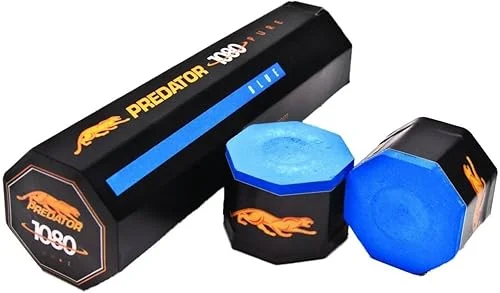
Predator Roadline (~$240-$280)
Predator built the Roadline specifically for players who wanted the 314 shaft without dropping $500+. The 314-3 is their workhorse low-deflection shaft: 10-piece maple with radial consistency that keeps the cue ball tracking where you aim it. The butt is plain black with minimal design (no exotic woods, no inlay work). That’s the whole point. On AZBilliards, the Roadline consistently ranks as the best value in Predator’s lineup. It plays above its price because Predator didn’t waste money making it pretty.
Check Price on Amazon →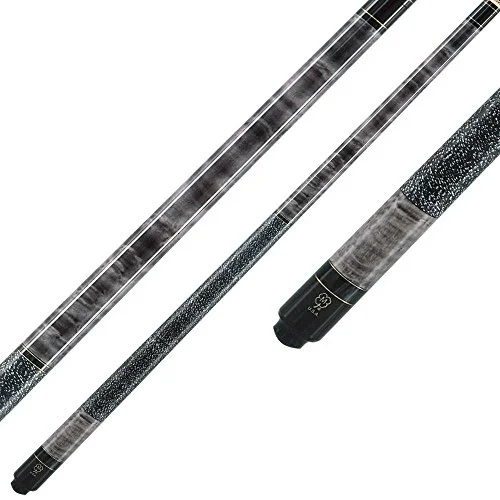
McDermott G-Series (~$220-$290)
The G-Core shaft uses a carbon fiber core wrapped in premium maple. Deflection sits between a standard maple shaft and a full LD shaft (call it 60% of the way to a Predator 314). What McDermott does better than anyone at this price is build quality: the joints are tighter, the wrap sits better in your hand, and the lifetime warranty means if this cue warps in 2035, they’ll replace it. The G-Series comes in about 40 different butt designs (G201 through G240+), all using the same shaft. Pick whatever looks good to you.
Check Price on Amazon →Lucasi Custom LZC Series (~$250-$300)
The LZC line is Lucasi’s “Custom” tier: a step above the Hybrid LH series we covered in our under-$200 guide. The shaft diameter drops to 11.75mm, which cuts deflection further and gives you precision on english shots that 13mm shafts can’t match. If you play a lot of position and spin the ball heavily, the narrower shaft matters. The Kamui Black soft tip holds chalk for 6-8 shots and shapes consistently. CCSI (Lucasi’s parent company) makes these in the same facility as their $500 Lucasi Custom Originals.
Check Price on Amazon →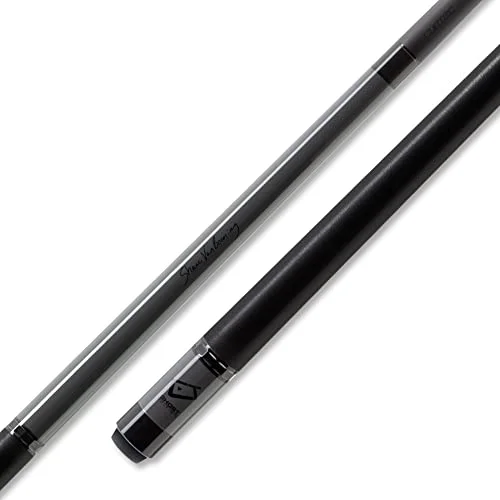
Cuetec Cynergy SVB (~$250-$280)
The “SVB” stands for Shane Van Boening, who plays competitively with a Cuetec Cynergy shaft. The carbon fiber gives you zero maintenance (no sealing, no conditioning, no warping), consistent deflection regardless of humidity, and a hit that’s firmer than maple but less “pingy” than cheaper carbon options. Compared to the CT-15K we recommended under $200, the SVB shaft has better weight distribution and a more natural feedback through the joint. At $260-$280, it’s the best carbon fiber value on the market.
Check Price on Amazon →Meucci 97-Series (~$250-$300)
Not everyone wants low deflection. Some players learned on standard maple and their aim compensates for deflection naturally. For them, switching to an LD shaft makes them worse. Meucci’s Black Dot shaft is premium-grade maple, hand-selected for straightness and consistent grain. The hit is warm and solid. You know exactly what it’s going to do before the cue ball leaves. The piloted joint gives a stiffer connection between butt and shaft. Meucci has been building cues in Byhalia, Mississippi since the 1960s. The 97-Series is their entry into the mid-range, and it plays like it costs more than it does.
Check Price on Amazon →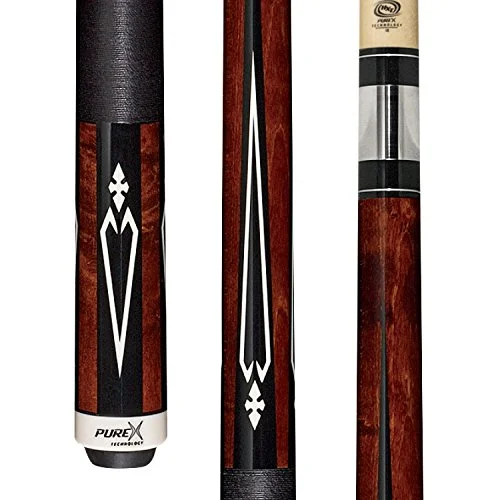
Players HXT-P2 (~$200-$230)
The HXT-P2 sits at the bottom of this price range and competes with cues $50-$100 more expensive. The HXT shaft uses CCSI’s low-deflection construction (the same engineering principle as the Lucasi Zero Flexpoint, simplified). You won’t get the precision of the Predator 314 or the refinement of the McDermott G-Core, but at $210 with a Kamui tip, it’s the most performance per dollar for players stepping up from our beginner cue guide.
Check Price on Amazon →Quick Comparison
| Cue | Price | Shaft | Tip | Tip Size | Best For |
|---|---|---|---|---|---|
| Predator Roadline | ~$240-280 | 314-3 LD | Victory | 12.75mm | Best overall performance |
| McDermott G-Series | ~$220-290 | G-Core | Leather | 12.75mm | Best build + warranty |
| Lucasi Custom LZC | ~$250-300 | Zero Flexpoint | Kamui Black | 11.75mm | Spin/english players |
| Cuetec Cynergy SVB | ~$250-280 | Carbon fiber | Tiger Everest | 12.5mm | Best carbon fiber |
| Meucci 97-Series | ~$250-300 | Black Dot maple | Le Pro | 12.75mm | Classic maple feel |
| Players HXT-P2 | ~$200-230 | HXT LD | Kamui Black | 12.75mm | Budget LD performance |
What Actually Changes Between $200 and $300
People ask this constantly, so here’s the honest breakdown.
The shaft is where most of the money goes. A $200 cue might use a basic spliced maple shaft with some taper work to reduce deflection. A $280 cue uses proprietary low-deflection engineering — 10-piece radial construction (Predator 314), carbon-fiber cores (McDermott G-Core), or multi-layer laminate designs (Lucasi Zero Flexpoint). These aren’t marketing gimmicks. They physically redirect where mass sits inside the shaft so the tip doesn’t push sideways as much when you hit off-center.
In numbers: a standard maple shaft deflects the cue ball about 2.5 inches on a full table length shot with one tip of english. A good LD shaft at this price cuts that to about 1.5 inches. That’s an inch of difference over 8 feet. If you’re running patterns and trying to get the cue ball on a specific rail, an inch is the difference between getting shape and not.
The tip is the other big upgrade. Most sub-$200 cues ship with generic leather tips or house-brand tips that mushroom after a few weeks. At $250+, you start seeing Kamui Black, Tiger Everest, and Predator Victory tips — all of which hold their shape for months, grip chalk better, and give you a more consistent hit. Replacing a tip at a pro shop costs $20-$35, so having a good one pre-installed saves you a trip and some cash.
Joint construction gets tighter too. Cheaper cues sometimes have a bit of play in the joint — twist the shaft and you feel a tiny wobble. The cues on this list all use precision-machined joints (Uni-Loc, piloted, or 3/8x10) that lock with zero movement. You feel the ball through the joint instead of feeling the joint itself.
The butt is where you DON’T see improvement. That’s the whole secret of this price range. The butts are plain. Simple stains, basic wraps, minimal inlays. Walk into a pool hall carrying a Predator Roadline and nobody’s going to comment on how it looks. But pick it up and shoot, and the difference from a $100 cue is immediate.
How to Decide
Three questions that narrow the field fast.
Do you want carbon fiber or maple? If carbon fiber, get the Cuetec Cynergy SVB. It’s the only carbon shaft here worth the money. If maple, keep reading.
Do you use a lot of english? If you spin the cue ball heavily for position, the Lucasi LZC’s 11.75mm shaft and Kamui tip will reward that. If you play mostly center ball and slight english, the Predator Roadline’s 12.75mm shaft is more forgiving.
Do you care about the warranty? McDermott’s lifetime warp warranty is unmatched. If you play in humid environments, travel with your cue, or just want insurance, the G-Series is the safe choice.
For everyone else: the Predator Roadline. The 314-3 shaft is the single best-performing component on this list, and Predator priced it lower than it should be.
One More Thing: Don’t Forget the Case
You’re spending $250+ on a cue. Don’t carry it in a grocery bag. A basic 1x1 hard case runs $30-$50 and keeps the shaft straight during transport. Humidity changes, car trunks, and accidental drops are how cues warp. The McDermott G-Series comes with a lifetime warp warranty which covers you, but the rest of these don’t. A $40 case from Casemaster or Billiard Evolution is cheap insurance on a $250 investment. We cover options in our best pool cue cases guide.
If you’re playing league, a 2x2 case gives you room for a backup shaft down the road. Most players at this level eventually buy a second shaft (either a break shaft or an upgrade LD shaft), and having case space ready saves you from buying another case later.
Related Reads
Looking at a different budget? Check our best pool cues under $200 or browse the full best pool cues for the money guide. If you’re still figuring out what matters in a cue, our pool cue anatomy breakdown covers every component. And if you’re wondering whether to go LD, the low-deflection cue guide explains the physics.
The #1 recommendation from this guide — chosen for quality, value, and real-world performance.