

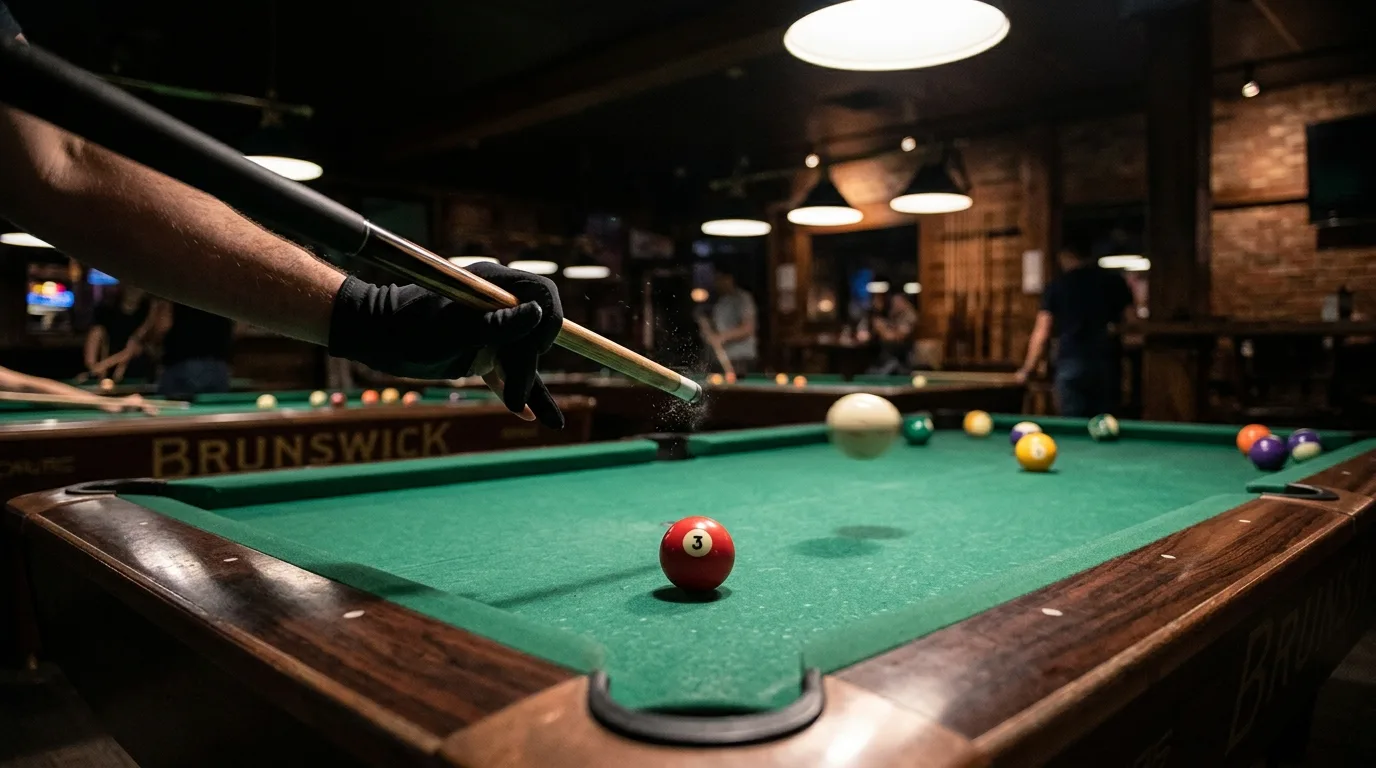
Your opponent just played safe and parked the cue ball behind a wall of solids. You’ve got two choices: kick at the ball from three rails away and probably sell out, or pull out 40 inches of phenolic-tipped fiberglass and jump clean over the blocker.
The jump shot changes the safety game entirely. A player with a reliable jump cue turns a defensive masterpiece into a one-shot problem. That’s why every serious league player carries one.
The catch: most people buy the wrong jump cue. They either spend $40 on a gas station jumper that miscues every third attempt, or $400 on a designer piece that doesn’t jump any better than a $150 cue. The sweet spot sits right in the middle, and the differences between good cues come down to tip material, shaft stiffness, and weight distribution.
Here’s the lineup.
The quick take
The Jacoby Jumper at $180 is the best jump cue for most league players. It pops clean, breaks down to a 24-inch section for tight spots, and costs less than half the next-best option. If money isn’t a factor, the Predator Air 2 at $350 is the lightest and fastest cue available. And if you just want to try jumping without committing $150+, the Players JB9 at $80 doubles as a break cue.
What makes a jump cue work
Tip hardness, cue weight, shaft stiffness, and length determine how cleanly a jump cue pops the cue ball over obstacles at 7-9 mph of downward stroke speed. You elevate the cue butt to 45-60 degrees and strike down through the cue ball at about 7-9 mph. The ball compresses into the slate, bounces up, and clears the obstacle. A typical jump shot pops the cue ball 1-2 inches off the surface for about 6-12 inches of horizontal travel.
Four things in the cue affect how cleanly this happens.
Tip hardness. Phenolic resin tips (basically hard plastic) are the standard. They transfer energy faster than leather with almost zero compression on impact. G-10 composite is the other option, slightly softer with marginally more grip. Predator uses phenolic. Mezz uses G-10. Both work. Leather tips on a jump cue are a mistake. (For more on how tips affect performance, check out our guide to pool cue tips.)
Weight. Jump cues run 6-10 oz. Lighter cues need less force to accelerate, which gives you more control on soft jumps (hopping over one ball at close range). Heavier cues carry more momentum for distance jumps. The Predator Air 2 at 6 oz represents one extreme. The Players JB9 at around 10 oz represents the other.
Shaft stiffness. A stiffer shaft transmits more energy to the cue ball. Fiberglass and carbon fiber are stiff. Wood is less stiff but has better feel. Most jump cues use fiberglass or some composite layup.
Length. BCA minimum is 40 inches. Most jump cues are 40-42 inches. Shorter cues give more elevation angle in tight spaces but sacrifice reach. The Jacoby Jumper breaks down to a 24-inch jumping section, which is the shortest practical length.
| Cue | Price | Weight | Tip | Length | Best for |
|---|---|---|---|---|---|
| Predator Air 2 | ~$350 | 6 oz | Phenolic | 41” | Tournament players wanting max pop |
| Mezz WX700 | ~$250 | 7 oz | G-10 | 41” | Best balance of control and power |
| Jacoby Jumper | ~$180 | 8 oz | Phenolic | 41” (breaks to 24”) | Versatility and value |
| Lucasi Custom | ~$150 | 8.5 oz | Phenolic | 41” | Solid mid-range performer |
| Players JB9 | ~$80 | 10 oz | Phenolic | 52” (breaks down) | Budget pick, doubles as break cue |
The cues, ranked
Five jump cues from $80 to $350, ranked by how well they actually get the cue ball airborne and where it lands when it comes down.
Predator Air 2 Jump Cue (~$350)
The Air 2 is the cue Shane Van Boening and other Predator-sponsored pros use in competition. At 6 oz, it’s absurdly light. The first time you pick it up, your brain thinks something is missing. Then you hit a jump shot and the cue ball launches off the table like it’s spring-loaded.
That lightness isn’t a gimmick. According to Predator’s engineering data, reducing mass by 25% while maintaining shaft stiffness through carbon composite construction means the cue ball reaches escape velocity with significantly less arm force. In practice, this means you can execute soft, controlled jumps that barely clear a ball — the kind of finesse jumps that win matches.
The phenolic tip is aggressive. Zero forgiveness on off-center hits, but perfect energy transfer on clean strikes. If your jump stroke is inconsistent, this cue will expose it. It rewards good technique and punishes bad technique equally.
At $350, this is the most expensive cue on the list by a wide margin. Whether that premium is worth it depends on how often you jump. If you’re in competitive 9-ball or one-pocket where jump shots come up multiple times per session, the Air 2 pays for itself in won safeties. If you jump twice a month at your Tuesday night league, the Jacoby does the same job for half the price.
Check Price on Amazon →Mezz WX700 Jump Cue (~$250)
Mezz is a Japanese cue maker that obsesses over manufacturing tolerances the way only Japanese companies do. The WX700 shows it. The joint between the shaft and butt sections has zero play. The shaft taper is perfectly consistent. These details don’t sound exciting, but they add up to a cue that feels exactly the same on every single jump attempt.
The G-10 tip is the differentiator. It’s a glass-fiber composite that sits between phenolic and leather on the hardness scale. The practical effect: you get about 5-8% more grip on the cue ball compared to phenolic, which translates to slightly more spin control on jump-draw and jump-follow shots. If you’re just clearing obstacles, it doesn’t matter much. If you’re trying to jump AND land with position, the G-10 gives you an edge.
At 7 oz, the WX700 splits the difference between the ultralight Air 2 and the heavier traditional jump cues. Most players find this weight the most natural. Light enough for finesse, heavy enough for distance jumps without muscling the stroke.
Mezz’s “Wavy Joint” connects shaft to butt with interlocking waves instead of a flat pin joint. According to Mezz, this increases the contact surface area by 40%, creating a more rigid connection. Whether you can feel the difference is debatable. What’s not debatable is that it looks cool.
Check Price on Amazon →Jacoby Jumper (~$180)
Dave Jacoby has been making cues in Wisconsin since the 1980s. The Jacoby Jumper is his most popular product, and for good reason: it jumps 90% as well as cues that cost twice as much.
The full-length cue is 41 inches with a standard joint in the middle. Unscrew the butt section and you’ve got a 24-inch dedicated jump stick. That short configuration is where this cue shines. In tight spots where a 41-inch cue can’t get enough elevation without hitting the ceiling or a light fixture, the 24-inch section lets you nearly vertical the stroke.
The phenolic tip pops clean. The 8 oz weight feels familiar to anyone who’s used a sneaky pete or short cue. The shaft is a wood-fiberglass hybrid that’s stiffer than pure maple but has more feel than pure fiberglass.
At $180, the Jacoby sits in the sweet spot where you’re not overpaying for brand prestige but you’re also not cutting corners on materials. APA league players especially love this cue because APA rules allow dedicated jump cues, and $180 won’t break the bank for a Tuesday night player.
One minor gripe: the joint between the two halves has a touch more play than the Predator or Mezz. It’s not a problem during jump shots (you’re applying downward force, not lateral stress) but it bugs some players.
Check Price on Amazon →Lucasi Custom Jump Cue (~$150)
Lucasi (part of the Cue & Case Sales family, same parent company as Players and Scorpion) makes their jump cue with the same phenolic tip and fiberglass shaft combination as most competitors. The performance is solid. Not best-in-class, but solidly in the B+ range for pop height and control.
Where Lucasi earns its spot is customization. They offer multiple wrap colors and butt designs at the $150 price point. If aesthetics matter to you, and you want your jump cue to match your playing cue or just look good in your case, Lucasi gives you more options than Jacoby or Mezz without charging extra.
The 8.5 oz weight is on the heavier side for a dedicated jump cue. It works fine for standard jump shots over one or two blockers, but soft finesse jumps require a cleaner stroke than lighter cues demand. The extra half-ounce compared to the Jacoby is noticeable on short-distance pops.
According to the BCA equipment specifications, any jump cue used in sanctioned play must be at least 40 inches long and cannot have a screw-on tip wider than 14mm. The Lucasi meets both requirements. The 13mm tip diameter is standard across the industry.
For a player buying their first dedicated jump cue, this is a perfectly reasonable entry point. It won’t hold you back until your jump stroke is good enough to notice the difference between this and the Mezz or Predator.
Check Price on Amazon →Players JB9 Jump/Break Cue (~$80)
The JB9 is a combo cue: full-length break cue that breaks down into a shorter jump cue by removing the butt extension. It’s two tools for $80, which is why it’s everywhere at APA and BCA league nights.
As a jump cue, it’s adequate. The 10 oz weight (in jump configuration) means you need more arm speed to get the same pop height as lighter dedicated jumpers. Soft finesse jumps are harder. But for the standard “ball is stuck behind a cluster and I need to get over one obstacle” scenario, the JB9 clears the ball just fine.
As a break cue, it’s actually decent. The heavier weight and phenolic tip deliver a hard, loud break. Players brand cues have been a reliable budget option for decades, and the JB9 continues that tradition.
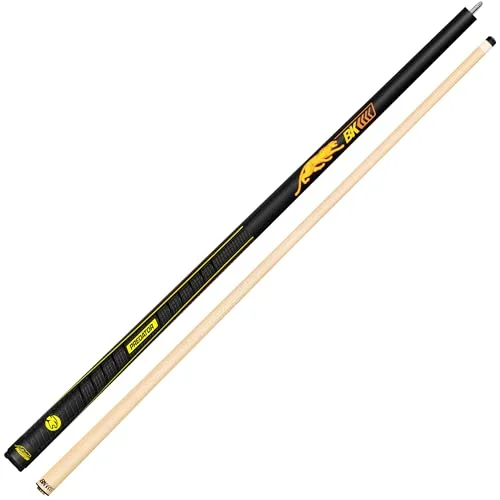
The compromise of combo cues is real though. It’s not as good at jumping as the Jacoby, and it’s not as good at breaking as a dedicated break cue like the Predator BK Rush. It’s 80% of both for 30% of the combined price. For most recreational players, that math works out.
If you’re just getting into the idea of jumping and want to see if it’s a skill worth developing before dropping $150+, the JB9 is your answer. Many players start here and upgrade to a dedicated jumper after a season or two.
Check Price on Amazon →How to actually hit a jump shot
Elevate the butt to 45-60 degrees, strike down through the cue ball’s equator, and let the slate do the bouncing. Scooping under the ball is a foul.
Stand slightly to the side of the shot line instead of behind it. Elevate the butt of the cue to 45-60 degrees. Grip the cue near the balance point with your back hand, not at the end of the butt like a normal shot. Your bridge hand goes on the table, close to the cue ball, with a tight V-bridge.
Now strike DOWN through the cue ball. Not at it. Through it. Hit the ball at its equator or just above, driving it into the slate. The ball compresses against the cloth, bounces up, and sails over the obstacle.
The most common mistake is trying to scoop under the ball. That’s a foul in every organized league. The ball has to jump from a downward strike, not an upward lift. Practice on a bare table first: put a piece of chalk 8 inches in front of the cue ball and jump over it. Once that’s consistent, add a ball.
Do you actually need a dedicated jump cue?
Yes if you play league and face safety battles regularly, no if you’re a casual player who shoots at bars or at home on weekends. A $150 jump cue converts 2-3 “I’m stuck” situations per night into offensive opportunities. Over a season, that’s the difference between winning and losing close matches.
If you play casually at home or at a bar, probably not. You can learn to jump with a regular playing cue (carefully), and most casual games don’t feature the kind of tactical safety play where jumping matters.
The tipping point is usually around your second season of league play. That’s when you’ve seen enough expert safes to know what you’re missing, and $150 starts feeling like a bargain compared to the racks you’ve lost to players who can jump and you can’t.
The #1 recommendation from this guide — chosen for quality, value, and real-world performance.