

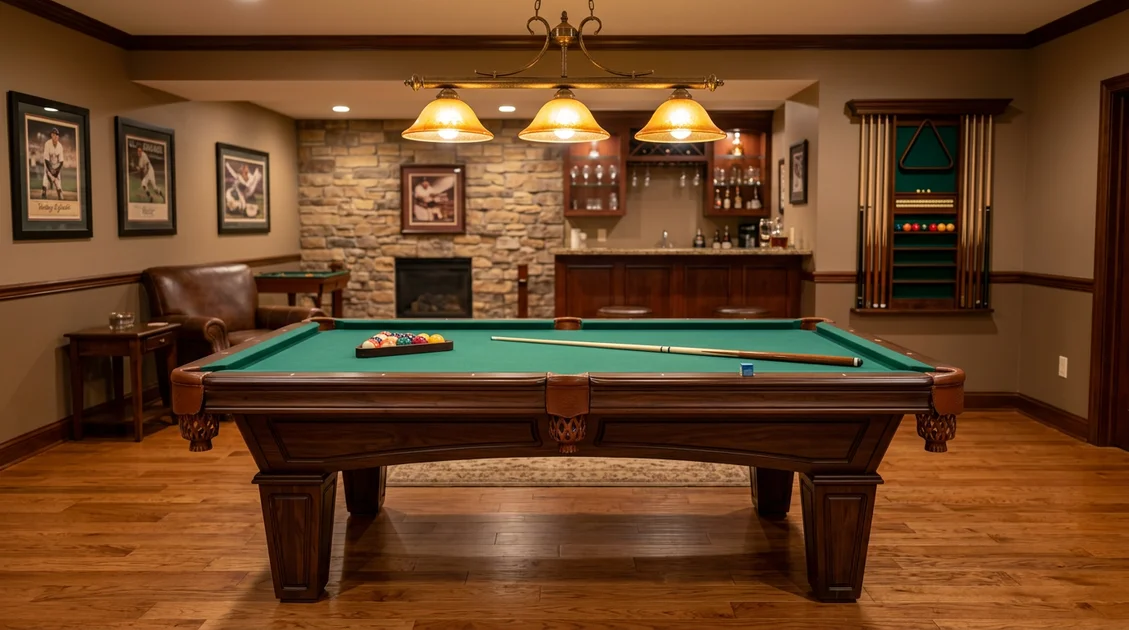
Eight feet is the pool table that most people picture when they think about owning one.
It’s the home standard for a reason. The 88” x 44” playing surface gives you enough room to work the cue ball without feeling cramped, but it’s not so large that casual players feel lost. When BCA and WPA hold 8-ball tournaments, they use 9-foot tables — but for the other 99.9% of pool played in garages, basements, game rooms, and finished basements across the country, 8 feet is the size.
The catch: you need space. An 8-footer with standard cues demands a room at least 17’4” x 13’9”. That eliminates a lot of spare bedrooms and narrow basements. But if you’ve got the room, this is where to put your money.
What Separates a $500 Table from a $5,000 Table
At $500, you get MDF (medium-density fiberboard) playing surface, basic rail rubber, polyester cloth, painted legs, and a frame that’ll last 3-5 years of regular use. The balls roll mostly true.
At $2,500, you get 1-inch 3-piece Italian slate, K-66 tournament-profile cushion rubber, hardwood frame built to hold 800+ lbs of rock, and finish quality that’ll last decades. The balls roll exactly true.
At $5,000+, you get that same slate and rubber, plus exotic hardwoods, precision-machined pockets, hand-rubbed finishes, specialty hardware, and a name on the brass plate that’s been building tables for a century.
Here’s the thing almost nobody talks about: the playing difference between a $2,500 slate table and a $5,000 slate table is small. The cosmetic difference is enormous. If you want the best-playing table, buy the cheapest slate table from a reputable manufacturer. If you want furniture, budget accordingly.
What to Look for in an 8-Foot Table
Before you buy, know what actually matters. Most pool players get this wrong.
Slate or bust. MDF is fine for casual play and parties. If you’re buying a table you’ll actually play on (bank shots in the evening, weekend games with friends), go slate. Period. The difference isn’t subtle. Slate plays flat for decades. MDF develops dead spots within a few years. That “good enough for now” logic costs you later.
Thickness matters less than you think. The standard is 1-inch 3-piece slate. Playcraft’s 3/4-inch slate plays just fine. The 1-inch version has a tiny edge on stability over time and looks a bit nicer, but the ball roll difference is academic. Save $400 if the thinner slate fits your budget.
K-66 is the working standard. You’ll see it on everything from $2,000 tables to $8,000 tables. It’s a tournament profile cushion rubber that gives consistent rebound and straight rails. Superior cushions (like Accu-Fast or SuperSpeed) give maybe 5% better consistency. Real players notice it. Casual players don’t. If you’re shopping and the table uses K-66, move on to other details.
Weight matters. Slate tables run 600+ lbs, MDF tables run 150-300 lbs. Heavier tables sit solid. They don’t shift. They don’t move when you lean on them hard. This affects pocket geometry too. Lighter tables can flex under your body weight, which throws off your aim on softer shots. If you’re between two options and one is noticeably heavier, that’s your signal.
Cloth quality is money. Strachan and Simonis are the names to know. Both are wool-nylon blends that play fast and true. Cheaper cloth is typically polyester, which grabs and slows the cue ball. When the spec says “tournament-grade cloth,” ask what brand. Strachan 6811 is standard. Simonis 860 is slightly faster. Budget tables use generic blends that feel different week to week.
Pocket design is easy to overlook. BCA regulation pockets are 4.5 inches at the throat and 5 inches at the opening. Tight pockets on budget tables can make cuts feel off. If you’re testing a table in a showroom, grab a stick and shoot a few simple shots into the pockets. A well-cut pocket should feel forgiving. The ball drops straight without fighting the edges.
Leveling and seams matter for slate. Three-piece slate tables ship with seams packed in beeswax. Professional installation levels the slate, fills the seams, and stretches the cloth tight. This isn’t optional. A level table makes a good table great. An unlevel table makes a great table unplayable. Budget $200-$300 for installation and leveling, and don’t skip it.
The Picks
Fat Cat Trueshot 8’ (~$400-$500)
Same manufacturer as the 7-foot version we recommended for budget buyers. The 8-foot Trueshot adds 12 inches of playing surface and about 30 lbs. MDF bed plays level for 2-3 years of weekly use before you start noticing dead spots near the center. The K-55 rubber gives soft rebounds (fine for casual play, frustrating for bank shots). The package comes with a full set of cues and accessories. For a first table or a table that sees action at parties rather than practice sessions, it works. For anything beyond that, keep scrolling.
Check Price on Amazon →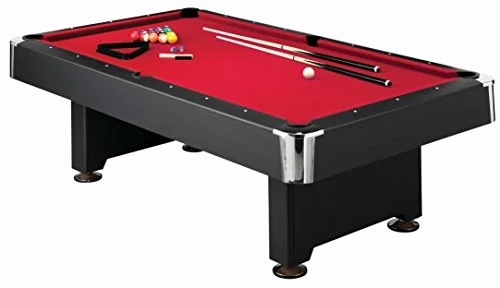
Mizerak Donovan II 8’ (~$600-$800)
Mizerak pulled the same trick here as on their 7-footer: they put better cloth and rubber on a budget frame. Strachan 6811 is a wool-nylon blend used on tournament tables, and K-66 cushion rubber gives the same rebound profile as tables costing five times more. The MDF bed is the weak link (3/4-inch thickness holds up to moderate play but will flex under heavy use). At 300+ lbs, it sits heavier than any other table under $1,000. If you’re committed to MDF and want the best possible ball behavior, the Donovan II is the ceiling.
Check Price on Amazon →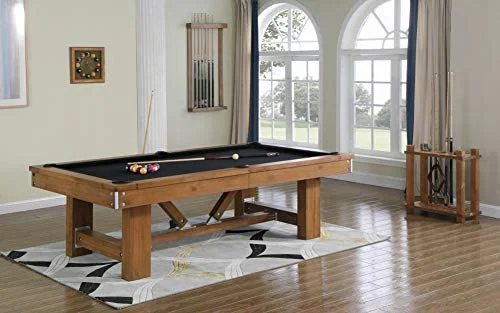
Playcraft Willow Bend 8’ (~$1,800-$2,200)
Playcraft built the Willow Bend as an entry point for slate skeptics. At $2,000, it costs less than most 1-inch slate tables because it uses 3/4-inch slate instead of the full-inch standard. The thinner slate plays fine (you won’t notice the difference in ball roll). Where it shows: a 3/4” slab is slightly more susceptible to chipping during moves, and it weighs less, which some people consider an advantage. The K-66 rubber and pocket cut are tournament-spec. If you’ve been playing on MDF and you’re ready for the jump to slate, this is where to jump.
Check Price on Amazon →Olhausen Classic 8’ (~$3,000-$4,000)
Olhausen makes roughly 60 tables per day at their Portland, Tennessee factory (the largest pool table operation in the US). The Classic is their best-selling 8-footer, and for good reason. One-inch Italian slate, their proprietary Accu-Fast cushion rubber (K-66 profile, natural gum), and a solid hardwood frame that’ll hold 750+ lbs without flexing. The playing surface is as good as any table at any price. The Accu-Fast cushions give maybe 5% better rebound consistency than standard K-66 rubber; it’s subtle, but you notice it on long bank shots. Available in dozens of wood finishes. Comes with a lifetime warranty on everything except the cloth.
Check Price on Amazon →Brunswick Gold Crown 8’ (~$5,000-$8,000)
Brunswick has been building pool tables since 1845. The Gold Crown is their flagship, used at the Mosconi Cup, US Open, and World Pool Championship. The matched slate means all three pieces come from the same quarry batch for uniform density. SuperSpeed cushion rubber is Brunswick’s proprietary formulation, tested for consistency to 0.1% rebound variance across temperature ranges. The pockets are precision-machined to BCA specifications: 4.5 inches at the throat, 5 inches at the opening. It’s the most expensive table on this list by a wide margin, and for most home players, the Olhausen plays 95% as well for half the price. But if money isn’t the primary concern and you want the best, this is it.
Check Price on Amazon →Plank & Hide Parsons 8’ (~$3,500-$4,500)
Pool tables don’t have to look like they belong in a 1970s rec room. Plank & Hide builds modern-aesthetic tables that use standard playing components (1-inch slate, K-66 rubber, regulation pockets) wrapped in contemporary design. The Parsons uses metal leg frames, clean-line wood rails, and exposed hardware. It looks like something from a high-end loft, but underneath the styling, it’s a proper 8-foot slate table (same 750-lb heft, same level playing surface, same pocket specs). If your partner vetoed a traditional table on aesthetic grounds, this might be the compromise that gets a table in the house.
Check Price on Amazon →Quick Comparison
| Table | Price | Surface | Rubber | Weight | Best For |
|---|---|---|---|---|---|
| Fat Cat Trueshot 8’ | ~$400-500 | MDF | K-55 | ~180 lbs | Casual / party table |
| Mizerak Donovan II 8’ | ~$600-800 | MDF | K-66 | ~300 lbs | Best playing MDF |
| Playcraft Willow Bend | ~$1,800-2,200 | 3/4” slate | K-66 | ~550 lbs | Entry slate |
| Olhausen Classic | ~$3,000-4,000 | 1” slate | Accu-Fast | ~750 lbs | Best overall |
| Brunswick Gold Crown | ~$5,000-8,000 | 1” slate | SuperSpeed | ~850 lbs | Tournament grade |
| Plank & Hide Parsons | ~$3,500-4,500 | 1” slate | K-66 | ~750 lbs | Modern design |
Where to Buy
Slate tables are rarely a good Amazon purchase. They weigh 600-900 lbs and require professional installation (leveling the slate, waxing the seams, stretching the cloth). Most reputable dealers (Olhausen, Brunswick) sell through authorized local dealers who include delivery, professional setup, annual leveling, and full warranty registration in the price.
Check local first. A local dealer who installs the table, relevels it for free in the first year, and troubleshoots any problems is worth $200-$300 more than a shipped table you have to figure out yourself.
For MDF tables (Fat Cat, Mizerak), Amazon is fine. They come in boxes, assembly is manageable with two people and 2-3 hours, and you don’t need a professional.
Room Size Reference
| Cue Length | Min. Room for 8’ Table | Notes |
|---|---|---|
| 58” (standard) | 17’4” x 13’9” | Full stroke everywhere |
| 52” (short) | 16’4” x 12’9” | Mild restriction at rails |
| 48” (short) | 15’4” x 11’9” | Tight but workable |
If your room doesn’t fit an 8-footer with standard cues, check our 7-foot pool table guide before buying short cues as a compromise. A proper table in a proper room beats a bigger table in a cramped room every time. For complete room planning, see how far a pool table needs to be from the wall.
Related Reads
Different budget in mind? See our guides for pool tables under $1,000, under $2,000, and best pool tables for home. Trying to decide between slate and MDF? That guide breaks down the real differences. And once your table arrives, our pool table setup guide walks you through leveling and cloth care.
The #1 recommendation from this guide — chosen for quality, value, and real-world performance.