

If 9-ball is pool’s sprint, 10-ball is the 400-meter race. Same speed, same rotation format, but one extra ball and one added rule change everything.
That rule: you have to call your shots.
In 9-ball, you can slop the game-winning ball into a pocket you weren’t even looking at and it counts. In 10-ball, if you call the 10 in the corner and it rattles into the side instead, it gets spotted back. This single rule is why the Predator Pro Billiard Series, the World Pool Championship, and most international pro events have shifted from 9-ball to 10-ball since 2018. The better player wins more often.
What You Need
Ten object balls numbered 1 through 10, a cue ball, and a standard pool table. Any size works: 7-foot bar tables, 8-foot home tables, or 9-foot tournament tables all play 10-ball.
You’ll also need a quality cue and a triangle rack. For your cue, a low-deflection shaft like the Predator 314 on Amazon improves your accuracy on called shots. Standard 8-ball racks work if you pull one row. Some players use a diamond rack (same one used for 9-ball) and add the 10th ball to extend it.
How to Rack
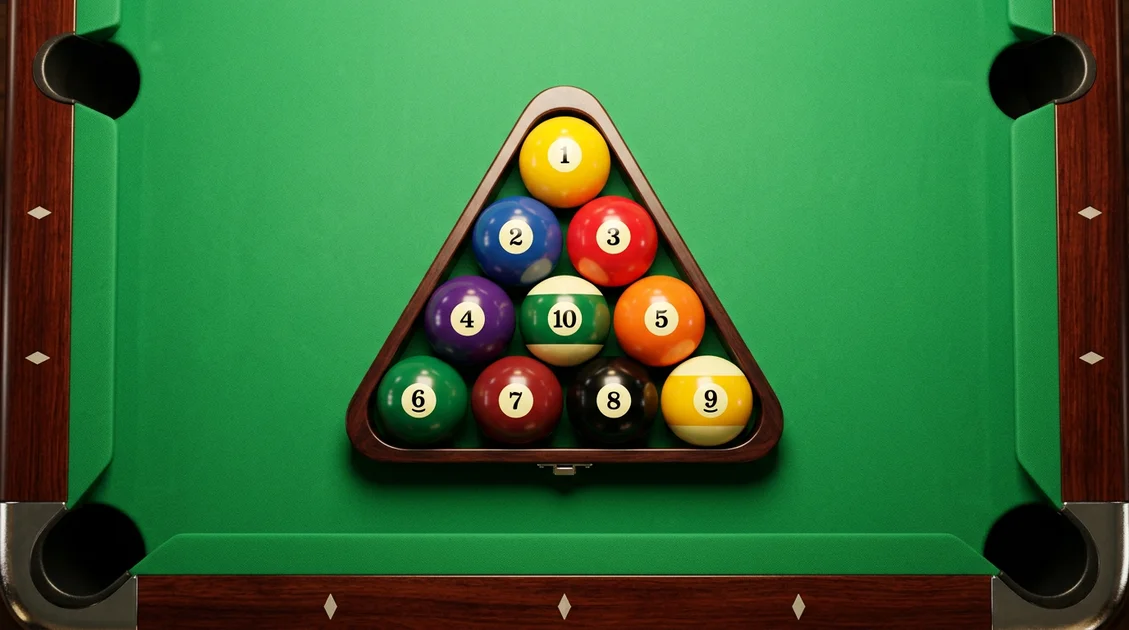
The rack forms a triangle with 4 rows: 1 ball in the first row, 2 in the second, 3 in the third, 4 in the fourth (10 balls total).
Two balls have assigned positions. The 1-ball sits at the apex of the triangle, centered on the foot spot. The 10-ball goes in the center of the third row. Everything else is random.
The WPA (World Pool-Billiard Association) rulebook specifies that the rack must be tight — all balls touching their neighbors with no gaps. A loose rack changes break dynamics significantly. On tournament tables, referees use a template rack to ensure consistency.
Breaking
The cue ball starts behind the head string (the “kitchen”). The breaker must hit the 1-ball first (since it’s the lowest numbered ball on the table, rotation rules apply from the very first shot).
For the break to be legal, at least 4 object balls must contact a cushion or a ball must be pocketed. If the break is illegal, the incoming player has two options: accept the table as-is, or have the balls re-racked and break again themselves.
If you pocket the 10-ball on the break, you win the game under WPA rules. Some local leagues modify this rule and spot the 10-ball instead. Check your league rules.
If the cue ball scratches on the break, it’s ball-in-hand behind the head string for the incoming player. They must shoot at the lowest ball on the table, and that ball must be past the head string or they cannot shoot directly at it.
How to Play
Every shot in 10-ball follows two rules at once: rotation and called shot.
Rotation means you must always contact the lowest-numbered ball on the table first. If the 1, 4, 7, and 10 are left, you must hit the 1 first. You can’t skip ahead.
Called shot means you name which ball goes in which pocket before shooting (e.g., “4-ball, side pocket”). You don’t have to call caroms, kisses, or rail contacts: just the final ball and final pocket. If the called ball goes in the called pocket, the shot is legal regardless of how it got there. Banks, combos, caroms are all legal as long as you call the result.
If you pocket the called ball in the called pocket and other balls fall in on the same shot, those other balls stay down. You only need to call the ball you’re intentionally pocketing.
The Push-Out
After the break, the player at the table (whether they broke or not) has one special option: the push-out.
A push-out lets you hit the cue ball anywhere on the table without regard to the lowest-ball-first rule. You can use it to move the cue ball to a better position or to give your opponent a difficult layout. You must announce “push” before the shot.
After a push-out, your opponent chooses: they can shoot from the new position, or hand it back to you. This creates a tactical layer where you want to leave the cue ball somewhere awkward but not impossible, so your opponent is tempted to shoot but unlikely to succeed.
The push-out is available only on the first shot after the break. Once either player takes a normal shot, the option expires.
Fouls
A foul gives your opponent ball-in-hand anywhere on the table. That’s huge in 10-ball: a ball-in-hand against a skilled player usually means game over.
The main fouls:
Failure to hit the lowest ball first. If the 3 is the lowest ball and your cue ball contacts the 5 first, that’s a foul even if the 3 goes in afterward.
No rail after contact. After the cue ball hits the object ball, at least one ball (any ball: cue ball or object ball) must contact a cushion. If everything stops in the middle of the table, it’s a foul that prevents safety stalemates.
Cue ball scratch. The cue ball goes in a pocket. Ball-in-hand for your opponent.
Cue ball off the table. Same as a scratch.
Shooting while balls are still in motion. Wait for everything to stop.
Wrong ball called. If you call the 6 in the corner and the 6 goes in the side, the 6 gets spotted on the foot spot. It’s not a foul; your turn just ends.
Three-Foul Rule
If a player commits three consecutive fouls (across three consecutive turns at the table), they lose the game. The referee or opponent must warn the player after the second foul. If no warning is given, the third foul counts as a standard foul, not a loss.
This rule prevents deliberate fouling as a defensive strategy. It’s rare in practice (most players go years without seeing it called), but it exists as a deterrent.
Winning
You win by legally pocketing the 10-ball. That means:
- You hit the lowest ball on the table first
- You called the 10-ball and the pocket
- The 10-ball went in the called pocket
You don’t have to pocket the 10-ball last. If the 10-ball is the lowest ball left (meaning you’ve already pocketed 1-9), you just call it and make it. But you can also pocket the 10 early by using a combination shot (hit the lowest ball first and combo or carom it into the 10-ball, sending the 10 into the called pocket).
Early combos on the 10 are a common strategy in professional 10-ball. If you see a clean combo path from the lowest ball to the 10, calling it is a smart play. Pros attempt this regularly when the layout doesn’t support a clean run-out. A good cue chalk helps ensure your tip catches cleanly on these precision shots.
10-Ball vs. 9-Ball
| 9-Ball | 10-Ball | |
|---|---|---|
| Balls | 1-9 | 1-10 |
| Called shots | No (slop counts) | Yes |
| Run-out difficulty | Moderate | Higher |
| Luck factor | Higher | Lower |
| Break advantage | Stronger | Weaker |
| Pro tour standard | Declining | Growing |
| Average rack length | 5-7 minutes | 8-12 minutes |
The extra ball matters more than it sounds. Running 9 balls requires 9 successful positions, while running 10 requires 10. That additional ball creates about 25-30% more situations where the run-out path gets blocked (according to analysis by pro commentator Mark Wilson). The called shot requirement on top of that means the better player wins roughly 65% of racks in 10-ball versus 55-60% in 9-ball.
Strategy Tips for Beginners
Don’t try to run the table. In your first 10-ball games, focus on making 2-3 balls and playing safe. Running 10 balls with called shots is extremely difficult (even pros fail run-outs more often than they succeed in 10-ball).
Learn the push-out. The push-out is the most underused weapon in amateur 10-ball. After the break, if you don’t have a clean shot, push the cue ball to a location that’s hard for your opponent (not impossible, just hard). Force them into a tough decision.
Play the 10 early when you see it. Don’t ignore combo opportunities on the 10-ball. If you see a 2-ball-to-10-ball combo with a clean path, call it and shoot it. You don’t have to pocket every ball in order.
Safety play wins games. When the run-out path is blocked, play safe. Hook your opponent behind a cluster or leave the cue ball tight on a rail with no angle. Defensive play in 10-ball is more rewarding than in 9-ball because called shots mean your opponent cannot slop their way out.
Related Reads
New to rotation pool? Start with our 9-ball rules guide — it’s simpler and teaches the same rotation fundamentals. For the oldest rotation game, straight pool (14.1) has its own tactical depth. Want to improve your game? Our guides on how to aim in pool and how to break properly apply directly to 10-ball play.
Check out our top-rated gear picks — selected and reviewed by billiards enthusiasts.