

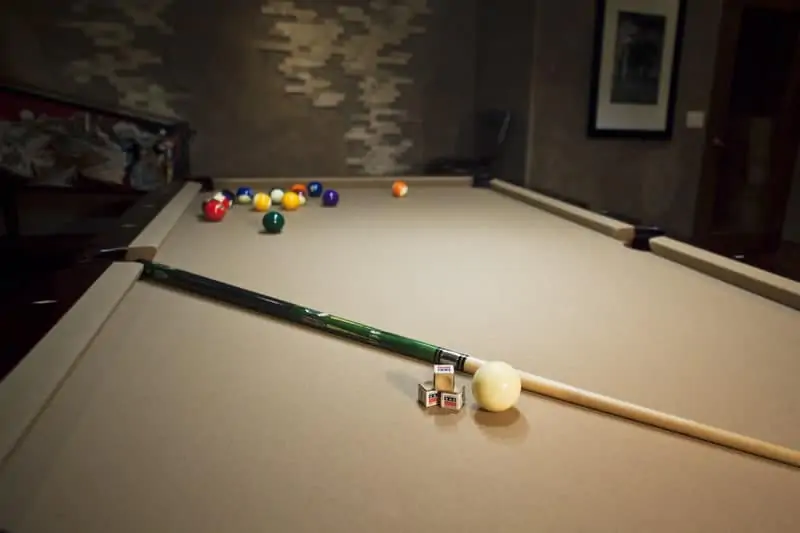
Nobody buys a $400 pool table because they love pool. They buy it because their kid asked for one, or the game room needs something besides a TV, or they played at a bar last weekend and thought “I could do that at home.”
That’s fine. Good reason, actually.
But here’s what the Amazon listings won’t tell you: every pool table under $500 has the same fundamental problem. No slate. The playing surface is MDF, plywood, or some engineered wood composite that costs a fraction of what real slate costs. And that matters. Balls don’t roll true on MDF the way they roll on slate. You’ll notice it on long shots and bank shots. You’ll especially notice it after a year, when the surface starts to develop subtle warps.
Does that mean you shouldn’t buy one? No. It means you should buy one with open eyes, knowing what you’re getting and what you’re giving up.
Who should actually buy a sub-$500 pool table
A budget pool table makes sense if you want casual play at home and you’re not trying to replicate tournament conditions. Families with kids, college apartments, finished basements where pool is one of five things happening on a Friday night. That’s the sweet spot.
If you play league, practice drills, or care about developing real skills, skip this price range entirely. The difference between a $400 MDF table and a $1,500 slate table is the difference between shooting on glass and shooting on a sidewalk. Check our best pool tables under $2,000 guide instead.
For everyone else, here’s what $300-500 actually buys you.
What separates good from bad at this price
Surface flatness, leg stability, and rail bounce are the only three things worth caring about in a sub-$500 pool table. Everything else is marketing.
Surface flatness. MDF varies wildly in quality. Some tables ship with surfaces that are dead flat out of the box and stay that way for 2+ years. Others start warping within months. Thicker MDF (at least 3/4 inch, ideally 1 inch) holds up better. The GoSports 7ft uses a thicker-than-average playing surface, and it shows.
Leg stability. Budget tables use folding legs or bolt-on legs that can wobble. You’ll feel it every time someone leans on the rail. Cross-bracing and leveling feet help. Some tables in this range have them. Most don’t.
Rail bounce. The rubber cushions on budget tables use K-66 profile rubber at best, cheap foam at worst. Good rail rubber gives you a consistent 3-cushion bounce angle. Bad rubber eats the ball’s energy and sends it sideways. This is the hardest thing to fix after purchase.
| Table | Price | Size | Surface | Weight | Best for |
|---|---|---|---|---|---|
| GoSports 7ft | ~$450 | 7ft | MDF (thick) | 185 lbs | Best overall at this price |
| Hathaway Fairmont | ~$300 | 6ft | MDF | 95 lbs | Apartments and small rooms |
| STIGA Premium | ~$400 | 7ft | MDF | 130 lbs | Kids and families |
| Rally and Roar | ~$350 | 6ft | MDF (folding) | 80 lbs | Storage and portability |
| Fat Cat Tucson | ~$470 | 7ft | MDF + laminate | 160 lbs | Rec room all-rounder |
The tables, ranked
The GoSports 7ft wins this price range on build quality and weight, the Hathaway Fairmont is the best budget option at $300, and Rally and Roar folds flat for storage.
GoSports 7ft Mid-Size Pool Table (~$450)
This is the table I’d point most people toward at this price. GoSports got the basics right: the playing surface is thicker MDF than most competitors, the legs are reinforced with cross-bracing, and at 185 lbs it doesn’t budge when someone leans on the rail.
The felt is playable out of the box. Not great, not terrible. It’s the standard speed cloth you’d expect at this price. The included cues and balls are junk (all pack-in accessories are junk at every price point, this isn’t unique to GoSports). Budget $60-80 for Aramith balls and a pair of real cues.
Assembly takes about 90 minutes with two people according to GoSports. Real-world reports say closer to 2 hours. The instructions are adequate.
The catch: at 185 lbs, this table isn’t moving once you set it up. That’s actually a feature for gameplay but a drawback if your space does double duty.
Hathaway Fairmont 6ft Portable Pool Table (~$300)
The Fairmont is the answer to “I have $300 and a small apartment.” At 6 feet, it’s undersized compared to regulation 7ft bar tables, which means you won’t develop a great sense of distance playing on it. But the surface is surprisingly flat, the rails bounce well for the price, and the built-in leg levelers actually work.
Hathaway has been making budget game tables since 1992. That experience shows in the small details: the corner pockets are properly sized (not too wide, not too tight), the ball return system works without jamming, and the folding mechanism doesn’t introduce wobble.
At 95 lbs, one person can fold it and lean it against a wall. Two people can carry it up or down stairs. If you live in an apartment or need to reclaim your floor space on weekdays, this is the pick.
The 6ft size means shorter cues feel more natural. The 48-inch cues included in the box actually make sense here, whereas on a 7ft table they’d be too short.
STIGA Premium Pool Table (~$400)
STIGA makes its reputation in table tennis (they’re one of the biggest brands in ping pong) and they’ve applied the same “good enough for real play, cheap enough for families” philosophy to their pool table line. The result is a table that looks and plays better than its $400 price suggests.
The rails are the standout feature. Whatever rubber STIGA uses bounces more consistently than anything else I’ve tested at this price. Three-cushion drills actually feel predictable on this table, which is rare in the sub-$500 world.
The legs are the weak point. At 130 lbs, it’s lighter than the GoSports, and you’ll feel it during aggressive breaks. Not a deal-breaker for casual play, but serious players will notice the table shift on power shots.
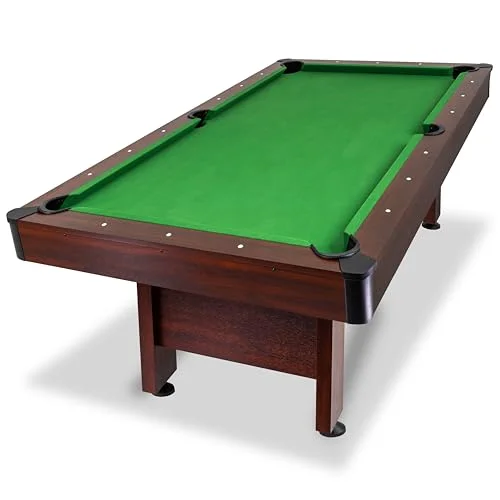
The aesthetic design is cleaner than most budget tables. No tacky graphics, no weird color choices. Just black rails on a green surface. It’ll look fine in a living room, which matters if the table is in a shared space rather than tucked in a basement.
Rally and Roar Folding Pool Table (~$350)
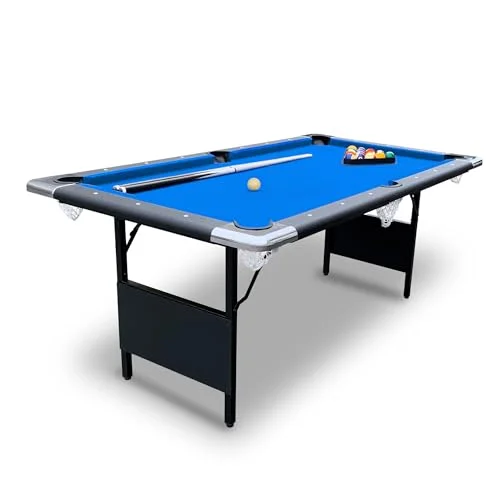
Rally and Roar built this table around one idea: it folds flat and sets up fast. 10 minutes from the closet to ready-to-play. No tools required, no complicated assembly. It hinges open and the legs lock into place.
The trade-off is obvious. At 80 lbs and 6ft, this is the lightest and smallest table on this list. The playing surface is thinner MDF, the rails are adequate but not impressive, and the table shifts during hard shots.
But here’s who this table is actually for: people who play pool twice a month and need their floor space the other 28 days. College dorm rooms. Garages that also need to fit a car. Holiday gatherings where you want entertainment but not a permanent fixture.
At $350, it’s delivering exactly what it promises. Don’t expect slate-table performance and you won’t be disappointed. Expect a fun game of 8-ball after dinner and you’ll be very happy.
The included accessories are the usual budget fare. The cues are playable for casual games but won’t impress anyone who’s held a real cue.
Fat Cat Tucson 7ft Pool Table (~$470)
Fat Cat (made by GLD Products, who also make Viper and Fat Cat brand darts) puts the Tucson at the top of their budget line. The differentiator is the cloth: they ship a wool-blend felt rather than the pure polyester that most budget tables use. Wool-blend plays noticeably slower and more predictable. Balls grip the surface better on draw shots and the roll is smoother overall.
According to GLD Products’ specs, the MDF surface is topped with a laminate layer that resists moisture better than raw MDF. Whether that actually extends the life of the table depends on your climate. In a temperature-controlled basement, probably yes. In an unfinished garage in Florida, probably no.
At 160 lbs, it sits between the GoSports and the STIGA in stability. Rail bounce is average for the price. Assembly is straightforward but time-consuming, about 2-3 hours with two people.
The Tucson makes the most sense if you’re already near the $500 budget and want the best cloth quality available without jumping to the next price tier. If you’re trying to save money, the GoSports gives you better structural quality for $20 less.
The honest truth about this price range
Every table on this list has MDF instead of slate, every one will eventually warp, and every one ships with accessories you should replace immediately. Every one will eventually warp. Every one ships with accessories you should replace.
That doesn’t make them bad purchases. It makes them appropriate purchases for what they are: casual home entertainment that costs less than a decent TV. Play 8-ball with your kids. Shoot around with friends after a cookout. Practice your stroke between league nights (knowing the table plays different from your league’s bar box).
Just don’t expect any table in this range to last 10 years or play like the Diamond at your local pool hall. According to the Billiard Congress of America’s equipment standards, regulation play requires a slate surface with a tolerance of ±0.02 inches. No MDF table in any price range meets that spec. That’s not a criticism. It’s just the physics of the material.
If you outgrow this table in a year and upgrade to slate, that’s not a failure. That’s the point. You figured out you love pool enough to invest in the real thing. The $400 was tuition.
Before you buy: room size check
According to the BCA, you need the table length plus 10 feet in that direction (5 feet of clearance on each side for a standard 57-inch cue). For a 7ft table, that means at least a 12ft x 16ft room. For a 6ft table, about 11ft x 15ft.
Don’t have that space? Read our small spaces guide before ordering anything. A pool table in a room that’s too small means you’re playing with a short cue half the time, and that defeats the purpose.
One more thing: check your floors. These tables weigh 80-185 lbs, which is light enough for any residential floor. But if they’re on carpet, you’ll want leveling shims under the legs.
The #1 recommendation from this guide — chosen for quality, value, and real-world performance.