

Fifteen hundred dollars is the line where pool tables stop being furniture and start being equipment. Below this price, most tables use MDF, which is pressed wood that warps the moment your basement humidity changes. At $1,500, slate becomes possible. Not guaranteed. But possible.
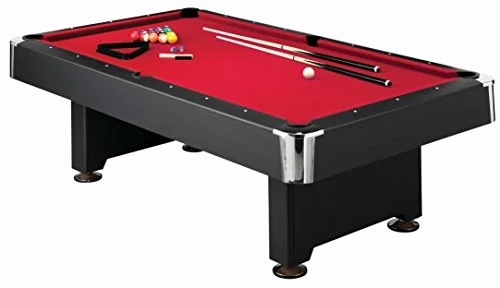
The Mizerak Donovan II 8-foot slate at around $1,200-$1,400 is the table I’d tell most people to buy in this bracket. Genuine 3-piece slate, K-66 cushions, and a price that’s roughly half what you’d spend on a Playcraft or Olhausen for the same playing surface. The wood trim won’t win design awards. The slate underneath doesn’t care.
That’s the trade-off at $1,500. You’re buying playability, not aesthetics. Here’s where your money actually goes.
Why $1,500 is the number that matters
Fifteen hundred dollars is the slate threshold. It’s the price where you stop gambling on synthetic surfaces and start buying natural stone. A slate pool table purchased today will play identically in 2056. An MDF table purchased today will need replacing by 2031, maybe sooner if it lives in a garage or basement with any moisture.
According to the BCA (Billiard Congress of America), regulation pool tables use a minimum 1-inch thick slate bed, ground to flatness tolerances of ±0.005 inches. That’s five thousandths of an inch across a 4-by-8-foot surface. No synthetic material holds that tolerance over time. Slate does it by existing.
I’ve played on tables at every price point in this range. Between $800 and $1,500, you get a handful of real slate options and a sea of MDF pretenders. The tables below are the ones worth your money.
The tables
Mizerak Donovan II 8-Foot Slate (~$1,200-$1,400)
The Mizerak Donovan II does one thing perfectly: it puts genuine 1-inch 3-piece slate under your cue ball for $1,200-$1,400. Mizerak has manufactured tables since 1975. The brand doesn’t carry the prestige of an Olhausen or Brunswick, and that’s exactly why you can afford the slate at this price. Your money goes into the playing surface instead of the nameplate.
The table ships with K-66 profile cushions (BCA standard), a wool-nylon blend felt, and starter accessories. The felt is serviceable for the first year. Plan on a Simonis 860 upgrade ($250-$350 installed) when you’re ready to feel the difference.
One critical warning: Mizerak sells a slatron version of this table for around $850. The slatron is MDF with a coating. Skip it entirely. The $400 difference between slatron and slate is the most important $400 you’ll spend in billiards. We break down why in our slatron vs slate comparison.
Check Price on Amazon →Imperial Eliminator 8-Foot (~$1,000-$1,300)
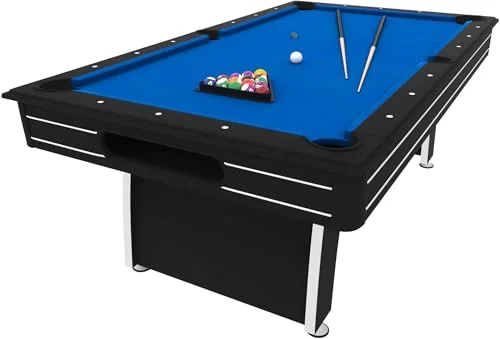
The Imperial Eliminator is the other genuine slate option in this bracket. Same 1-inch 3-piece slate, same K-66 cushion rubber, but at a slightly lower entry price. The 8-foot model measures 102” x 58” x 31.5” and ships at roughly 900 lbs (packaging included).
What separates the Eliminator from the Donovan II is mostly cosmetic. The Eliminator uses a black-and-chrome aesthetic with metal corner caps and internal drop pockets. It also ships with Teflon-coated, spill-resistant cloth, which is useful if the table lives near a bar or if you have kids. The playing surface is functionally identical to the Mizerak at the same slate spec.
Forum reviewers on AzBilliards have measured less than 0.01-inch deviation across the 8-foot surface. At this price, that’s remarkable. I’ve shot on both side by side. The difference is feel and aesthetics, not performance. If you can try both at a showroom, do it.
Check Price on Amazon →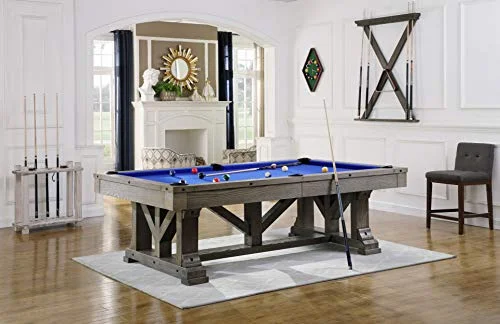
Playcraft Cross Creek 7-Foot Slate (~$1,300-$1,500)
The Playcraft Cross Creek 7-foot squeezes into the under-$1,500 bracket in its smaller size. The 8-foot version runs $1,500-$1,900 and we cover it in our best tables under $2,000 guide. But the 7-foot gives you the same matched 3-piece slate, the same solid hardwood frame, and the same K-66 cushions at a lower price. It fits rooms as small as 13 x 16 feet with standard cues.
Playcraft backs it with a 5-year warranty, which is the longest in this price range. The slate is book-matched and honed to thousandths of an inch. The 21-ounce wool blend cloth comes in 25 colors. If you’re in a room that measures less than 13 x 17 feet and you want slate, this is the table.
Check Price on Amazon →Fat Cat Reno 7-Foot (~$800-$1,100)
The Fat Cat Reno sits at the very bottom of the “worth buying” spectrum. At 7 feet it’s bar size. Same dimensions as the table you play at the local pub. The playing surface uses a slate-composite bed that’s a real step above pure MDF but not genuine stone slate. Think of it as the middle ground.
For rooms that can’t fit an 8-foot table, or wallets that max out around $1,000, the Reno plays well enough for casual games and basic practice. The K-66 cushions are the real deal and the ball return system is a nice convenience feature. But if you can stretch to $1,200 for the Mizerak or Imperial slate, do it. The difference in how the table rolls after year two is enormous.
Check Price on Amazon →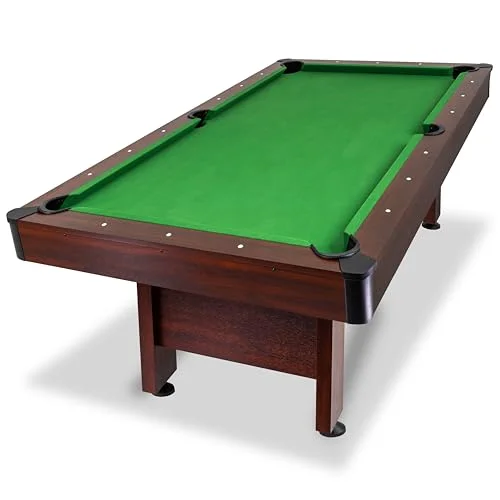
GoSports 7-Foot Pool Table (~$800-$1,000)
The GoSports 7-foot exists for renters, apartment dwellers, and anyone who might need to move in the next few years. It weighs 200 lbs versus the 500-700 lbs of a slate table. The legs fold. You can move it without hiring help.
The playing surface is engineered wood, not slate. It’s flat enough for casual play and league practice. It won’t hold its level like stone does over a decade. But if permanence isn’t your priority, 200 lbs of portable table beats 0 lbs of table you couldn’t buy because your apartment building said no. Forum users on AzBilliards report playing on these 3 times a week for 18+ months with no issues.
Check Price on Amazon →Quick comparison
| Table | Price | Size | Surface | Weight | Best For |
|---|---|---|---|---|---|
| Mizerak Donovan II | $1,200-1,400 | 8 ft | 3-piece slate | ~500 lbs | Best overall value |
| Imperial Eliminator | $1,000-1,300 | 8 ft | 3-piece slate | ~350 lbs | Cheapest real slate |
| Playcraft Cross Creek | $1,300-1,500 | 7 ft | Matched slate | ~600 lbs | Best 7-foot slate |
| Fat Cat Reno | $800-1,100 | 7 ft | Slate composite | ~350 lbs | Budget entry |
| GoSports 7-Foot | $800-1,000 | 7 ft | Engineered | ~200 lbs | Portability |
Where every dollar goes at this price
At $1,500 or less, the budget math is simple. About 60% of what you’re paying for is the playing surface. Another 20% is the frame and rail system. The remaining 20% covers cosmetics, felt, accessories, and the box it all ships in.
The playing surface is the table. Everything else is the box it comes in. A $1,300 table with real slate and ugly legs will outplay a $1,500 table with MDF and gorgeous cabinetry in year one, year five, and year twenty. Slate doesn’t warp, sag, or change shape when your basement goes from 30% humidity in winter to 70% in August. MDF does all of those things.
K-66 profile cushion rubber is the BCA specification for American pool tables. It determines how the ball rebounds off the rail on every single bank shot, kick shot, and cushion-first safety. Cheaper tables use K-55 (narrower profile) or generic rubber that loses its bounce after 5-8 years. Every table in this guide runs K-66 except the GoSports.
Frame weight tells you about build quality without opening the box. A well-built 8-foot slate table weighs 500-800 lbs assembled. If an 8-foot “slate” table weighs under 400 lbs, something is off. Either the slate is thinner than 1 inch or the frame is particle board.
How to avoid the common mistakes
Mistake #1: Buying slatron thinking it’s slate. Slatron is a marketing term for MDF with a synthetic coating. It’s not slate. It’s not close to slate. Multiple tables in the $800-$1,200 range advertise “slatron” in the product name hoping you’ll confuse it with real stone. The Mizerak Donovan II comes in both slatron ($850) and slate ($1,200+). Same name, wildly different table. Read the product listing carefully. Our slatron vs slate guide breaks down exactly what you’re getting with each.
Mistake #2: Forgetting to measure the room. An 8-foot table needs a minimum 13 x 17 feet of clear space for a standard 58-inch cue. A 7-foot table needs 13 x 16 feet. No exceptions, no shortcuts, no “we’ll just use shorter cues.” Shorter cues change your bridge length, your stance, and your stroke. They make you a worse player. Measure your room first.
Mistake #3: Skipping professional installation. Slate tables ship in pieces. Each slate slab weighs 150-170 lbs. A professional installer levels the slabs, fills the seams with beeswax, stretches the felt, and aligns the cushions. This costs $200-$400 depending on location and stair situation. DIY installation without experience means a table that rolls slightly off-true for its entire life. Budget for it.
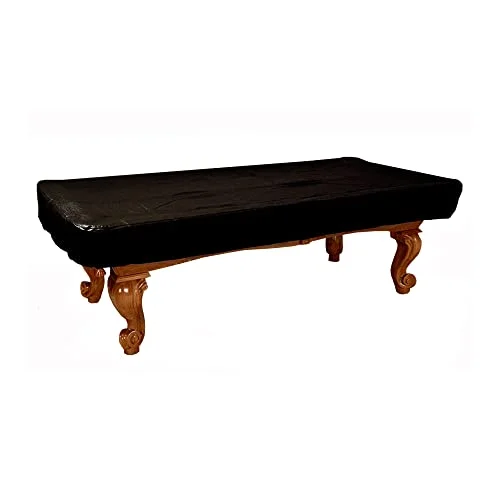
Mistake #4: Not budgeting for accessories. Every table under $1,500 ships with starter cues that you’ll replace within months. Set aside $100-$200 for a real cue, $25 for decent chalk, $40 for a case, and $30 for a table cover. The table is the investment. The accessories are what you’ll actually hold every time you play.
The verdict
If you have $1,200-$1,400 and a room that fits an 8-foot table, buy the Mizerak Donovan II slate. It’s the most table for the money in this bracket. If the budget is tighter, the Imperial Eliminator sometimes dips below $1,100 and gives you the same slate playing experience.
If your room is small, the Playcraft Cross Creek 7-foot is the best 7-foot slate table under $1,500.
If you need portability or you’re not ready to commit to 500+ lbs of stone in your spare room, the GoSports 7-foot gets you playing for under a grand with zero permanence risk.
For more options above this range, see our guide to the best pool tables under $2,000 where the slate selection opens up. For tables under $1,000, our budget guide covers what’s realistic when MDF is the playing surface. And if you want to understand the full market, start with how much pool tables actually cost.
The #1 recommendation from this guide — chosen for quality, value, and real-world performance.